
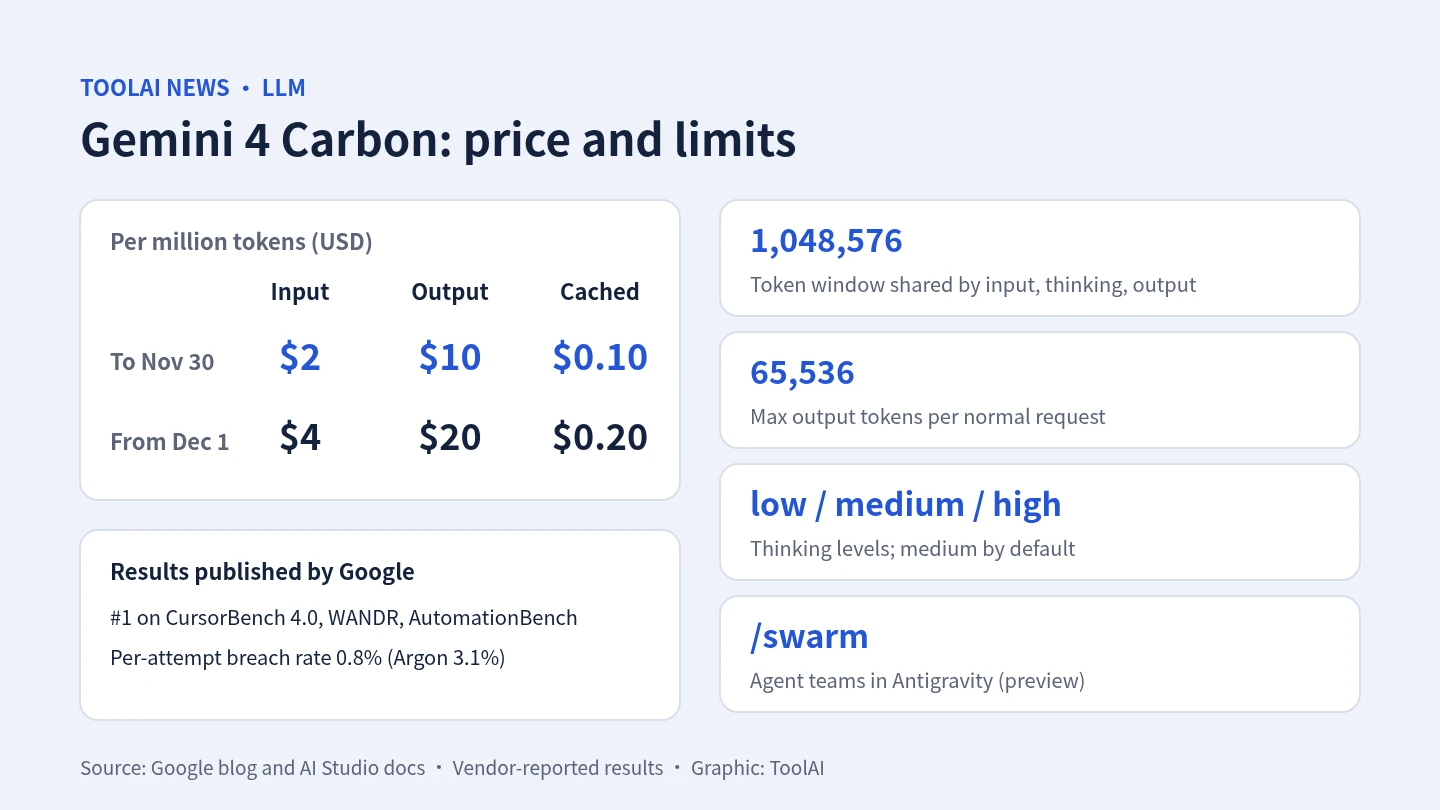
Google made Gemini 4 Carbon available to paying developers on November 10. It is the model above Gemini 4 Argon: it spends more tokens reasoning and checking its work, and Google aims it at long agent runs, hard software problems, scientific reasoning and security work. Developers can call it as gemini-4-carbon in the Gemini API through Google AI Studio and Gemini Enterprise. Google AI Ultra subscribers are getting it in Google Antigravity, the Gemini app and AI Mode in Search.
Key changes
- Price: $2 per million input tokens and $10 per million output tokens until November 30, the same as Argon. From December 1 the price doubles to $4 and $20. Cached input costs $0.10 per million, rising to $0.20. Carbon is not on the free tier.
- Limits: a 1,048,576-token window shared by input, thinking and output. A normal response stops at 65,536 output tokens; in background mode a response can run up to the rest of the window.
- Thinking levels: low, medium (the default) and high. Thinking tokens count toward
max_output_tokens, and Google suggests setting it to at least 32,768. - API differences: moving from Argon only needs the new model ID.
temperature,top_pandtop_kare ignored, and explicit context caching is not supported; implicit caching is on for prompts of 4,096 tokens or more. - Benchmarks (Google’s figures): first on CursorBench 4.0, Perplexity WANDR and Zapier AutomationBench, at less than half the cost per task of the next-best outside model. In Google’s attack simulations the per-attempt breach rate fell to 0.8%, from 3.1% for Argon.
Agent teams in Antigravity
Google also previewed /swarm in Google Antigravity. One prompt starts a team of agents that you can watch in real time. Carbon can take the roles that need the most reasoning, such as design, coordination and review, while faster models work in parallel in separate workspaces and adversarial checkers test each change.
Who else gets access
Enterprises can also use Carbon through Antigravity and CodeMender. Scientists can apply for six months of free access at Antigravity’s highest usage tier, and security teams can apply for “Carbon for cyber” through Google’s Fairwind Program. Both depend on eligibility and capacity.
What it means for users
Google itself recommends Argon for everyday coding and interactive work, because it is faster and uses fewer tokens. Carbon is for the hard cases: deep debugging, architecture decisions, proofs and security audits. Its price per token matches Argon for now, but it uses more tokens per answer, so a task can still cost more. If you plan to test it, do it before November 30, and budget for the doubled price after that. The benchmark results are Google’s own; Anthropic’s Fable 5.2 announcement on November 9 also listed Carbon ahead on AutomationBench, 53.9% against 51.4%.
Related tools
On ToolAI: Google AI Studio, Gemini CLI, Jules, the Gemini model page, and other coding tools such as Cursor and Claude.
Sources: Google: Gemini 4 Carbon is now available · Google AI Studio: What’s new in Gemini 4 Carbon