
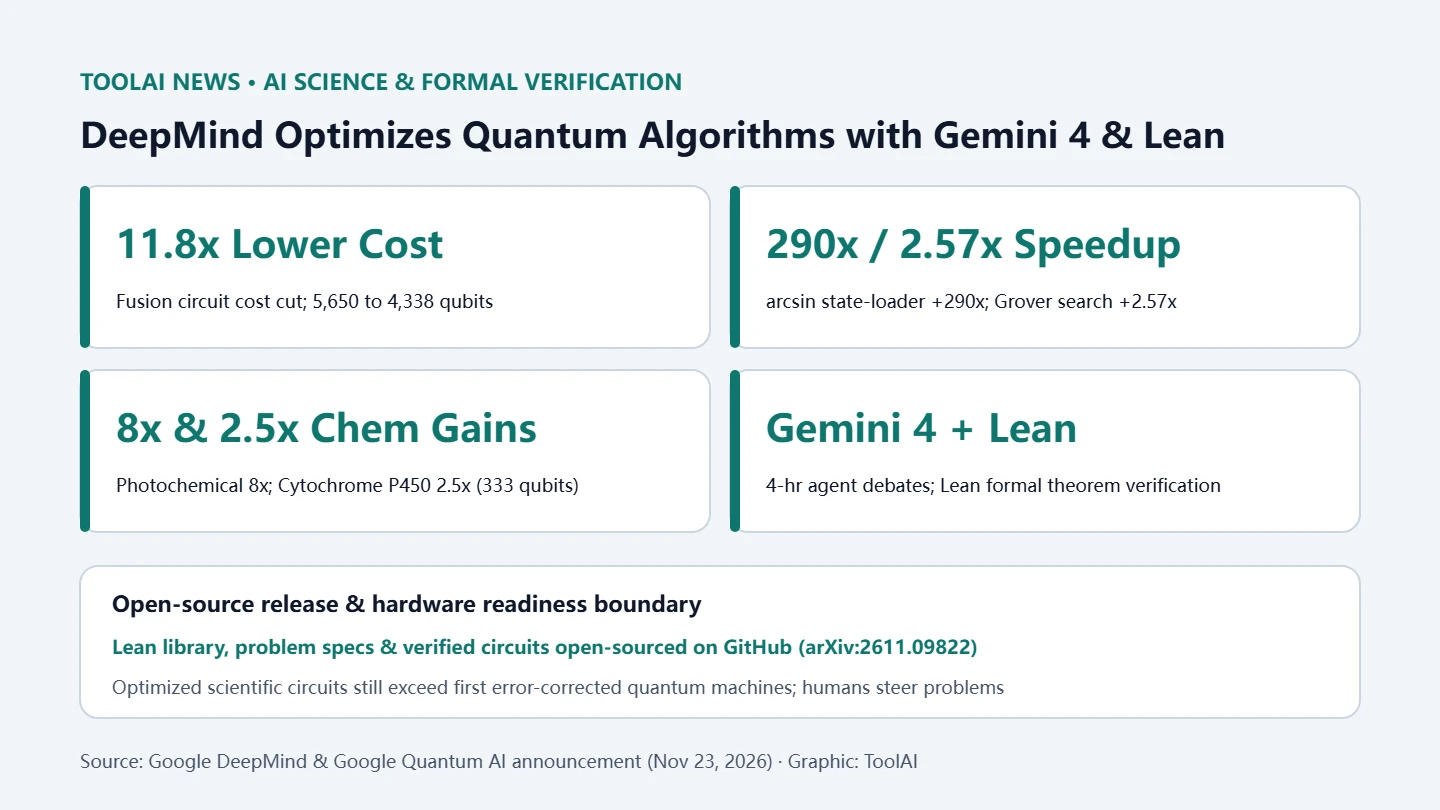
Google DeepMind and Google Quantum AI published new research on November 23, 2026 showing how collaborating teams of Gemini 4 agents paired with the Lean theorem prover can synthesize mathematically verified speedups for quantum algorithms. Alongside the announcement and paper, researchers released their open-source Lean quantum-algorithm library, formal problem specifications, and verified circuits on GitHub.
How agent debates and Lean formal proofs work together
Even when quantum researchers start with textbook circuits, large scientific simulations demand far more qubits and gate operations than near-term fault-tolerant hardware can support. Because full-scale quantum circuits cannot simply be tested empirically on classical supercomputers or today’s small quantum processors, mathematical proof of correctness is mandatory. DeepMind addressed this bottleneck by building a dedicated Lean library for quantum algorithms and assigning multiple independent Google DeepMind agent teams to hunt for structural circuit optimizations in parallel.
- Four-hour agent conferences: Proposed algorithmic ideas first had to clear automated Lean proof verification before entering a shared research notebook. Every four hours, independent agent teams convened in a virtual conference to inspect, debate, and compare verified approaches, driving circuit resource requirements steadily down over time.
- Inertial confinement fusion gains: For calculating a key property in laser-driven inertial confinement fusion simulations, agent teams reduced total computational cost (combining qubit count and operations) by 11.8x and trimmed required memory from 5,650 to 4,338 error-corrected qubits.
- Chemistry and drug metabolism: On Cytochrome P450—an enzyme central to human drug metabolism—agents replaced bulky memory-lookup steps for a 2.5x overall improvement while cutting memory from 481 to 333 qubits. On a common light-sensitive photochemical reaction molecule, simplifying how particle positions and electric forces are tracked yielded an 8x cheaper quantum simulation.
- Foundational quantum subroutines: Outside domain-specific chemistry and fusion targets, proof-checked search delivered a 2.57x speedup on a specific implementation of Grover’s search algorithm and a dramatic 290x speedup for
arcsinstate-loading routines reused across broader quantum algorithms.
Practical boundary for early quantum hardware
DeepMind researchers emphasized an explicit realism boundary: even after double-digit or hundred-fold circuit compression, full scientific simulations of fusion plasmas and enzymes still require more compute than the very first wave of error-corrected quantum computers is expected to deliver. Rather than replacing quantum theorists, proof-checked agent search compresses design cycles that historically demanded years of manual derivation, keeping researchers focused on problem formulation and interpretation.
Related pages
Review the Gemini model family specifications, read the Google DeepMind vendor overview, or explore builder environments such as Google AI Studio and Google Antigravity.
Source: Google DeepMind: Finding faster quantum algorithms with agents and formal verification