
OpenAI published an expanded measurement report on November 18, 2026 titled Research acceleration: The jagged frontier, updating its September baseline on how internal AI coding agents such as OpenAI Codex and GPT-family tools are reshaping frontier research execution. Structuring its evaluation across research inputs (AI tools, human labor, data, and compute), internal workflow processes, and capability outputs, the report documents rapid gains alongside stark unevenness across engineering workflows and a marked reallocation of human headcount toward safety.
Jagged autonomy gains vs. surging internal API intensity
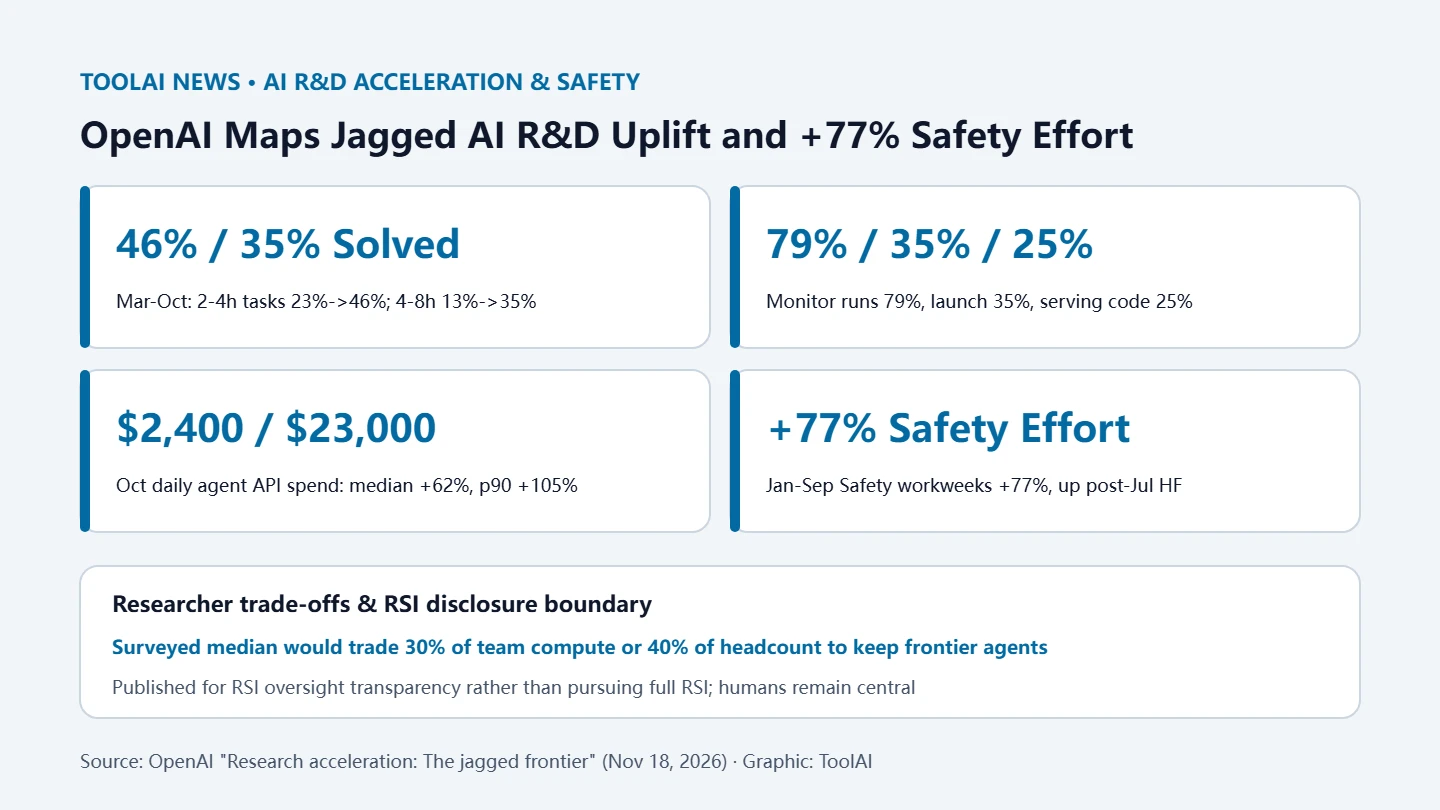
Between March and October 2026, OpenAI estimated that autonomous agents nearly doubled completion rates on multi-hour research engineering tasks: success climbed from 23% to 46% on two-to-four-hour tasks and jumped from 13% to 35% on four-to-eight-hour assignments. Yet task-level breakdowns expose a sharply jagged frontier where human researchers stay essential inside the inner loop:
- Wide dispersion across workflows: Autonomous agents succeeded 79% of the time when monitoring active training runs, but dropped to 35% when launching training runs and just 25% when writing inference and serving-stack production code.
- Rising daily compute & token intensity: Measured at public API list prices, the median OpenAI researcher consumed roughly $2,400/day on agentic tools in October (up 62% from $1,500 in September), while the 90th-percentile researcher surged 105% month-over-month from $11,000 to $23,000/day. These spend figures reflect broader coding-agent intensity alongside workload shifts inside the research org.
- What teams would trade for agents: In an internal survey asking researchers what they would sacrifice to keep frontier coding agents for three months, the median response was 30% of team compute or, asked separately, 40% of team headcount.
Safety Staffing up 77% and RSI disclosure framing
Across all major research tracks tracked by OpenAI, Safety and Alignment recorded the largest absolute expansion in documented human effort: weekly engineering and research workweeks increased by 77% between January and September through both external hiring and internal researcher transfers, accelerating sharply following OpenAI’s response to the Hugging Face incident in July 2026.
Building on its frontier policy blueprint, OpenAI stated that AI labs should track and publicly report quantitative indicators of recursive self-improvement (RSI) so oversight governance can keep pace with capability shifts—adding explicitly that sharing RSI indicators should not be interpreted as pursuing full autonomous self-improvement, and noting encouragement that peer labs are publishing complementary AI R&D acceleration measurements.
Related pages
Compare model generations on the GPT family page and OpenAI vendor overview, or inspect tooling pages for OpenAI, OpenAI Codex, ChatGPT, and Hugging Face.