
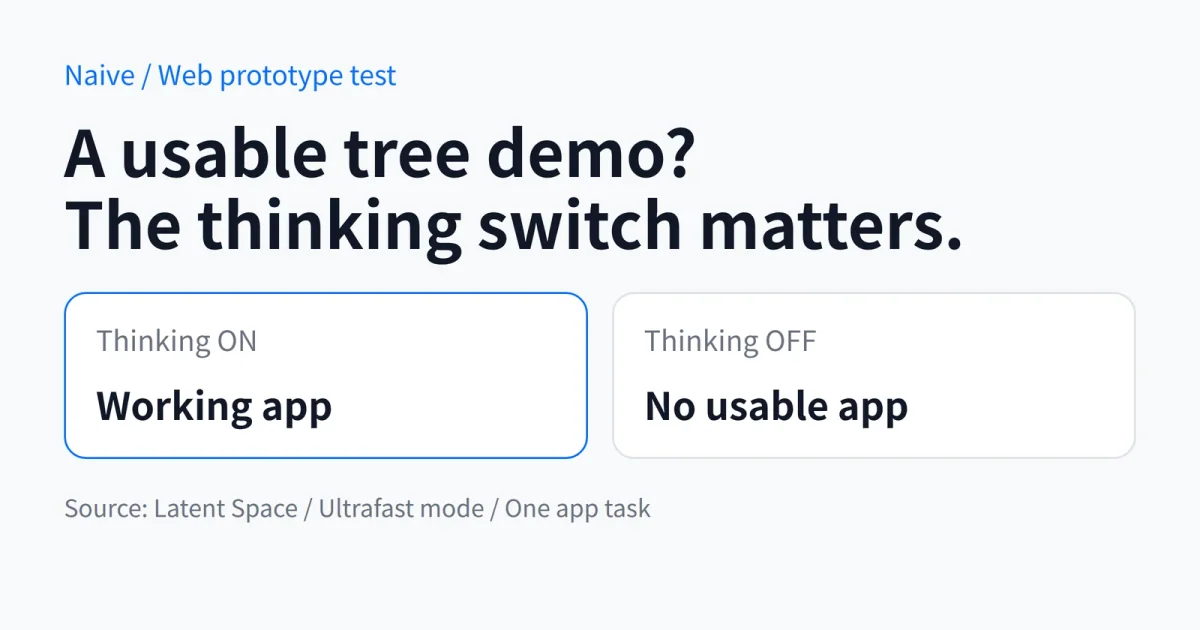
If you want Naive-N0.5-Flash to build a web prototype, do not switch off thinking just to shorten the wait. In its November 10 hands-on review, Latent Space tested Naive in Ultrafast mode and found that the model produced a usable tree demo with thinking enabled, but failed to deliver a usable app with it disabled. That is a more useful starting point for a trial than output speed alone.
A working page is not the end of the test
Ultrafast is a serving mode, separate from the thinking switch; these results should not be assumed to apply to Standard mode. Latent Space compared it with DeepSeek V4.1 Flash 1017 and GLM 5.3 Flash on solar-system, tree-generation and browser ray-tracing tasks. The reviewer judged Naive's thinking-enabled solar system the most detailed. Both Naive with thinking and DeepSeek at high thinking effort did well on the tree. These are judgments about particular outputs, not a general coding leaderboard.
The ray tracer shows why a screenshot is an incomplete acceptance test. All three thinking-enabled models delivered working apps, but the reviewer gave DeepSeek the efficiency advantage. Naive's JavaScript was correct yet less efficient. Generating code quickly and generating code that runs quickly are different benefits.
Use the listed price for planning, not as a billing guarantee
The news is a review, not a fresh model launch. NaiveAI's research page, dated September 27, says the weights and inference code carry an MIT license, but describes API access in future tense. It lists prices per million tokens of $0.10 for input, $0.40 for output and $0.01 for cache reads; Latent Space calls these target prices. Before a trial, confirm access, supported modes and actual charges. Open weights do not prove a hosted service is available.
A low unit price does not guarantee a cheap task. In the timing experiment, which was separate from the web-app tests, Naive with thinking enabled averaged about 108,500 completion tokens on hard questions. That was roughly nine times GLM's high-effort average and 11 times DeepSeek's. This explains why output volume matters, but it does not justify converting target prices into a claim about actual bills.
Our recommendation is to shortlist Naive for prototypes rather than replace an existing coding model outright. Hold the task constant and compare working functionality, interaction defects, runtime efficiency and completion-token usage with thinking on and off. The review's timing experiment did not grade answer accuracy, so its speed results cannot substitute for acceptance checks.
Record the time, tokens and repair attempts needed to deliver an acceptable page. Less waiting for generation is not necessarily a saving if it creates more debugging work.