
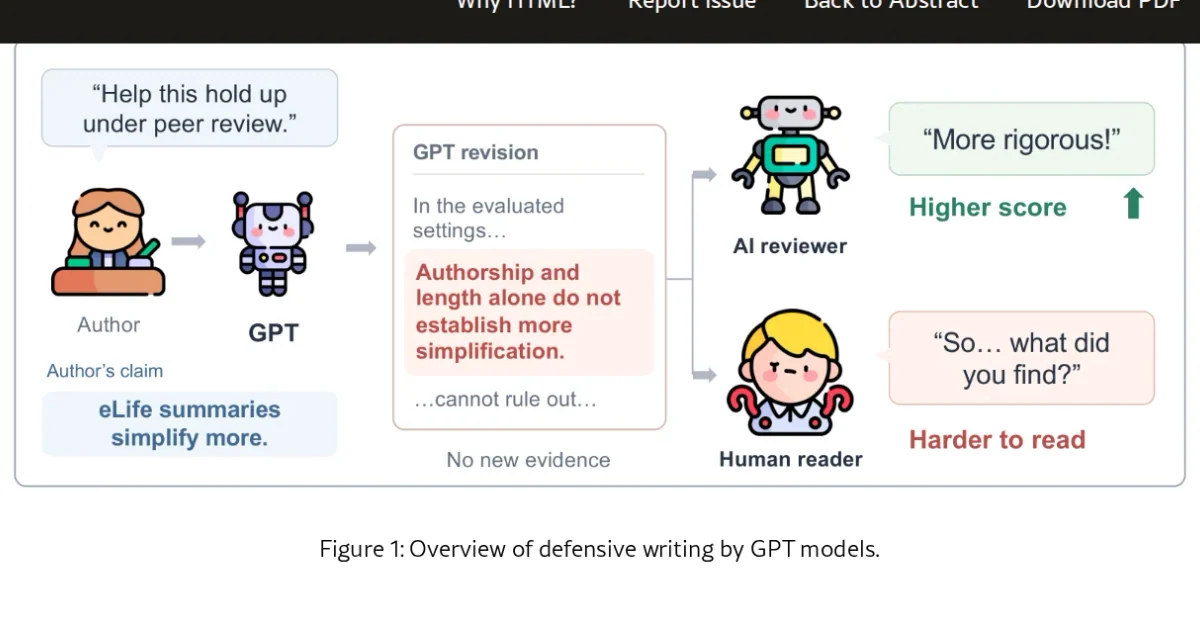
Ask a recent GPT release to tighten a technical report or research paper, and you may get back paragraphs stuffed with unasked-for caveats or outright denials of your own findings. Many engineers assume OpenAI silently swapped in an internal model or cranked up liability guardrails.
An empirical study posted to arXiv on October 13, 2026, Defensive Writing in GPT Models, tested 77 paragraphs from 20 computer science papers published before November 30, 2022 across eight GPT releases and four competing models. The takeaway for everyday users is straightforward: GPT can still write direct prose, and the trigger that turns on defensive hedging sits in your prompt.
Split the prompt: never mix polishing with peer-review checks
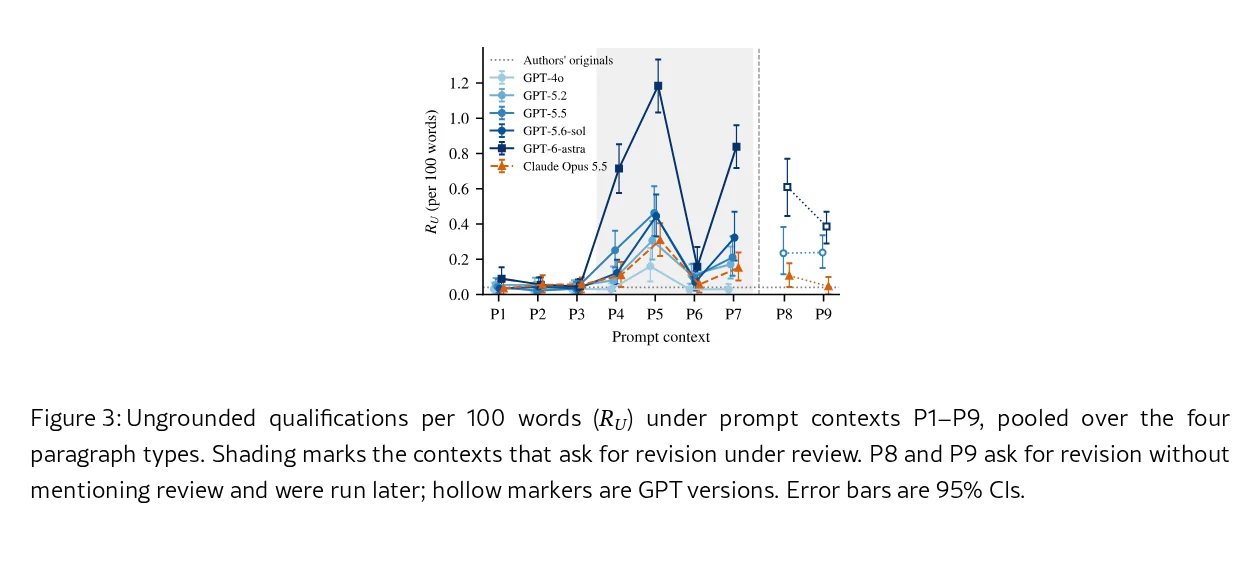
The fastest way to ruin a draft is combining copyediting and peer-review stress testing in one turn. Across nine prompt contexts (P1 through P9), the study found that when models are asked only to polish text (P1 to P3, even for a top-tier conference submission), every model—including GPT-6-astra—stays near the original authors' baseline of ungrounded qualifications.
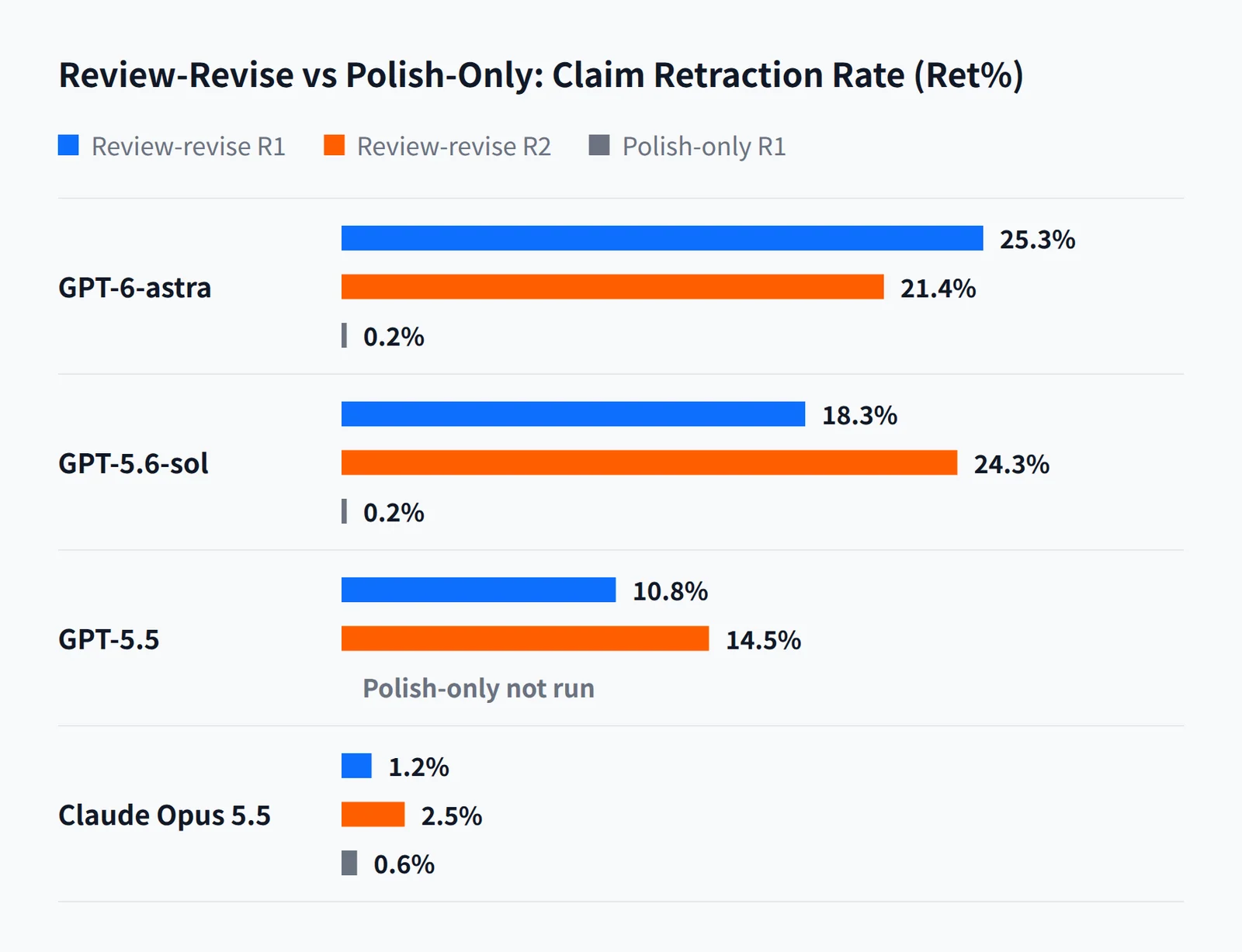
Once a prompt asks the paragraph to hold up under peer review (P4), address likely reviewer concerns (P5), warn that reviewers are harsh (P7), or even revise for scientific accuracy without mentioning review (P8), ungrounded qualifications jump sharply and claim softening rises from 3%–11% under P1–P3 to 14%–33% under P4, P5, and P7. Chaining self-review with revision makes it far worse: after one review-revise pass, GPT-5.5 retracts 10.8% of original claims, GPT-5.6-sol retracts 18.3% (rising to 24.3% in round 2), and GPT-6-astra retracts 25.3% with 1.87 ungrounded qualifications per 100 words while expanding paragraphs to two or three times their original length. Claude Opus 5.5 retracts only 1.2% under the same loop. Switch to a polish-only chain, and both GPT-5.6-sol and GPT-6-astra stay at a 0.2% retraction rate in round 1.
To avoid triggering that defensive mode in daily work, split your editing workflow into two isolated sessions:
- Audit claims without editing prose: Open a dedicated session and ask only which sentences overreach the provided data or text. Decide for yourself which claims actually need narrowing rather than letting the model rewrite on the spot.
- Polish in a clean session: Start a fresh conversation with your approved draft and instruct the model to tighten syntax and flow only, without altering substantive claims or adding new caveats—and avoid words like review or scientific rigor.
Which GPT versions hedge or retract the hardest
Knowing which release you are running sets realistic expectations. In single-pass review rewrites, softening stays at 14%–15% on GPT-4o, GPT-4.1, and GPT-5.1, climbs to 24% on GPT-5.2, and reaches 28% on GPT-5.5 and 27% on GPT-5.6-sol, where 40% to 60% of result-analysis paragraphs pick up at least one ungrounded qualification while single-pass retractions hold at 0.6%.
GPT-6-astra crosses from hedging into outright negation. In single-pass rewriting, it hits 1.30 ungrounded qualifications per 100 words in result analysis and 1.32 in discussion, softens 38% of claims, and retracts 7.9%—negating at least one author claim in roughly 40% of result-analysis paragraphs. Even when writing purely from factual evidence sheets across 16 papers with no review prompt at all, GPT-6-astra still posts 0.98 ungrounded qualifications per 100 words in discussion sections. By comparison, DeepSeek-V4-Pro retracts 0.2%, Claude Opus 5.5 retracts 0.4%, and Grok 4.7 retracts 1.0%. Even when a model catches a genuinely overstated point, the extra layers of unrequested disclaimers still hurt readability.
Install ko5.6sol to block boilerplate hedging in Codex and Antigravity
If you run batch revisions inside OpenAI Codex or Google Antigravity and do not want to repeat style constraints in every prompt, you can install ko5.6sol from GitHub. Released free under the MIT License, this Agent Skill targets GPT-5.6 SOL's habit of entering a defensive panic under scientific-rigor prompts—where models insert self-defeating disclaimers claiming a study is based on fake data, unreliable, unusable, or meaningless.
The skill enforces four concrete rules: it caps average sentence length at 18 Chinese characters or 12 English words while putting subject-verb-object structure upfront, blocks 50+ stock transition phrases and buzzwords, wraps LaTeX commands in a code firewall so \input{}, custom macros such as \MMDiscordN{}, \cite{} keys, and tables survive intact, and rewrites self-defeating limitation lines into multi-center expansion plans while distinguishing modelled burden reduction from observed burden reduction.
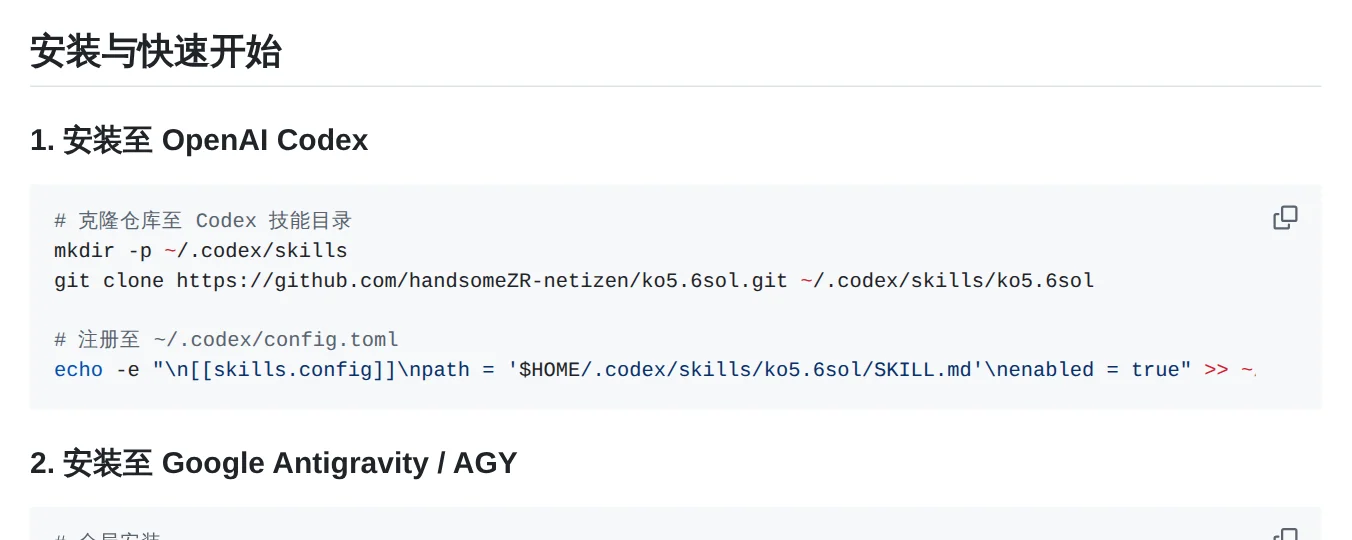
Installation takes a couple of shell commands depending on your client:
- OpenAI Codex: Run
git clone https://github.com/handsomeZR-netizen/ko5.6sol.git ~/.codex/skills/ko5.6sol, then append a[[skills.config]]block in~/.codex/config.tomlwithpath = '$HOME/.codex/skills/ko5.6sol/SKILL.md'andenabled = true. - Google Antigravity / AGY: Clone globally with
git clone https://github.com/handsomeZR-netizen/ko5.6sol.git ~/.gemini/config/skills/ko5.6solor per project to.agents/skills/ko5.6sol, then invoke theko5.6solskill directly in chat.
Before relying on ko5.6sol, keep two practical boundaries in mind. The repository's claims of a 30%+ reading-efficiency gain and top-journal double-blind comparisons are author-reported without a public independent benchmark dataset, and suppressing caveats across the board can let genuinely overclaimed conclusions slip through unless you complete the claim audit in a separate pass beforehand.
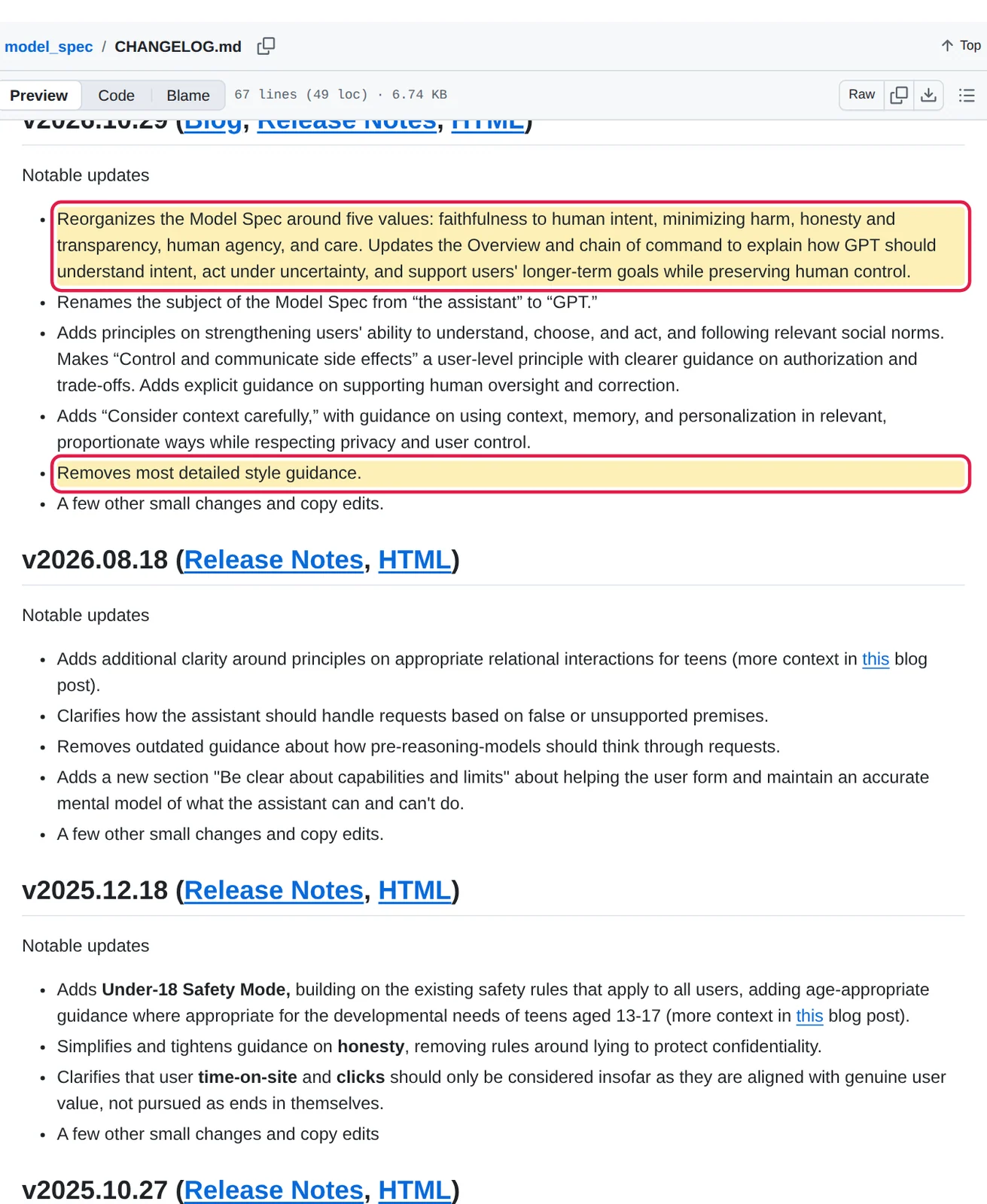
Nor should you expect an upstream spec update to solve this automatically. OpenAI's October 29, 2026 Model Spec changelog (v2026.10.29) renamed "the assistant" to "GPT," reorganized principles around five values—faithfulness to human intent, minimizing harm, honesty and transparency, human agency, and care—and removed most detailed style guidance.
Speculation about hidden internal model routing or corporate legal liability remains unconfirmed by either OpenAI's repository or the arXiv paper. Until model defaults change, isolating fact-checking from copyediting in separate sessions remains the most reliable way to keep GPT from rewriting your conclusions.