
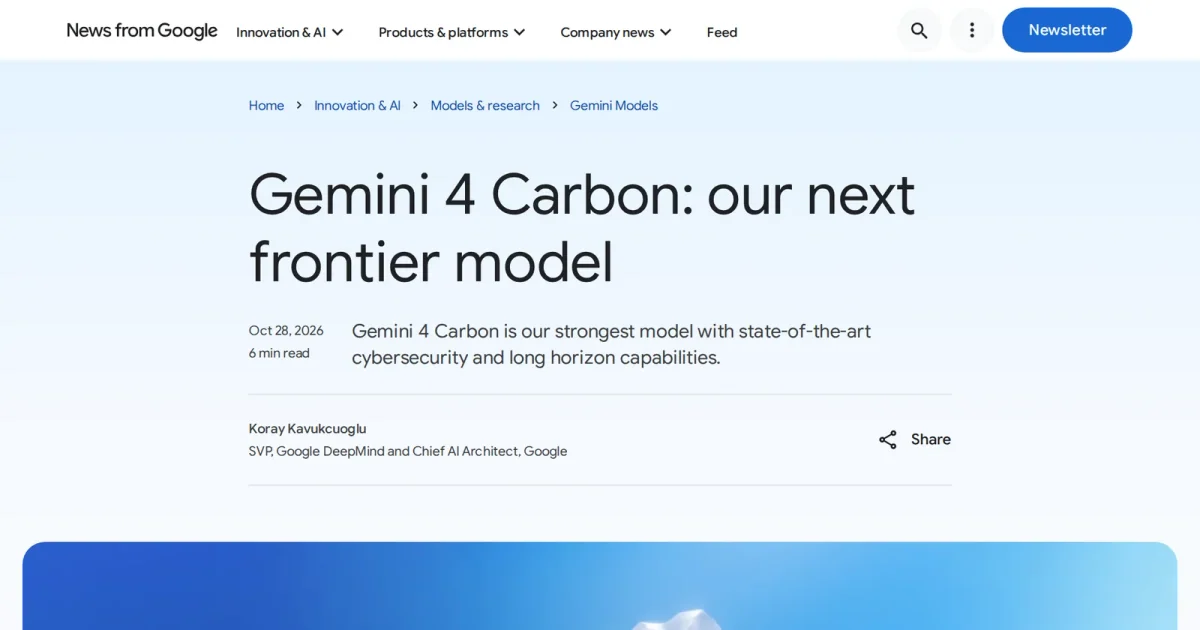
Google opened Gemini 4 Carbon broadly on November 10, 2026, and launched Gemini 4 Hydrogen two days later. For anyone choosing a primary research model alongside OpenAI's GPT-6 Astra, the practical questions come down to three checks: which account gets you in, what API workloads actually cost, and what public benchmarks really measure.
Before setting up an API key or paying for a plan, put Google's access rules, pricing tables, Towards AI's ToneBench, and BenchLM side by side.
Access Gates First: Where Each Model Runs and What Pricing Leaves Out
Availability varies sharply across the three options:
- Gemini 4 Hydrogen: The easiest to reach today. It is live across all tiers of Google AI Studio, the Gemini API, Android Studio, Gemini for business, and Google Search. In the Gemini app, even free users can trigger Hydrogen through automatic model selection, while Google Antigravity and Gemini in Google Sheets require paid Google AI Pro, Ultra, or eligible business subscriptions.
- Gemini 4 Carbon: Available to paying developers via the Gemini API in AI Studio and Android Studio, and to enterprises in Gemini for business, Google Antigravity, and CodeMender. Consumer access in the Gemini app, Search AI Mode, and Antigravity is limited to Google AI Ultra subscribers. Scientists can also apply for Google's six-month free highest-tier Antigravity program for 10,000 researchers, which expanded to include Carbon on November 10 on a rolling eligibility basis.
- GPT-6 Astra: BenchLM lists it under Limited Availability across OpenAI's Responses API, Chat Completions API, ChatGPT Plus, Pro, Business, and Enterprise, plus Microsoft Azure and AWS Bedrock.
One pricing detail is missing from these pages: both Google's announcements and BenchLM quote per-token API rates, not consumer monthly fees for Google AI Pro, Ultra, or ChatGPT plans. Check each product's billing page separately if you plan to use a web subscription instead of API tokens.
API Budget Math: Three Workloads and Hydrogen's Four Thinking Tiers
On token pricing, Hydrogen costs a flat $1.50 per 1M input tokens and $7.50 per 1M output tokens across its 1M context window. Carbon runs at an introductory $2 input and $10 output ($0.1 cached input) through November 30, 2026, doubling to $4 and $20 afterward. GPT-6 Astra sits at $10 input and $50 output ($1 cached input).
BenchLM's three preset workloads show how Carbon's current intro rate compares with Astra—and why the gap is not uniformly fivefold:
- Chat turn (1K fresh input + 500 output): $0.007 on Carbon vs. $0.035 on Astra, an exact 5x gap.
- Repository review (50K fresh input + 3K output): $0.13 on Carbon vs. $0.65 on Astra, again 5x.
- Cache-heavy agent loop (200K cached + 20K fresh input + 10K output): $0.16 on Carbon vs. $0.9 on Astra—more than fivefold, because cached input is priced at $0.1 vs. $1 (a 10x spread).
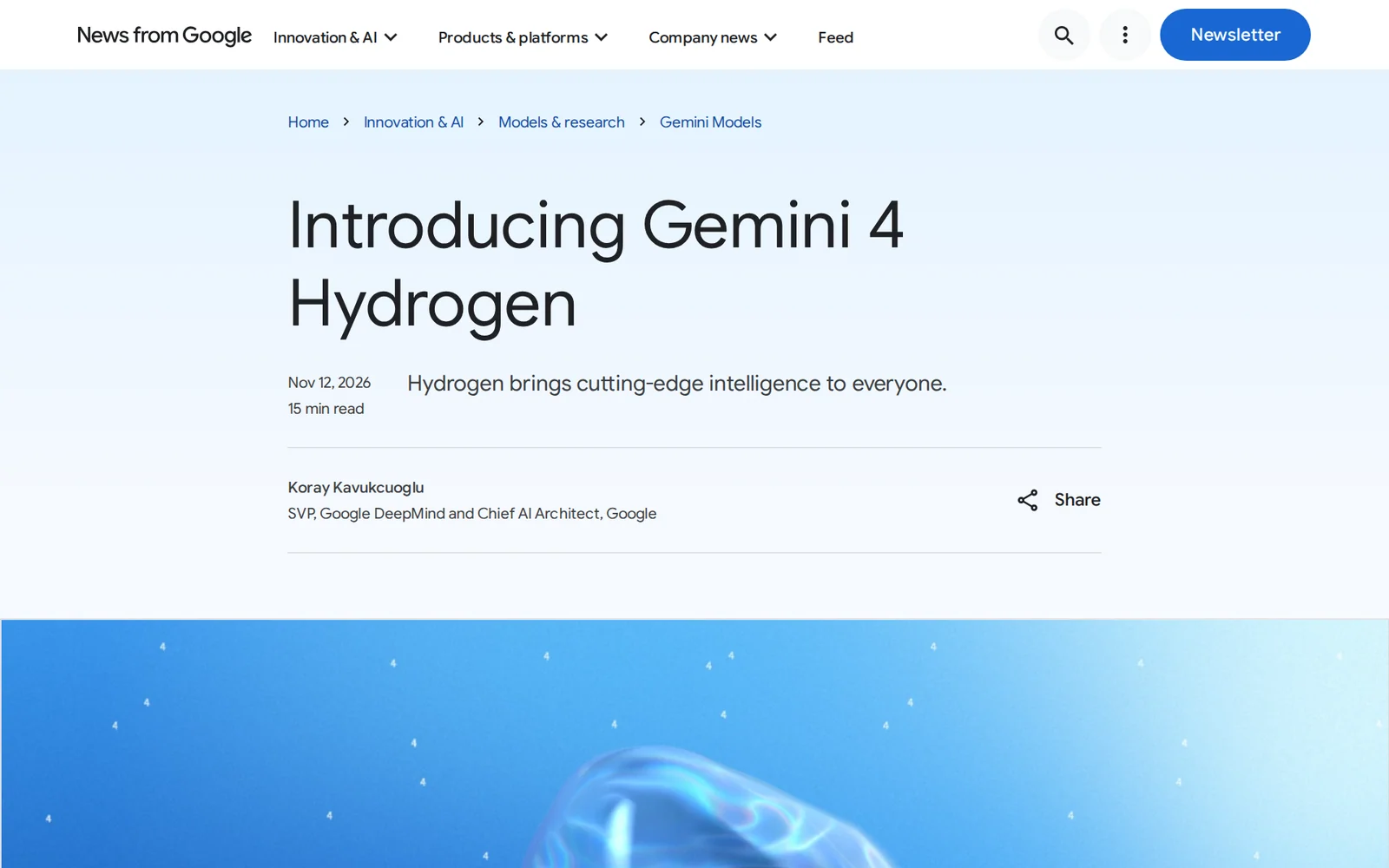
Hydrogen handles the speed-and-budget tier with four thinking levels—low, medium, high (default), and xhigh. At default high, it scores 51 on the Artificial Analysis Intelligence Index (beating Argon's 50) and hits 54 at xhigh. Compared with Gemini 3.8 Flash, it completes tasks 2.5 times faster, lifts Terminal-Bench 4.1 from 18.2% to 57%, and hits 94% on internal agent honesty tests. Pairing Carbon and Hydrogen inside Google Antigravity's Orchestrator reached near-Carbon completion on Terminal-Bench 4.0 while saving 24% quota and running 19% faster.
Benchmark Limits: Why ToneBench Is Not an Academic Writing Test
When checking prose quality, keep ToneBench in scope. It tests closed-book generation of 10 YouTube scripts (five drafts each) written in the voice of creator Louis-François Bouchard under a strict style guide. Carbon's scorecard explicitly notes that it measures long-form scripted writing and does not carry over to every kind of text.
Within that script benchmark, Gemini 4 Carbon (high thinking) places #27 of 87 models (#54 of 151 configurations), with an 80.1 Writing Score. On Slop Score, where higher marks mean fewer stock AI phrases, Carbon scores 83.6 against an 81.3 configuration median (#51), behind OpenAI's GPT-6 Sol (medium) at a board-best 89.0. Anthropic's Claude Opus 5.5 (xhigh) leads the overall script board at 85.8 ($1.003 per script).
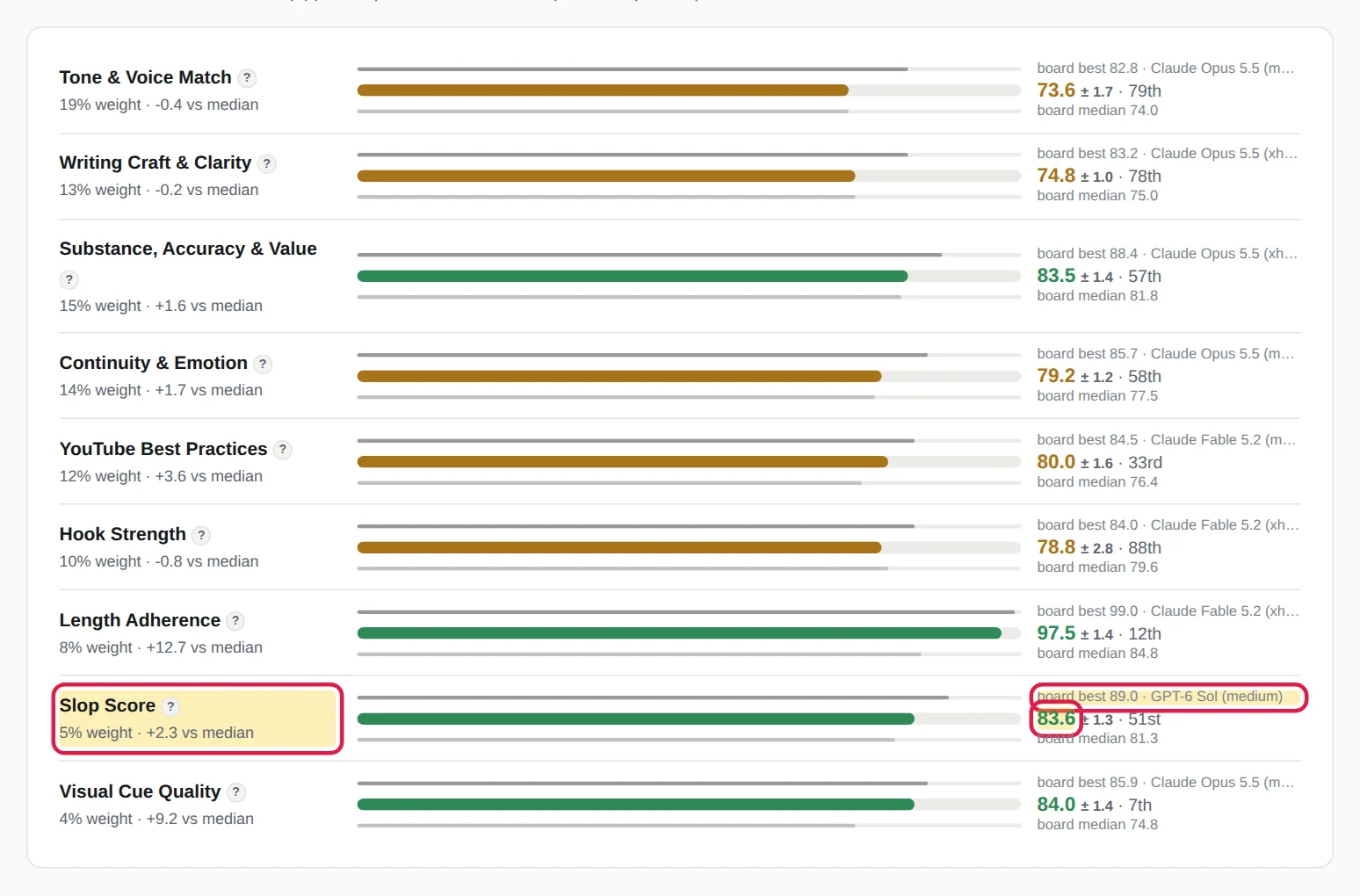
In that same ToneBench run, Carbon (high thinking) averaged $0.586 per script and 8.7 minutes per script including retries (roughly six times the 1.5-minute median). Dropping to medium thinking cuts that to $0.218 and 3.1 minutes (79.2 Writing Score), and low thinking drops to $0.061 and 0.8 minutes (77.2). Because neither Hydrogen nor GPT-6 Astra has a comparable ToneBench scorecard yet, how fast or natural Hydrogen feels on your own research drafts remains something to test directly rather than assume from the board.
On quantitative and software suites tracked by BenchLM (updated November 13), GPT-6 Astra pulls ahead on FrontierMath v2 Tiers 1-3 (93.684% vs. 90.526%) and Tier 4 (97.600% vs. 95.122%) as well as FrontierSWE v2 (65.5% vs. 61.2%), alongside a 1.05M documented context window vs. 1M.
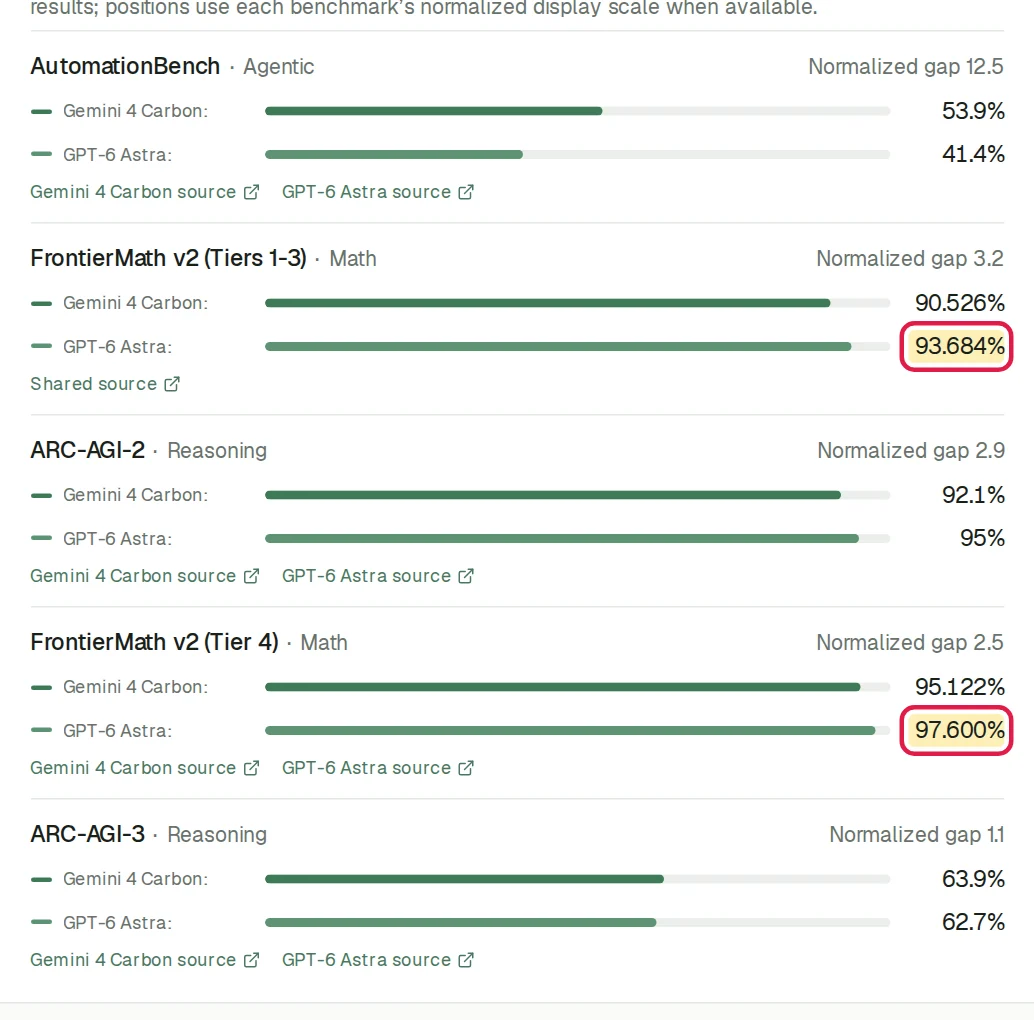
Carbon leads Bug Hunt Bench (57.3 vs. 45.0) and GraphWalks BFS 256K-1M (96.2% vs. 71.8%). BenchLM documents native text, image, video, audio, and PDF inputs for Carbon versus text and image documented for Astra, while leaving undocumented formats unspecified. On data checking, Google's November 10 release reports that Carbon declined to invent missing experimental data 98% of the time in its internal 375-task agentic honesty test. Treat that internal benchmark as support for assistive checking rather than a reliability guarantee—raw numbers and final claims still need human review.
Three Checks Before You Commit a Workflow
Start with Hydrogen on your own literature notes or section edits—via free Gemini app auto-selection or $1.50/$7.50 API calls—instead of treating Carbon's 8.7-minute ToneBench script average as universal latency. If you need Carbon's multimodal window for heavy PDFs and media, eligible researchers can apply for Google's six-month free Antigravity tier, and API teams should test workflows before Carbon doubles to $4 and $20 after November 30, 2026.
Reserve Limited Availability GPT-6 Astra for FrontierMath-grade proofs, FrontierSWE repairs, or 1.05M-context runs that justify paying more than five times as much on cached loops. If your goal is strictly cutting stock phrasing in long-form English scripts, ToneBench gives direct Slop Score backing to GPT-6 Sol (89.0), while Claude Opus 5.5 leads the overall script score.