
If your team is weighing a migration from Claude Fable 5.1 to open-weight or lower-cost Kimi K3.1 Pro, do not flip the switch across every endpoint at once. A line-by-line check of Moonshot AI's Hugging Face model card shows a lopsided profile: Kimi K3.1 Pro leads Claude Fable 5.1 on multi-step agent harnesses and document workflows, while trailing sharply on single-shot strict coding and hard reasoning.
Vendor timelines add another constraint. Moonshot plans to retire all K2 series models by the end of December, while regulators have opened a data-security probe into both Moonshot and DeepSeek. Practical model selection means weighing the benchmark split, per-token rates, and Moonshot's year-end migration schedule together.
Where Kimi K3.1 Pro Wins and Where It Trails Fable 5.1
Headline numbers in the Kimi K3.1 Pro tech blog highlight Terminal-Bench 4.0 at 65.7% and OfficeQA Pro v2 at 64.4, which can make it look like an across-the-board match for closed frontier models. Comparing every benchmark on the model card where both Kimi K3.1 Pro (at max reasoning effort) and Claude Fable 5.1 have scores tells a different story.
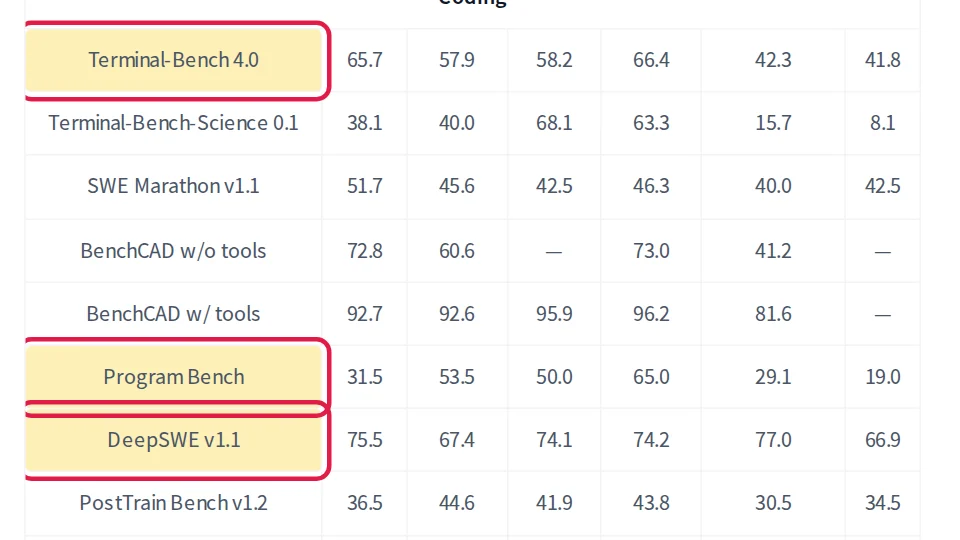
In tool-assisted, multi-step execution and enterprise document tasks, Kimi K3.1 Pro comes out ahead: 73.3 versus 59.4 on Automation Bench-AA, 64.4 versus 54.5 on OfficeQA Pro v2, 75.5 versus 67.4 on DeepSWE v1.1, 65.7 versus 57.9 on Terminal-Bench 4.0, and 1846 versus 1754 Elo on GDPval-AA v2.1.
Outside iterative tool loops, the gap reverses. On binary strict-pass Program Bench, Kimi K3.1 Pro scores 31.5 compared with Claude Fable 5.1's 53.5. On HLE-Diamond, it posts 39.4 against 55.1 (and 51.1 versus 57.6 on text-only or no-tool HLE-Full). Security evaluations show a similar spread: 74.7 versus 83.0 on ExploitBench and 20.7 versus 30.4 on ExploitGym. It also trails on PostTrain Bench v1.2 (36.5 vs. 44.6), Frontier Finance (58.6 vs. 60.8), and OSWorld V2.1 (79.6 vs. 80.7).
Moonshot AI explains part of the security gap in its own blog: to limit open-weight misuse, the team stripped cyber-related data from mid-training and reinforcement learning, pulling its internal xdev-bench-hard pass@3 rate down from 90.5% to 81.0%. The company notes that its cyber capability remains behind frontier proprietary models released at least three months earlier. Developers expecting Fable 5 parity on hard one-shot logic or vulnerability tasks will run directly into those deficits.
Three Integration Constraints Before You Deploy
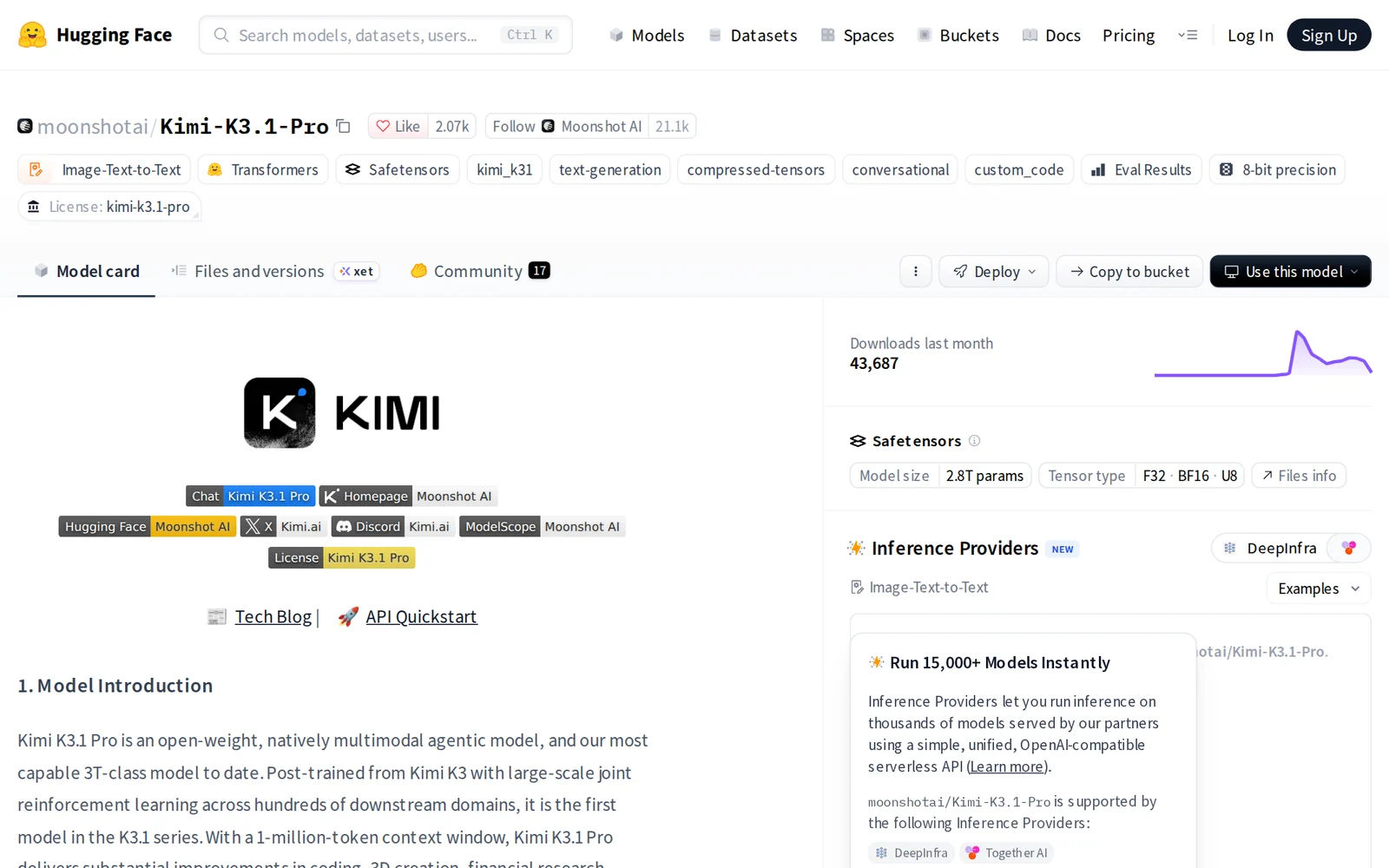
Under the hood, Kimi K3.1 Pro is a 2.8T-parameter Mixture-of-Experts model activating 104B parameters per token, paired with a 401M-parameter MoonViT-V2 vision encoder, a 1,048,576-token context window, and quantization-aware MXFP4/MXFP8 training. Moonshot also ships Kimi K3.1 Pro Highspeed at 2-3x the generation speed.
Even with MXFP4 weights, self-hosting a 2.8T-parameter MoE model on vLLM or SGLang requires a heavy multi-GPU cluster, so most small and mid-sized teams will be better served by a hosted API. Whichever deployment path you take, three engineering details require attention before rollout:
- Match the evaluation harness: Moonshot evaluated Kimi K3.1 Pro on Terminal-Bench 4.0, DeepSWE v1.1, and Program Bench inside the Claude Code harness. Custom agent loops with weaker tool orchestration may underperform the published table.
- Echo full reasoning state in multi-turn calls: Through the OpenAI- and Anthropic-compatible API, multi-turn and tool-calling requests must pass back the complete prior assistant message, including
reasoning_contentandtool_calls, rather thancontentalone. - Review the custom license: Weights on Hugging Face carry the bespoke Kimi K3.1 Pro License rather than MIT or Apache 2.0, so check redistribution and hosted-service terms first.
Billing Rates, Caching Rules, and the December K2 Cutoff
On OpenRouter, Moonshot AI's own endpoint lists Kimi K3.1 Pro at $2.00 per million input tokens and $10.00 per million output tokens ($0.20 per million for cache reads), while Moonshot AI Highspeed runs $4.00 / $20.00 and third-party providers such as Relace start as low as $0.2375 input and $8.4114 output. By comparison, Anthropic's pricing page lists Claude Fable 5.1 at $10 per million input tokens and $50 per million output tokens ($0.25 for cache hits, $12.50 for 5-minute cache writes, and $20 for 1-hour writes).
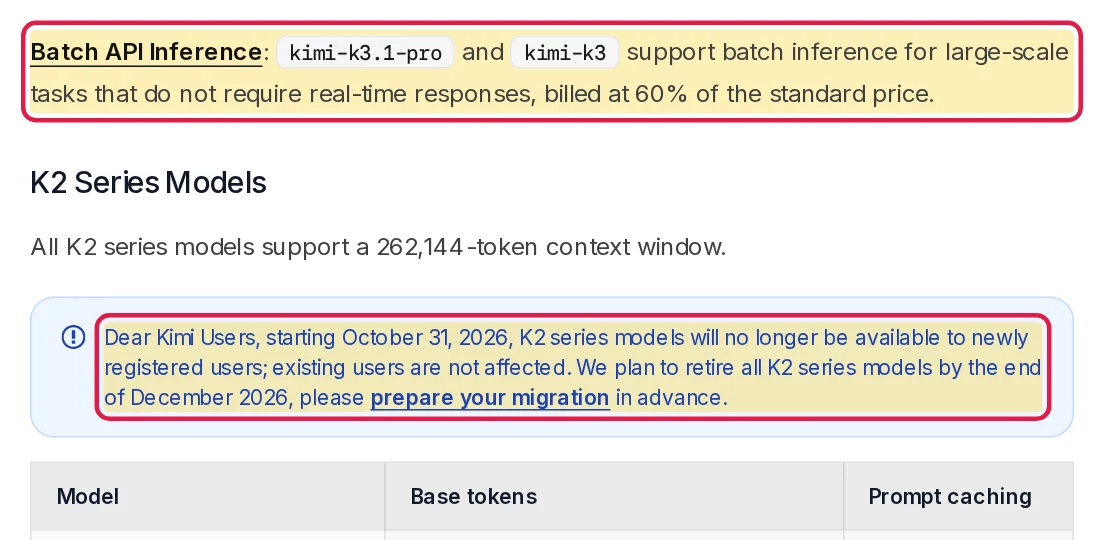
On the Kimi API Platform pricing page, direct inference is strictly pay-as-you-go with no subscription bundle, separate from Kimi consumer memberships and Kimi Code; because the documentation text omits the direct rate table, check first-party token rates in the console before committing traffic. K3 models include automatic context caching with a default 5-minute TTL (plus a 1-hour option), where cache hits pay only the hit rate with no extra write fee, and file upload and extraction APIs are temporarily free. Non-urgent workloads on kimi-k3.1-pro and kimi-k3 can use Batch API inference at 60% of the standard rate. More urgently, K2 models stopped accepting newly registered users on October 31, and Moonshot plans to retire all K2 series models by the end of December.
How to Route During Moonshot's Restructuring
External risks also argue against single-vendor lock-in. On November 13 and 14, AI Weekly and Mingpao cited Wall Street Journal reporting that Moonshot AI is unwinding its Cayman Islands holding company ahead of a targeted early-2027 Hong Kong IPO amid market turbulence, an active data-security probe, and an unresolved investor dispute. Keeping a split-model router protects production teams: send long-PDF extraction, high-volume batch jobs via the 60% Batch API, and iterative repo fixes to Kimi K3.1 Pro, while keeping Claude Fable 5.1 as the fallback for strict single-pass code synthesis, hard reasoning, and security audits. Teams still on K2 should update their reasoning_content message handling and start testing K3.1 Pro migrations this month.