Entwickler-Tools
Qdrant
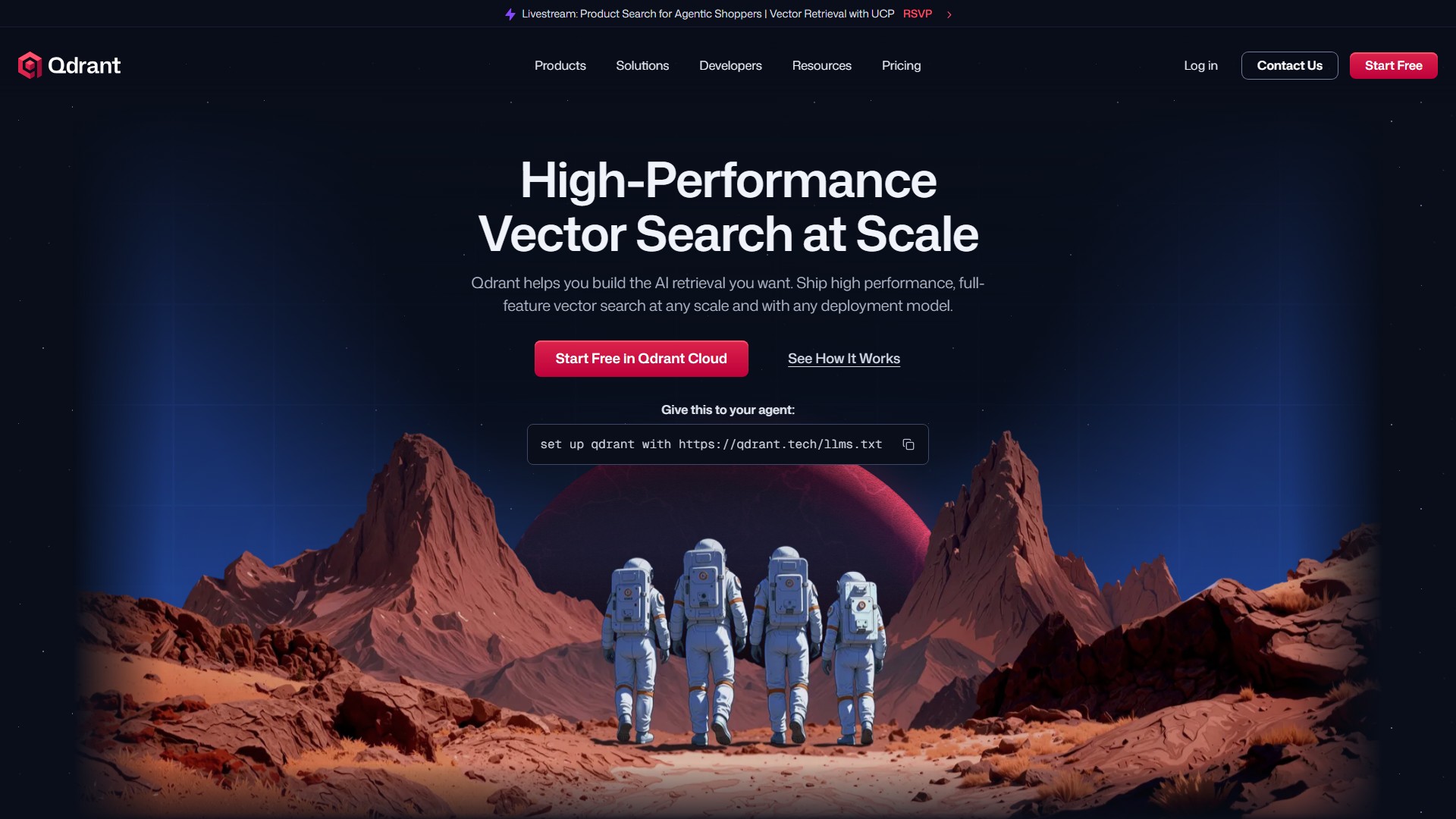
High-performance open-source vector database and managed cloud retrieval engine.
What is Qdrant? Quick Facts & Alternatives
Qdrant (Open-source free self-hosting; Cloud Free Tier $0 / Standard usage-based) — High-performance open-source vector database and managed cloud retrieval engine, with top alternatives including Shumai (Meta), WAAS, PlasticDB.
- Category
- Entwickler-Tools
- Pricing
- Open-source free self-hosting; Cloud Free Tier $0 / Standard usage-based
- Verified
- 2026-11-24
Über dieses Tool
Overview
Qdrant is an open-source, Rust-based vector similarity search engine and vector database engineered for high-throughput retrieval-augmented generation (RAG), semantic search, anomaly detection, and multi-step AI agents. Teams can self-host the open-source engine at no software cost or deploy managed Qdrant Cloud, Hybrid Cloud, and isolated Private Cloud clusters across AWS, Azure, and GCP.
Main features
- High-performance vector retrieval: Combines dense/sparse vector search, payload filtering, GPU indexing (paid tiers), and horizontal/vertical scaling.
- Flexible deployment modes: Choose between self-hosted open source, Qdrant Managed Cloud (AWS, Azure, GCP), Hybrid Cloud (running clusters inside your own VPC), Private Cloud air-gapped setups, and Qdrant Edge (beta).
- Cloud resilience & automation: Paid Managed Cloud adds shard rebalancing, automated backup and disaster recovery, multi-AZ topology awareness, and Terraform/Pulumi/CLI automation.
- Enterprise security: Offers encryption at rest and in transit, custom encryption keys, enterprise SSO, and private VPC links on Premium and Private deployments.
Pricing
- Open-source Self-Hosted: Free software engine deployed on your own infrastructure (infrastructure and community support only).
- Qdrant Cloud Free Tier: $0 forever for prototypes and small workloads (single-node cluster with 0.5 vCPU, 1 GB RAM, and 4 GB disk, plus free cloud inference on selected open/external models).
- Standard Tier: Usage-based pricing billed by cluster compute, memory, and storage resources; includes 99.5% uptime SLA, high availability setups, backup/disaster recovery, and 10x5 standard support.
- Premium Tier & Enterprise: Minimum spend or custom on-request contracts, unlocking SSO, Private VPC Links, 99.9% (single-AZ) to 99.95% (multi-AZ) uptime SLAs, and 24/7 support with 1-hour Severity-1 response.
Who it is for
Backend and AI platform engineers building low-latency RAG pipelines, recommendation engines, agent memory stores, or large-scale multimodal semantic search services.
How to start
Pull the open-source Qdrant Docker container for local prototyping, or sign up on Qdrant Cloud to launch a forever-free 1 GB RAM cluster in minutes and connect via Python, TypeScript, Rust, or Go SDKs.
Things to note
Cluster costs scale with active RAM, disk, and replica count when exceeding the 1 GB / 4 GB Free Tier ceiling; advanced governance such as SSO and private VPC peering are reserved for Premium (minimum-spend) and Hybrid/Private Cloud tiers.
Similar tools
Pinecone, Weaviate, Milvus, Chroma, pgvector.
| Tool-Name | Qdrant |
|---|---|
| Kategorie | Entwickler-Tools , Suchmaschine |
| Preismodell | Open-source free self-hosting; Cloud Free Tier $0 / Standard usage-based |
| Aufnahmedatum | 2026-11-24 |
| Top-Alternativen | Shumai (Meta) , WAAS , PlasticDB |
Traffic-Analyse
Traffic-, Ranking- und Engagement-Signale für dieses Tool.
Noch keine Analysedaten
Interface-Vorschau
Nutzerbewertungen
Embed "Featured on ToolAI.io" Badge
Copy the HTML snippet below to display your ToolAI featured badge on your website or docs.