Developer tools
Qdrant
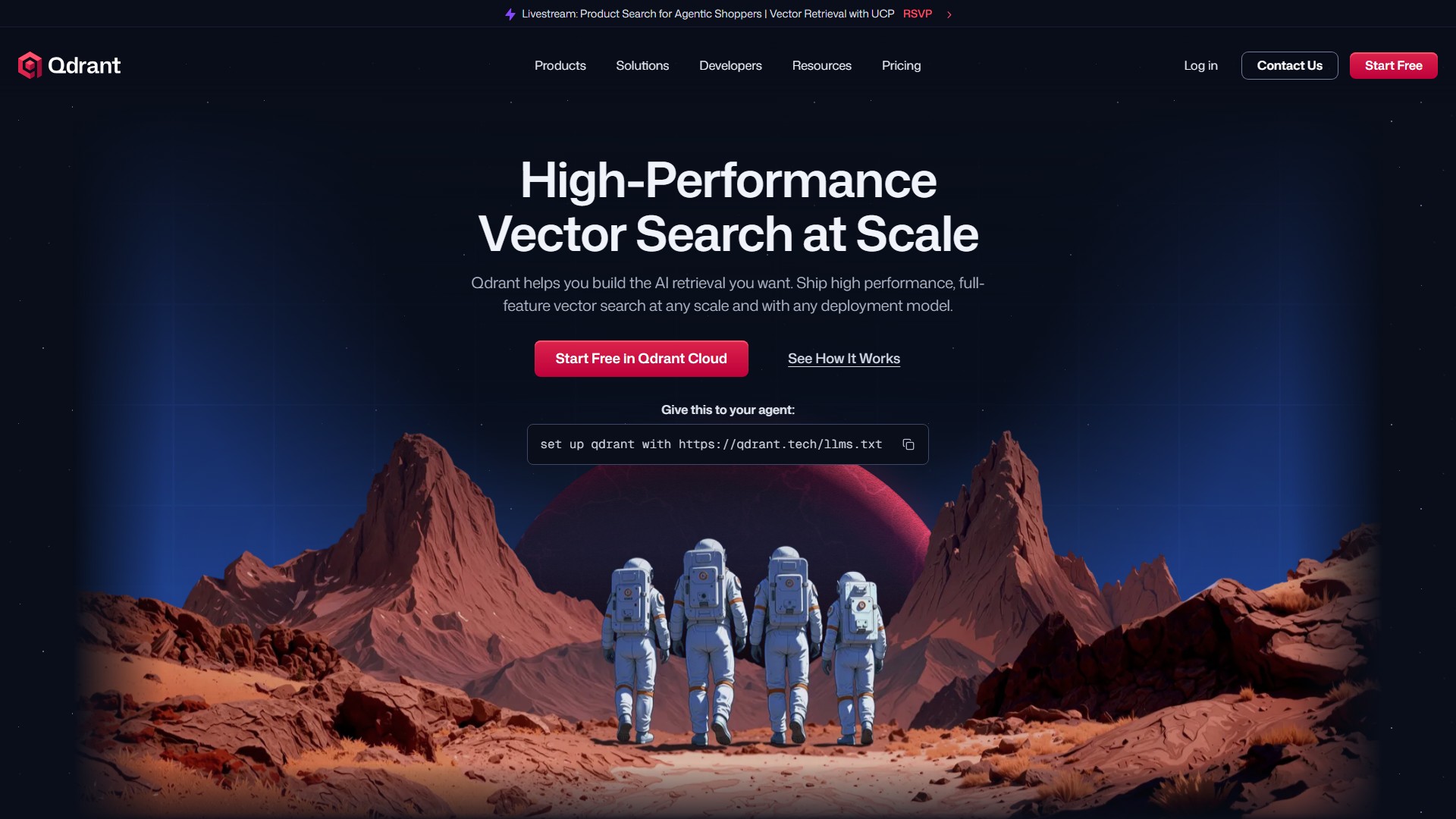
High-performance open-source vector database and managed cloud retrieval engine.
What is Qdrant? Quick Facts & Alternatives
Qdrant (Open-source free self-hosting; Cloud Free Tier $0 / Standard usage-based) — High-performance open-source vector database and managed cloud retrieval engine, with top alternatives including Shumai (Meta), Keyword Faq, Tantl.
- Category
- Developer tools
- Pricing
- Open-source free self-hosting; Cloud Free Tier $0 / Standard usage-based
- Verified
- 2026-11-24
About this tool
Overview
Qdrant is an open-source, Rust-based vector similarity search engine and vector database engineered for high-throughput retrieval-augmented generation (RAG), semantic search, anomaly detection, and multi-step AI agents. Teams can self-host the open-source engine at no software cost or deploy managed Qdrant Cloud, Hybrid Cloud, and isolated Private Cloud clusters across AWS, Azure, and GCP.
Main features
- High-performance vector retrieval: Combines dense/sparse vector search, payload filtering, GPU indexing (paid tiers), and horizontal/vertical scaling.
- Flexible deployment modes: Choose between self-hosted open source, Qdrant Managed Cloud (AWS, Azure, GCP), Hybrid Cloud (running clusters inside your own VPC), Private Cloud air-gapped setups, and Qdrant Edge (beta).
- Cloud resilience & automation: Paid Managed Cloud adds shard rebalancing, automated backup and disaster recovery, multi-AZ topology awareness, and Terraform/Pulumi/CLI automation.
- Enterprise security: Offers encryption at rest and in transit, custom encryption keys, enterprise SSO, and private VPC links on Premium and Private deployments.
Pricing
- Open-source Self-Hosted: Free software engine deployed on your own infrastructure (infrastructure and community support only).
- Qdrant Cloud Free Tier: $0 forever for prototypes and small workloads (single-node cluster with 0.5 vCPU, 1 GB RAM, and 4 GB disk, plus free cloud inference on selected open/external models).
- Standard Tier: Usage-based pricing billed by cluster compute, memory, and storage resources; includes 99.5% uptime SLA, high availability setups, backup/disaster recovery, and 10x5 standard support.
- Premium Tier & Enterprise: Minimum spend or custom on-request contracts, unlocking SSO, Private VPC Links, 99.9% (single-AZ) to 99.95% (multi-AZ) uptime SLAs, and 24/7 support with 1-hour Severity-1 response.
Who it is for
Backend and AI platform engineers building low-latency RAG pipelines, recommendation engines, agent memory stores, or large-scale multimodal semantic search services.
How to start
Pull the open-source Qdrant Docker container for local prototyping, or sign up on Qdrant Cloud to launch a forever-free 1 GB RAM cluster in minutes and connect via Python, TypeScript, Rust, or Go SDKs.
Things to note
Cluster costs scale with active RAM, disk, and replica count when exceeding the 1 GB / 4 GB Free Tier ceiling; advanced governance such as SSO and private VPC peering are reserved for Premium (minimum-spend) and Hybrid/Private Cloud tiers.
Similar tools
Pinecone, Weaviate, Milvus, Chroma, pgvector.
| Tool Name | Qdrant |
|---|---|
| Category | Developer tools , Search engine |
| Pricing Model | Open-source free self-hosting; Cloud Free Tier $0 / Standard usage-based |
| Listed Date | 2026-11-24 |
| Top Alternatives | Shumai (Meta) , Keyword Faq , Tantl |
Traffic analysis
Traffic, ranking, and engagement signals for this tool.
No analytics data yet
Interface preview
Embed "Featured on ToolAI.io" Badge
Copy the HTML snippet below to display your ToolAI featured badge on your website or docs.