
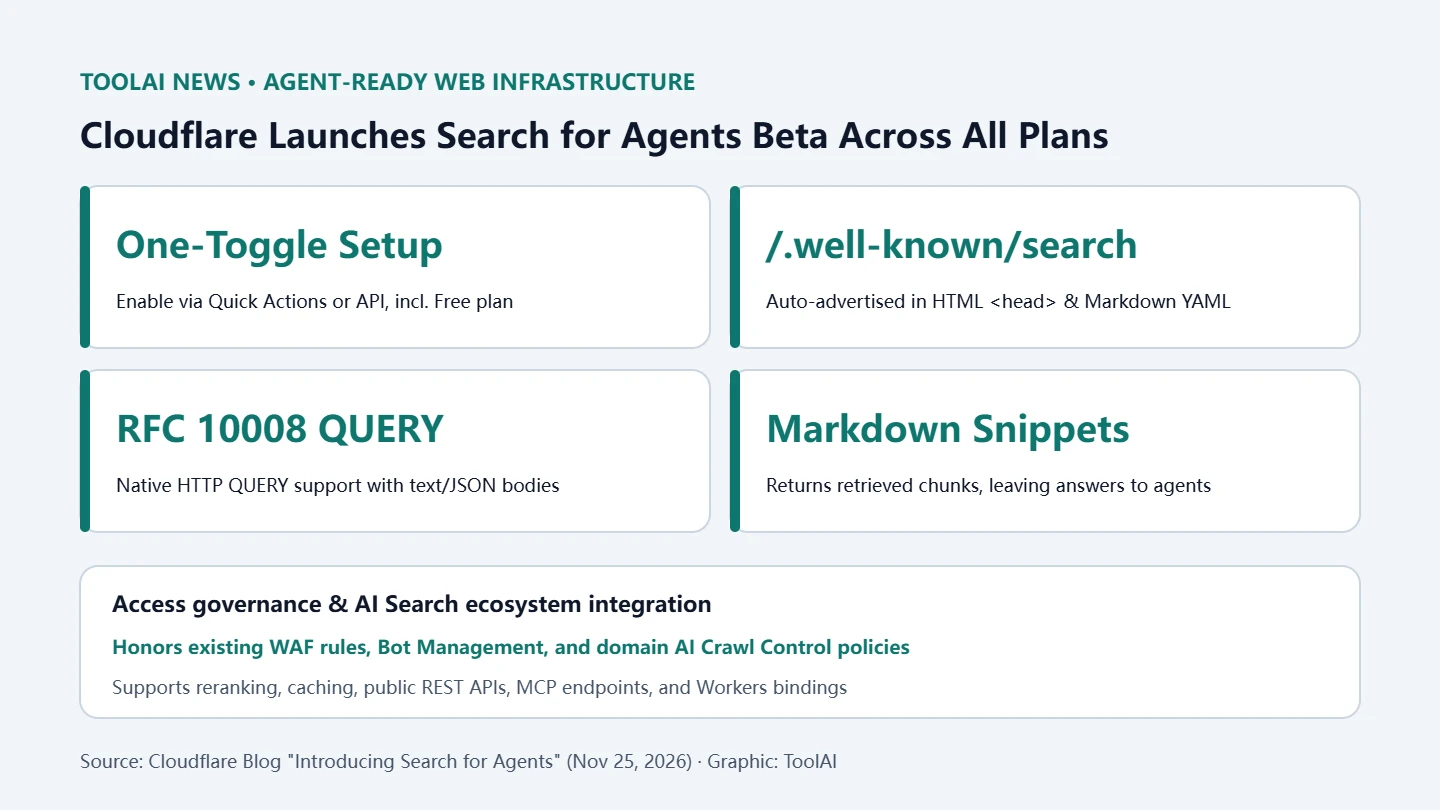
On November 25, 2026, Cloudflare launched Search for Agents in beta, giving website owners a single dashboard toggle under Quick Actions or an API call to index their domain and expose a native search endpoint for AI agents. Available across all customer plans including Free (subject to AI Search pricing and Workers account quotas), the service extends Cloudflare’s earlier Markdown for Agents content-negotiation work by pairing automated crawling with domain-level retrieval APIs.
How .well-known/search and HTML metadata discovery work
Once Search for Agents is switched on for a zone, Cloudflare provisions an AI Search instance automatically, crawls pages under the domain, and exposes an endpoint at https://example.com/.well-known/search?q={query}. Instead of requiring coding agents like Claude, Cursor, or Gemini CLI to scrape dozens of HTML pages iteratively, Cloudflare advertises the endpoint directly inside every page’s HTML <head>:
- Structured HTML discovery tags: Each HTML response includes
agent:instructions,agent:endpoint,agent:method, andagent:documentationmeta tags pointing agents to the domain search URL. If Markdown for Agents is also enabled, requests carryingAccept: text/markdownreceive the exact same discovery block inside YAML front matter. - Markdown snippets without extra LLM generation: The search endpoint returns ranked source chunks formatted as Markdown with relevance scores rather than synthesizing a new answer. Because callers typically run frontier reasoning models such as the Claude family or GPT series, handing back clean retrieved text preserves accuracy and avoids double model inference.
- Native IETF RFC 10008 HTTP QUERY support: Search for Agents supports standard
GETqueries as well as the HTTPQUERYmethod standardized in June 2026 (RFC 10008, coauthored by Cloudflare’s James Snell). Clients such ascurlandundicican transmit plain-text or JSON search payloads in a request body while keeping semantics safe, idempotent, and cacheable.
Access controls and ecosystem options
Turning on agent discovery does not bypass site governance. Every request hitting /.well-known/search continues to obey domain WAF rules, Bot Management, and AI Crawl Control settings. Because the backend runs on a standard AI Search instance, site operators can also turn on reranking, adjust cache rules, expose REST or MCP endpoints, bind retrieval into Cloudflare Workers, or embed the same index for human visitors.
Related pages
Explore coding agents that consume web search endpoints on ToolAI, including Claude, Cursor, and Gemini CLI, or check specifications for Claude and GPT models.