
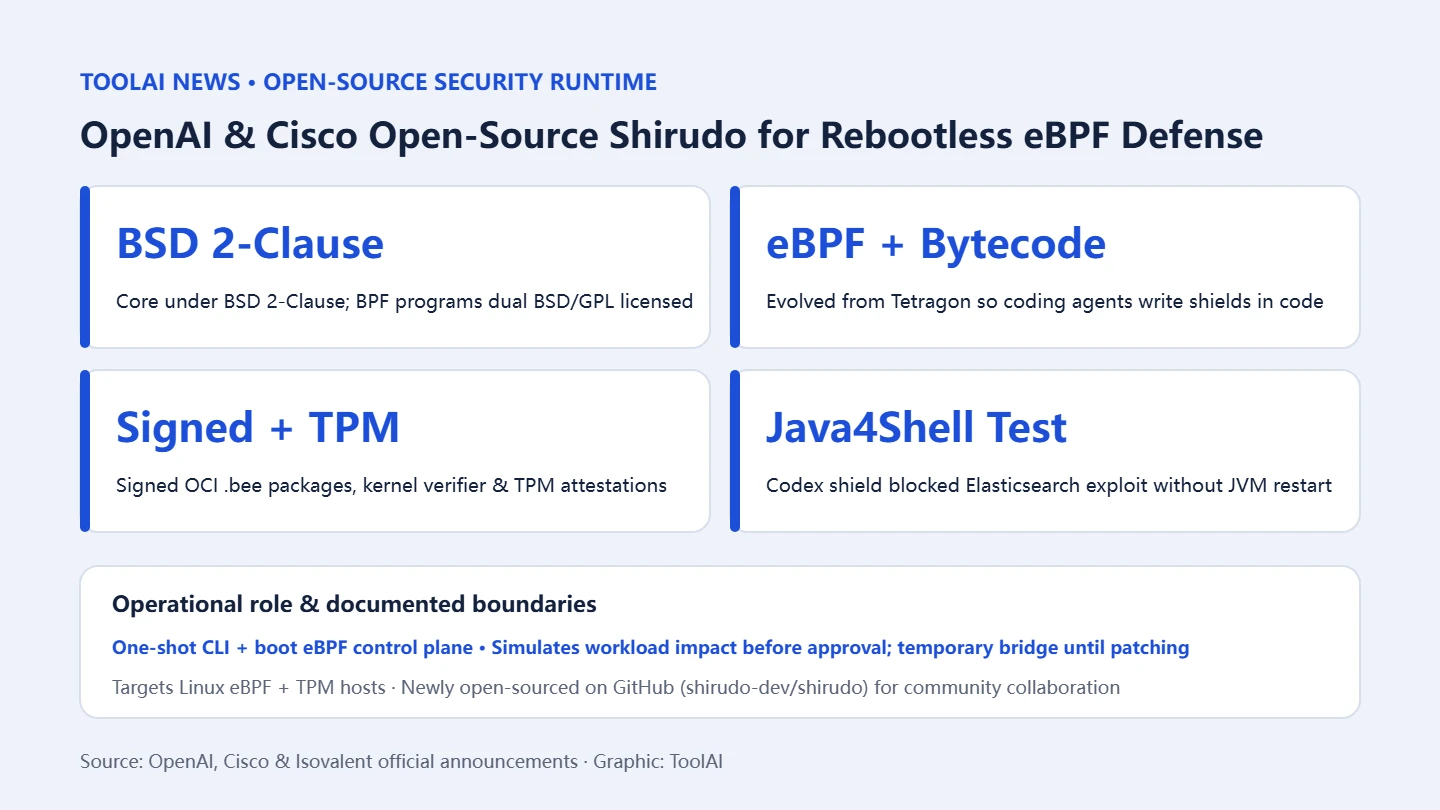
OpenAI and Cisco jointly open-sourced Shirudo on November 23, 2026, a Linux security runtime built to protect live production servers during the gap between vulnerability disclosure and permanent patching. Rooted in Cisco Isovalent’s Tetragon security project (open-sourced in 2022), Shirudo replaces rigid human-centric policy wrappers with a code-native interface so frontier agents such as OpenAI Codex can draft and verify targeted mitigations directly in code.
How Shirudo shields workloads without restarts
- Code-native agent architecture: Shirudo ships as a one-shot CLI paired with a boot-loaded Linux kernel eBPF control plane, avoiding heavy permanent daemons on either operator build hosts or target servers. Instead of parsing static human YAML abstractions, coding agents write small Linux eBPF bytecode guards or runtime bytecode checks directly against vulnerable code paths.
- Signed delivery and TPM attestation: Approved shields are compiled into cryptographically signed
.beepackages and distributed through OCI registries. Before enforcement, target hosts validate package signatures, check safety rules via Linux’s built-in eBPF verifier, and log every active or removed guard in a hardware Trusted Platform Module (TPM) audit trail. - Java4Shell live validation test: To test user-space runtime mitigation, the teams fed Java4Shell disclosure details into an agentic control plane backed by Codex. The agent generated a Java bytecode guard attaching Base64 input validation to
java.util.Base64$Decoder.decode0inside a running Elasticsearch 9.5.5 instance, blocking exploit attempts in logs without restarting the JVM. - Open-source governance: Released on GitHub at
shirudo-dev/shirudoalongside a VM quickstart and Linux Plumbers Conference walkthrough, core runtime code uses the BSD 2-Clause license while BPF components are dual-licensed under BSD and GPL.
Practical role and current constraints
Both partners position Shirudo around a shrinking defender’s window: Cisco notes that recent PHP flaws and Java4Shell were found with AI security tooling and saw active exploit campaigns within a day of disclosure. Teams already running ChatGPT, the GPT model family, or Claude Code can study how code-level shields complement existing vulnerability pipelines. Still, OpenAI and Cisco emphasize clear boundaries: temporary shields never substitute for permanent vendor patches, operators must simulate workload impact and sign off manually to avoid false-positive outages when exploits share paths with legitimate requests, and current tooling focuses on Linux servers equipped with eBPF and TPM support rather than acting as a turnkey commercial product.
Related tools
Read more about OpenAI Codex, OpenAI, ChatGPT, and the GPT model series.
Sources: OpenAI: Introducing Shirudo · Isovalent Technical Post · Cisco Security Blog