
Picking a budget API endpoint just got noisier. In a November 10 interview with Deirdre Bosa, OpenAI CFO Sarah Friar said the company's lightweight Luna model costs roughly one-fifth to one-sixth as much to call as Chinese open-weight rivals, dismissing the idea that Chinese models are cheaper as one of the myths of 2026. She added that cutting Luna's price by around 80% two weeks after launch drove a 10-fold surge in usage.
Do not swap endpoints on a soundbite alone. Look at the actual rate cards first. Cross-checking OpenAI's official API pricing, DeepSeek's pricing docs, and Nadir's November 2026 rate-card comparison yields a split verdict: Luna undercuts Chinese open-weight models served on third-party cloud layers by several multiples, yet against first-party budget endpoints and heavy prompt caching, that five-to-six-times gap vanishes.
Where the 5x Gap Holds -- and Where It Breaks
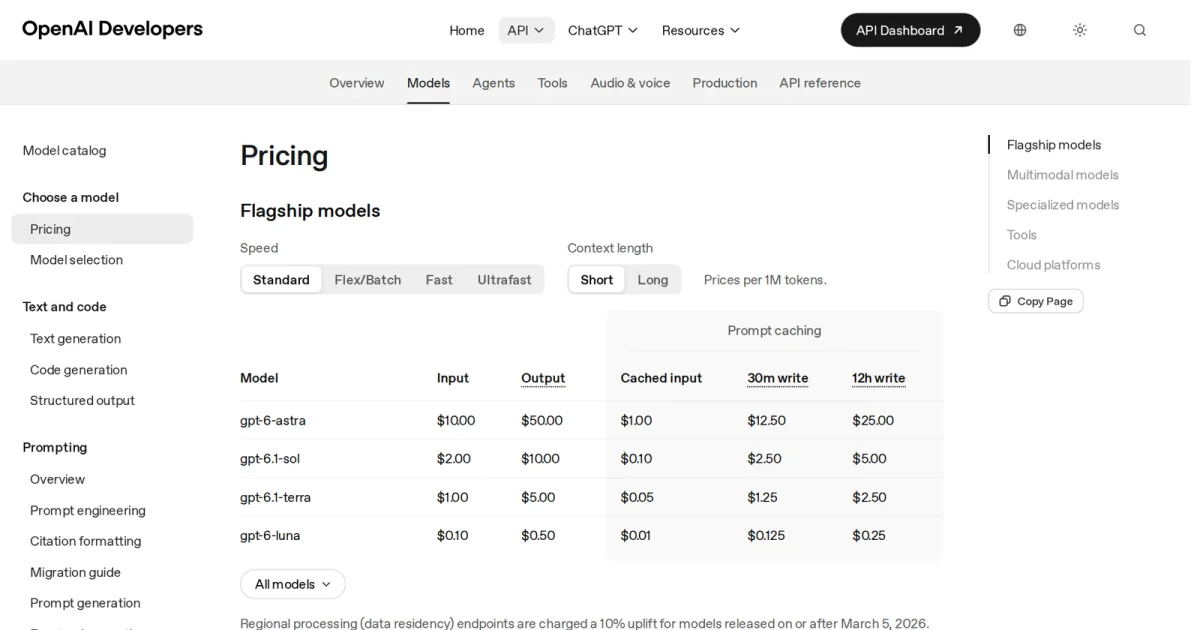
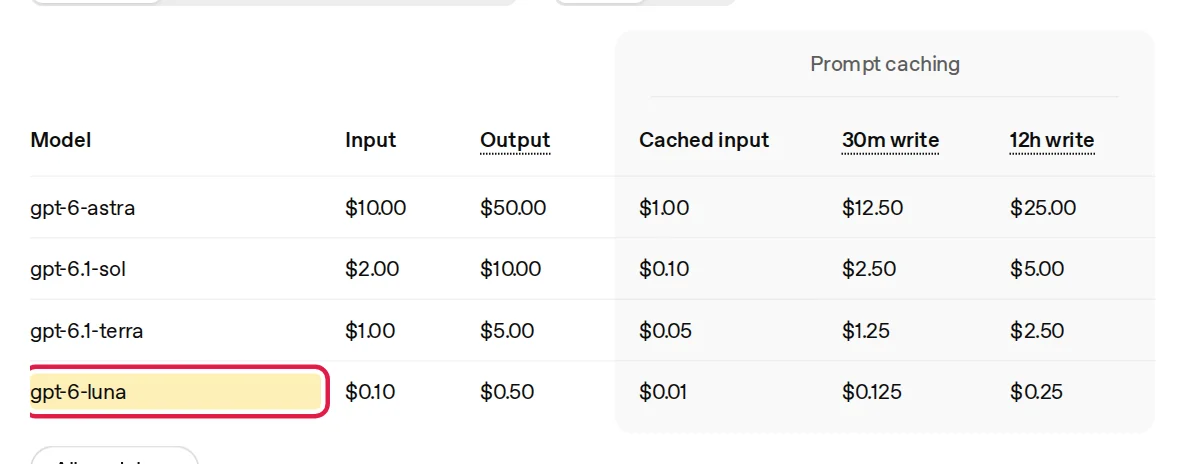
On OpenAI's standard table, gpt-6-luna costs $0.10 per 1M input tokens, $0.01 for cached input, and $0.50 per 1M output tokens, alongside prompt-cache write fees of $0.125 (30-minute TTL) and $0.25 (12-hour TTL). Batch and Flex cut every number in half to $0.05 input, $0.005 cached input, and $0.25 output. Fast mode -- renamed from Priority Processing on July 30 -- doubles standard pricing to $0.20, $0.02, and $1.00, while regional data-residency and FedRAMP endpoints add a 10% uplift for models released on or after March 5, 2026. Unlike flagship GPT-6 Astra, Luna still allows reasoning_effort to stay at none, keeping simple classification jobs from burning extra reasoning tokens.
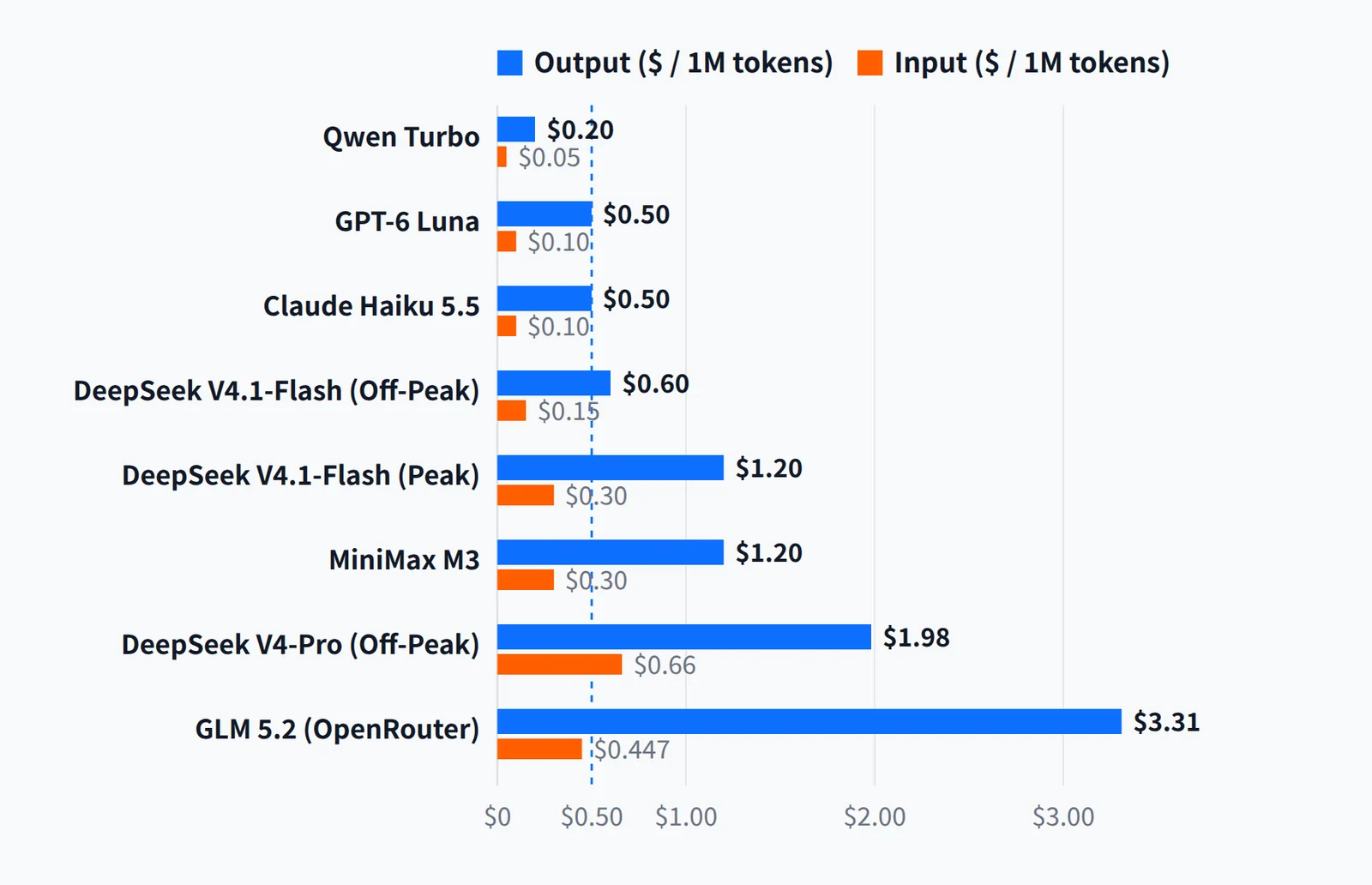
Friar's ratio checks out when you benchmark Luna against cloud-hosted open weights or higher-tier models. At Goldman Sachs' conference in September, Quartz reported that Friar specifically compared deploying Luna against Z.ai's GLM 5.3 on a cloud layer. Nadir's OpenRouter weighted average across hosts puts GLM 5.2 at $0.447 input and $3.31 output per 1M tokens. Against GLM 5.2, Moonshot's Kimi K2.6 ($0.95 / $4.00), MiniMax M3 ($0.30 / $1.20, with thinking billed as output), or DeepSeek V4-Pro off-peak ($0.66 / $1.98), GPT-6 Luna (which replaced GPT-5.6 Luna at $0.20 / $1.20 on September 22) really does land near a fifth to a sixth of the price.
Against Chinese vendors' own entry tiers, the math flips fast. DeepSeek's lightweight deepseek-flash (DeepSeek-V4.1-Flash) bills $0.15 input and $0.60 output during off-peak hours -- close to Luna, nowhere near five times pricier. Better still for agents with static system prompts, DeepSeek's off-peak cache hit rate is $0.003 per 1M tokens, beating Luna's $0.01 cached rate. Meanwhile, Alibaba's Qwen Turbo lists at $0.05 input and $0.20 output in Nadir's catalog, and Groq hosts open-weight GPT-OSS 20B at $0.075 / $0.30 alongside GPT-OSS 120B at $0.15 / $0.60.
Three Billing Cliffs That Double Your Real Invoice
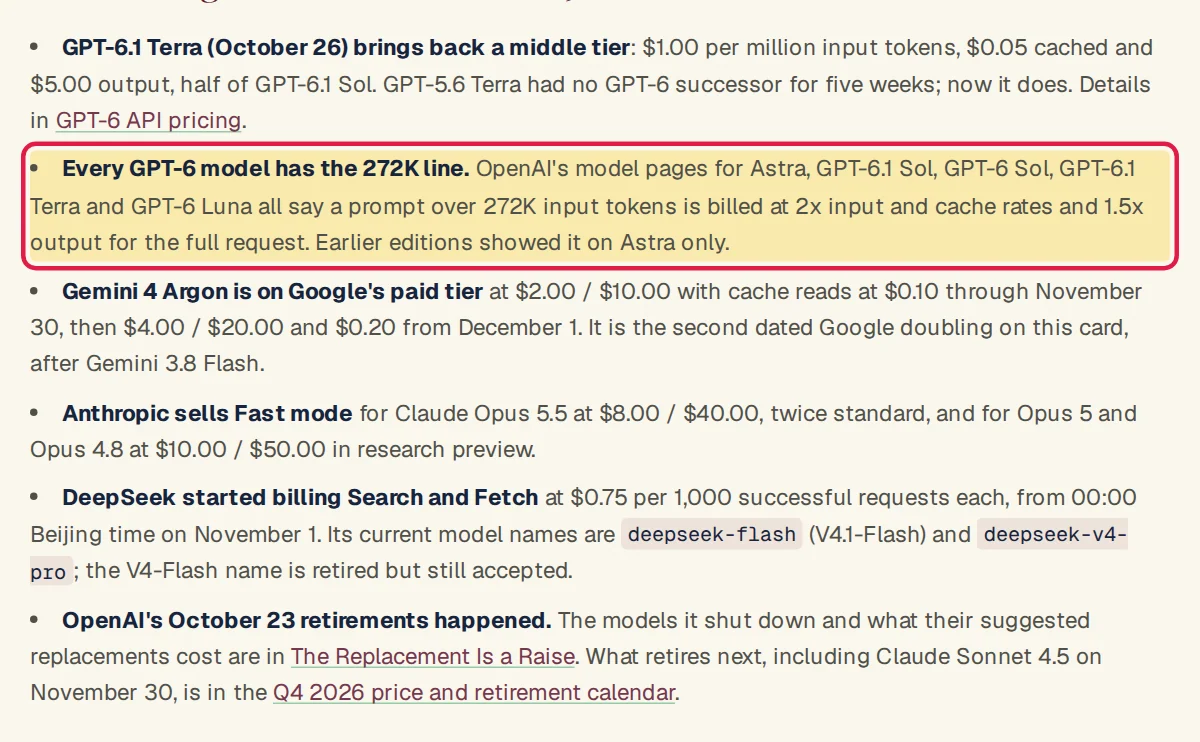
Sticker rates rarely match monthly bills once hidden triggers kick in. First comes OpenAI's prompt-length cliff. Nadir's review of OpenAI's model pages found that every GPT-6 model -- including GPT-6 Luna, despite its 1.05M context window and 128K output cap -- enforces a 272K input-token cutoff. Cross 272K input tokens and the entire request reprices at 2x input and cache rates plus 1.5x output rates, including the tokens before the threshold.
Anthropic's closest rival cuts even deeper. Claude Haiku 5.5 launched on October 7 at the same $0.10 / $0.50 sticker and $0.01 cache read, yet any request above 100K tokens -- counting cache reads and writes -- pays 5x on every token ($0.50 input / $2.50 output). DeepSeek V4.1-Flash skips long-context cliffs altogether, yet it retired flat pricing on August 16 in favor of a daily clock.
Under DeepSeek's rules, Peak Hours run Monday through Friday from 01:00 to 04:00 and 06:00 to 10:00 UTC (09:00 to 12:00 and 14:00 to 18:00 Beijing Time). During those seven weekday hours, deepseek-flash doubles to $0.30 input, $0.006 cache hit, and $1.20 output, while DeepSeek V4-Pro climbs from $0.66 / $1.98 to $1.32 input, $0.044 cache hit, and $3.96 output. DeepSeek also started billing Search and Fetch separately on November 1 at $0.75 per 1,000 successful requests each. Route uncached Asian business-hour traffic to DeepSeek, and the invoice jumps well past Luna.
Four Checks Before Switching Endpoints
Check your real traffic before changing providers:
- Prompt size distribution: Long document extraction jobs and full-repo coding prompts easily cross 100K or 272K tokens, triggering 5x surcharges on Haiku 5.5 or 2x/1.5x billing on GPT-6 Luna.
- Traffic time zones: US and European overnight batch runs hit DeepSeek's $0.15 / $0.60 off-peak floor, whereas daytime Asian synchronous calls pay Peak rates unless shifted to OpenAI's 50%-off Batch tier.
- Cache hit and write ratio: High-repetition prefixes maximize DeepSeek's $0.003 off-peak cache hit; write-heavy or uncached pipelines should weigh Luna's $0.125 (30m) and $0.25 (12h) cache writes or Qwen Turbo's $0.05 / $0.20 list rate.
- Built-in tool and sandbox fees: DeepSeek charges $0.75 per 1,000 successful Search or Fetch calls, while OpenAI bills $10.00 per 1,000 Web search calls (plus content tokens), $2.50 per 1,000 File search calls (plus $0.10 per GB-day after 1 GB free), and $0.03 to $1.92 per 20-minute Hosted Shell or Code Interpreter container session depending on memory size (1 GB to 64 GB).
Replay one week of production logs against token lengths, cache hit percentages, UTC timestamps, and tool calls. That spreadsheet beats any executive quote.