
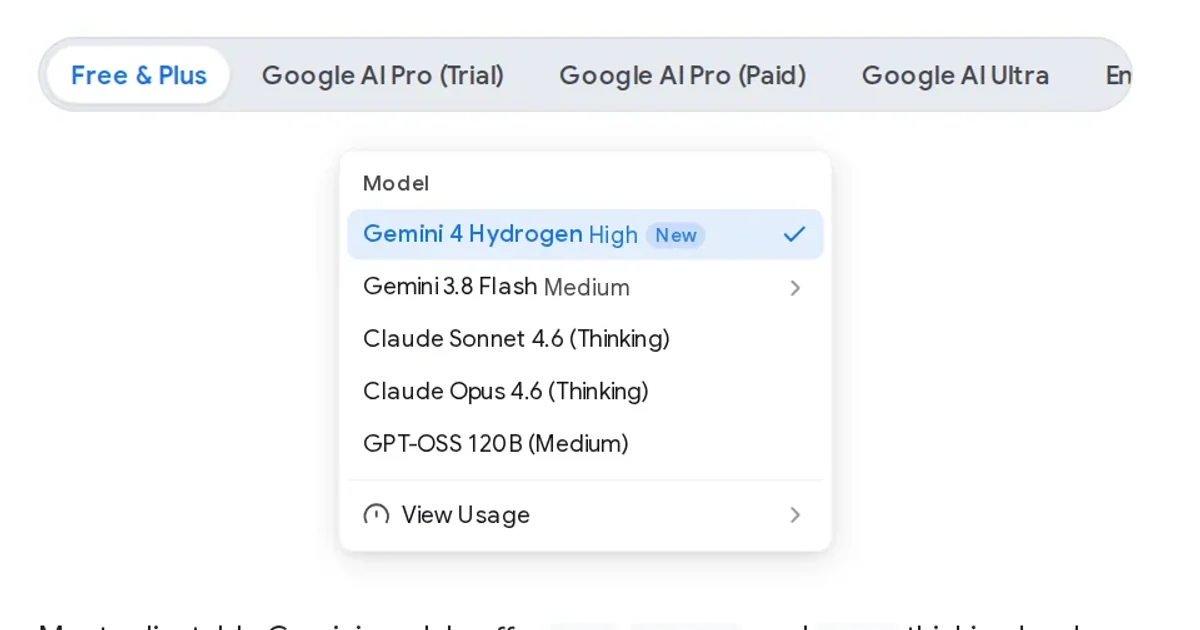
If you have opened the model menu in Google Antigravity this week, you may have spotted the countdown warning on GPT-OSS 120B (Medium). On November 18, 2026, that open-weight model is coming out of the selector, and it is not leaving by itself. Check the asterisks in Antigravity's Choose a model documentation and you will see that Claude Sonnet 4.6 (thinking) and Claude Opus 4.6 (thinking) share the exact same November 18 cutoff. Three third-party options are disappearing together.
Users actually received a short extension before the final drop. According to a November 11 response on the Google AI Developers Forum, the Antigravity team originally scheduled the removal for November 2, 2026 before pushing it back to November 18 across Free, Google AI Plus, Google AI Pro, and Google AI Ultra plans in every supported region. No automatic fallback migration is being pushed to your settings, so anyone relying on those three models needs to update workflows manually ahead of November 18.
Check your plan first: trial accounts face the steepest cut
Even though every individual tier sees the same calendar date, what remains in your dropdown after November 18 varies sharply by subscription. Look row by row at the official reasoning model table: Free and Google AI Plus accounts currently have 5 reasoning choices, and 3 of them are marked for removal. Once GPT-OSS-120b, Claude Sonnet 4.6, and Claude Opus 4.6 are gone, Free and Plus accounts retain only Gemini 4 Hydrogen and Gemini 3.8 Flash, leaving zero third-party models.
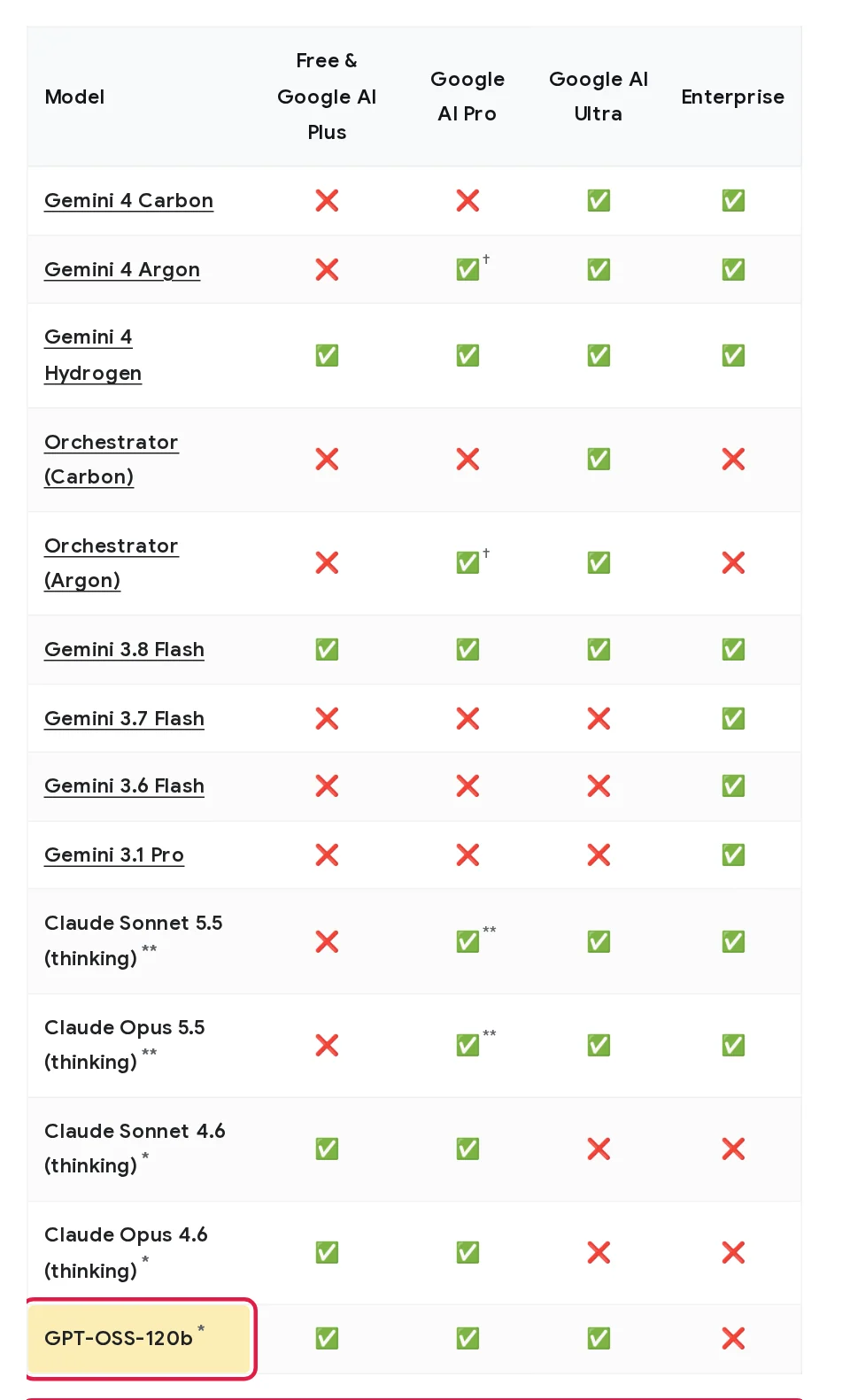
Google AI Pro trial subscribers sit in an easy-to-miss trap. At a quick glance, the Pro column shows green checkmarks next to Claude Sonnet 5.5 (thinking) and Claude Opus 5.5 (thinking), which makes it look like an easy upgrade path. Read the double-asterisk footnote below the table, however, and you will notice those two Anthropic models are restricted strictly to non-trial paid Google AI Pro plans—the docs even link to a request form to cancel your trial early and switch to paid billing. Meanwhile, Gemini 4 Argon and Orchestrator (Argon) only unlock on paid Pro or trials tied to eligible premium devices. On a standard Pro trial, November 18 leaves you in nearly the same position as a Free user.
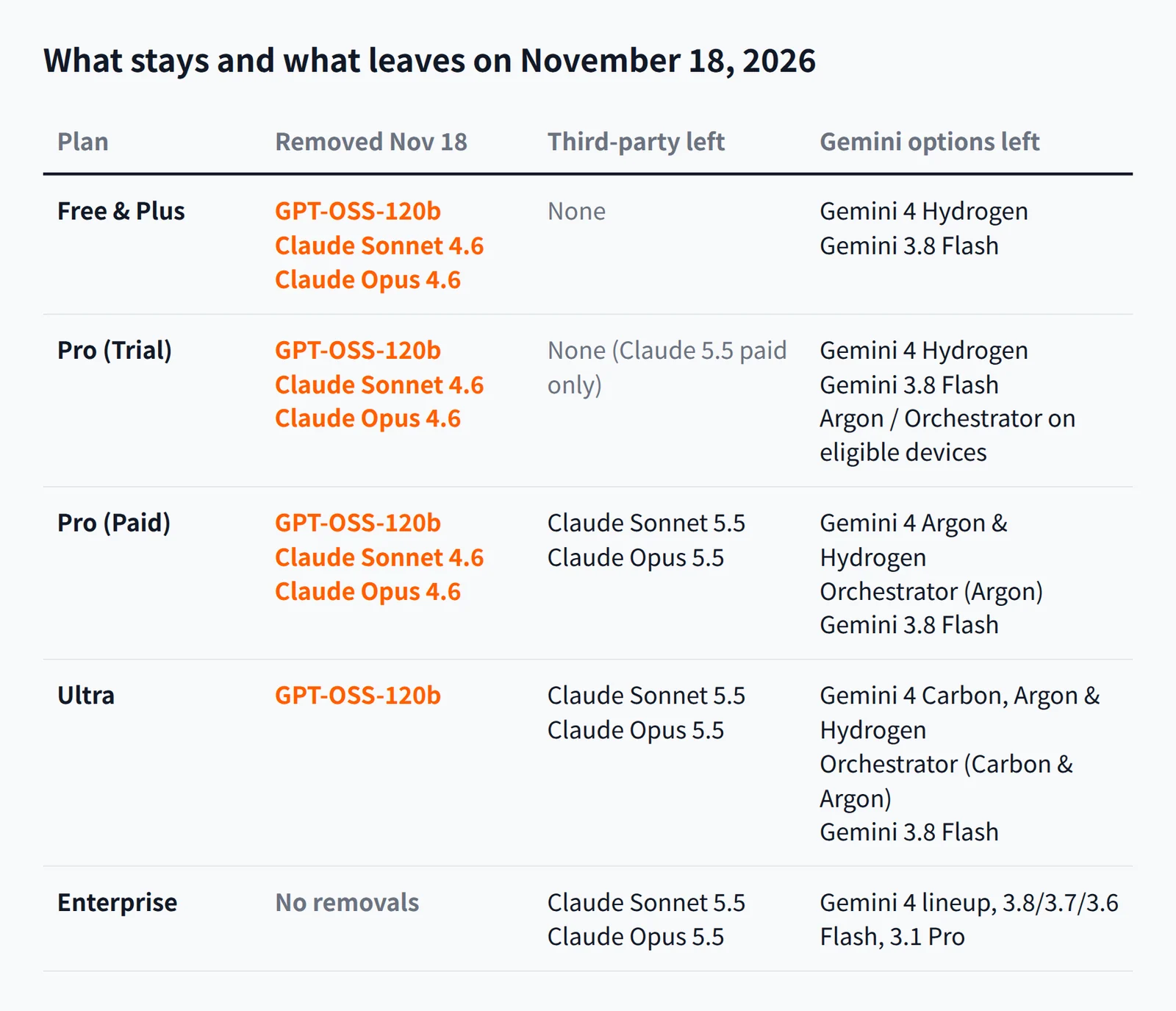
Paid Google AI Pro subscribers keep Claude Sonnet 5.5 and Claude Opus 5.5, plus Gemini 4 Argon, Gemini 4 Hydrogen, Orchestrator (Argon), and Gemini 3.8 Flash. Google AI Ultra never carried the Claude 4.6 models in the first place, so Ultra users only lose GPT-OSS-120b while keeping flagship Gemini 4 Carbon, Orchestrator (Carbon), and Claude 5.5. Gemini Enterprise uses a separate administrator-managed model catalog where none of the three retiring models were offered, so enterprise developers will not notice a difference.
Quota pools, billing switches, and mid-turn model locks
For many developers, keeping GPT-OSS 120B (Medium) in rotation was less about raw accuracy and more about quota management. In the View Usage panel documented on the models page, Antigravity splits rate limits into two separate buckets: Gemini Models and Claude and GPT models, each displaying independent five-hour and weekly remaining percentages.
Once November 18 arrives, Free, Plus, and standard Pro trial accounts have no remaining models inside that second quota pool. Can you plug in your own API key or local endpoint to keep using an open-weight model inside Antigravity? No. Antigravity's Plans documentation explicitly rules out bring-your-own-key (BYOK) and bring-your-own-endpoint setups for extra rate limits, and notes there are no custom organizational contract tiers either. Paid Pro and Ultra subscribers can still rely on Claude 5.5 inside the second bucket, or adjust their AI Credit Overages setting if they hit baseline ceilings: setting it to Never pauses usage until the five-hour or weekly window resets, while Always automatically draws down purchased or promotional AI credits at standard Gemini Enterprise consumption rates and switches back once the baseline quota refreshes.
There is also one session behavior worth keeping in mind while testing replacements. Your chosen model persists across messages inside a conversation, and changing the model while the agent is actively executing a turn will not interrupt the current step—the agent finishes that turn on the previously selected model unless you cancel the run first. When comparing outputs between GPT-OSS 120B and a Gemini replacement, either wait for the turn to settle or start a fresh conversation.
How to migrate in Antigravity App, IDE, and CLI before Nov 18
The timing of the November 18 cutoff lines up directly with Google's newest releases. Per the Antigravity Changelog, Google rolled out Gemini 4 Carbon on November 10 (adding Google Cloud application default credential support in v2.31.2 on November 11) and launched Gemini 4 Hydrogen alongside Orchestrator on November 12. If you used GPT-OSS 120B (Medium) for fast coding edits or routine agent tasks, follow these four steps to move cleanly before the deadline.
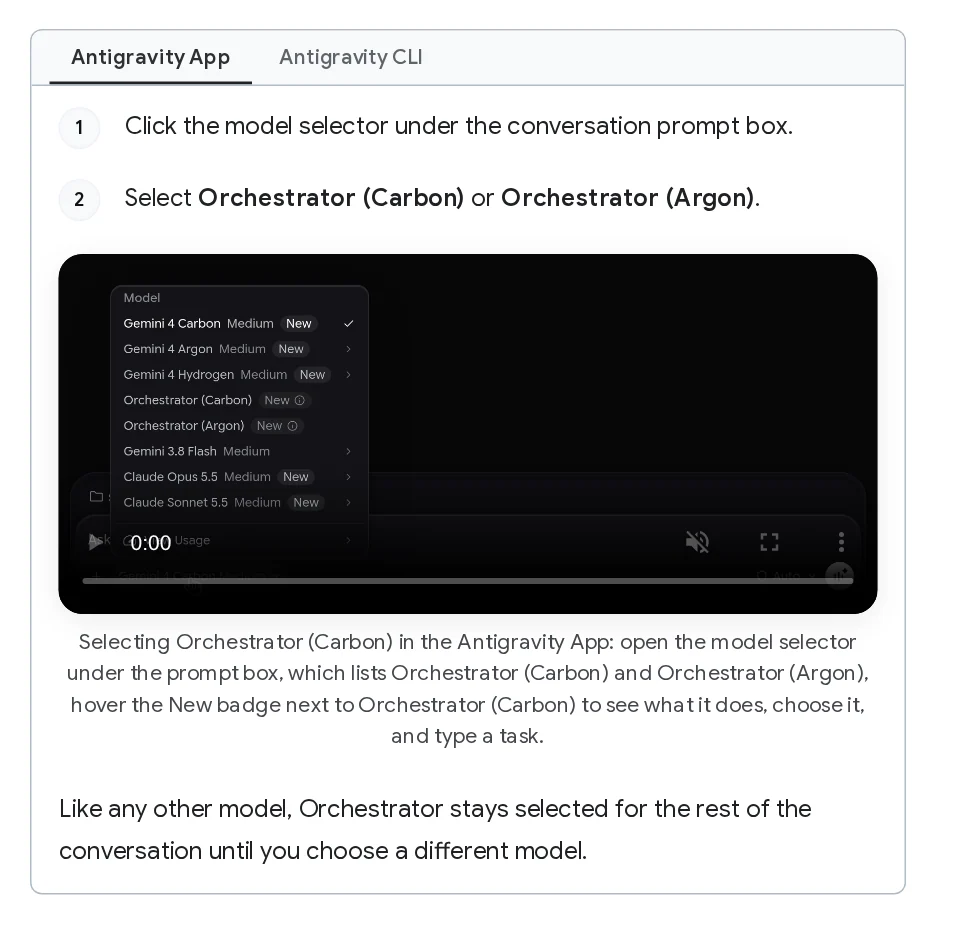
- Move everyday coding and quick tasks to
Gemini 4 Hydrogen: Available across every plan including Free, it defaults toHighthinking and exposesLow,Medium,High, andExtrain the selector. Drop toLoworMediumfor boilerplate edits and unit tests, or pass--model gemini-4-hydrogen-xhighor--effort xhighin the Antigravity CLI when a debugging task needs maximum reasoning depth. - Route multi-file features on paid Pro or Ultra through
Orchestrator: SelectingOrchestrator (Carbon)orOrchestrator (Argon)pairs a read-only planner withGemini 4 Hydrogenfor edits, builds, and test verification inside a single turn. Remember that Orchestrator runs a fixed configuration, so running/effortor passing--effortin the CLI will return an error stating effort is not adjustable for it. - Verify CLI flags and headless scripts with
agy models: Runagy modelsin your terminal to list every valid identifier on your account, switch interactively via/model, and update any saved startup commands such asagy --model "Orchestrator (Carbon)"or headless calls usingagy -pso automated jobs do not break on November 18. - Update to
v2.32.0if your model menu stalls: If newly released Gemini 4 entries fail to appear while third-party options rotate out, the November 13v2.32.0update expands the selector to fit screen height and adds a Refresh button whenever models fail to load.
Before November 18 hits, take one representative coding or refactoring prompt from your backlog and run it through Gemini 4 Hydrogen at Medium and High, then double-check your AI Credit Overages setting in Settings so there are no surprises once the old models vanish.