
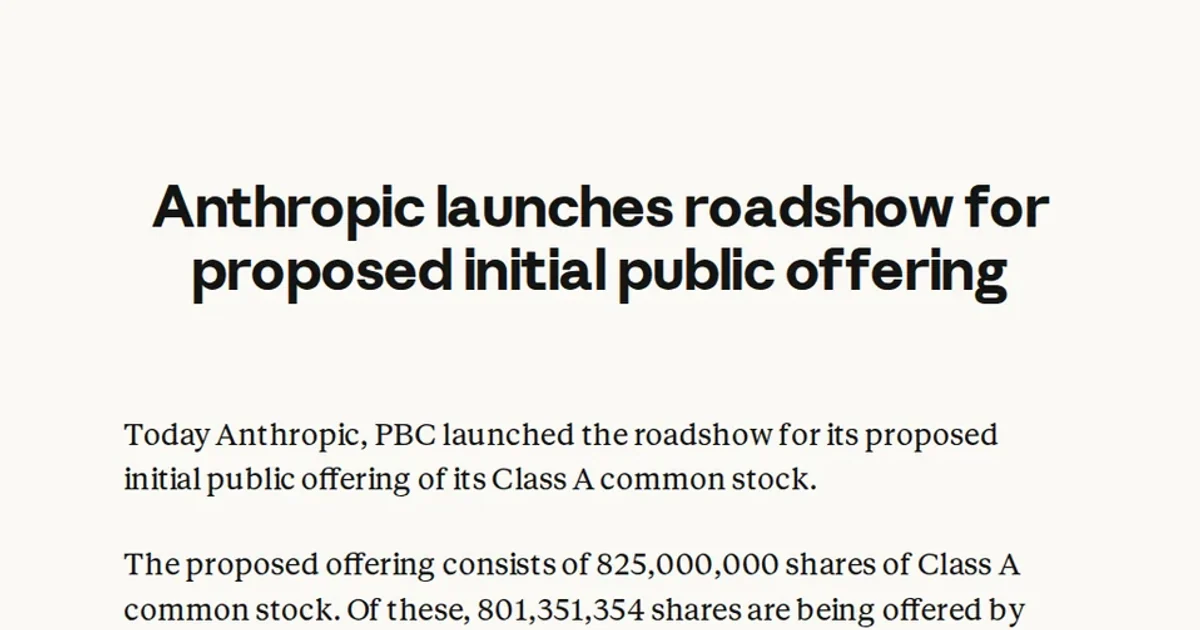
If your team builds on the Claude API or runs daily workflows through Claude Code, next week's Nasdaq listing matters far more for your compute budget and release reliability than most model announcements. According to a Nasdaq Trader technical notice and Anthropic's roadshow announcement, the company expects to price its IPO on Nov. 18, 2026, and begin trading on the Nasdaq Global Select Market on Nov. 19 under the ticker ANT.
In Amendment No. 2 to its Form S-1 filed with the SEC on Nov. 10, Anthropic laid out the concrete offering terms: 825,000,000 Class A shares—801,351,354 sold by the company and 23,648,646 by existing stockholders—marketed at $70.00 to $78.00 per share, with a 30-day underwriter option for up to 123,750,000 additional shares.
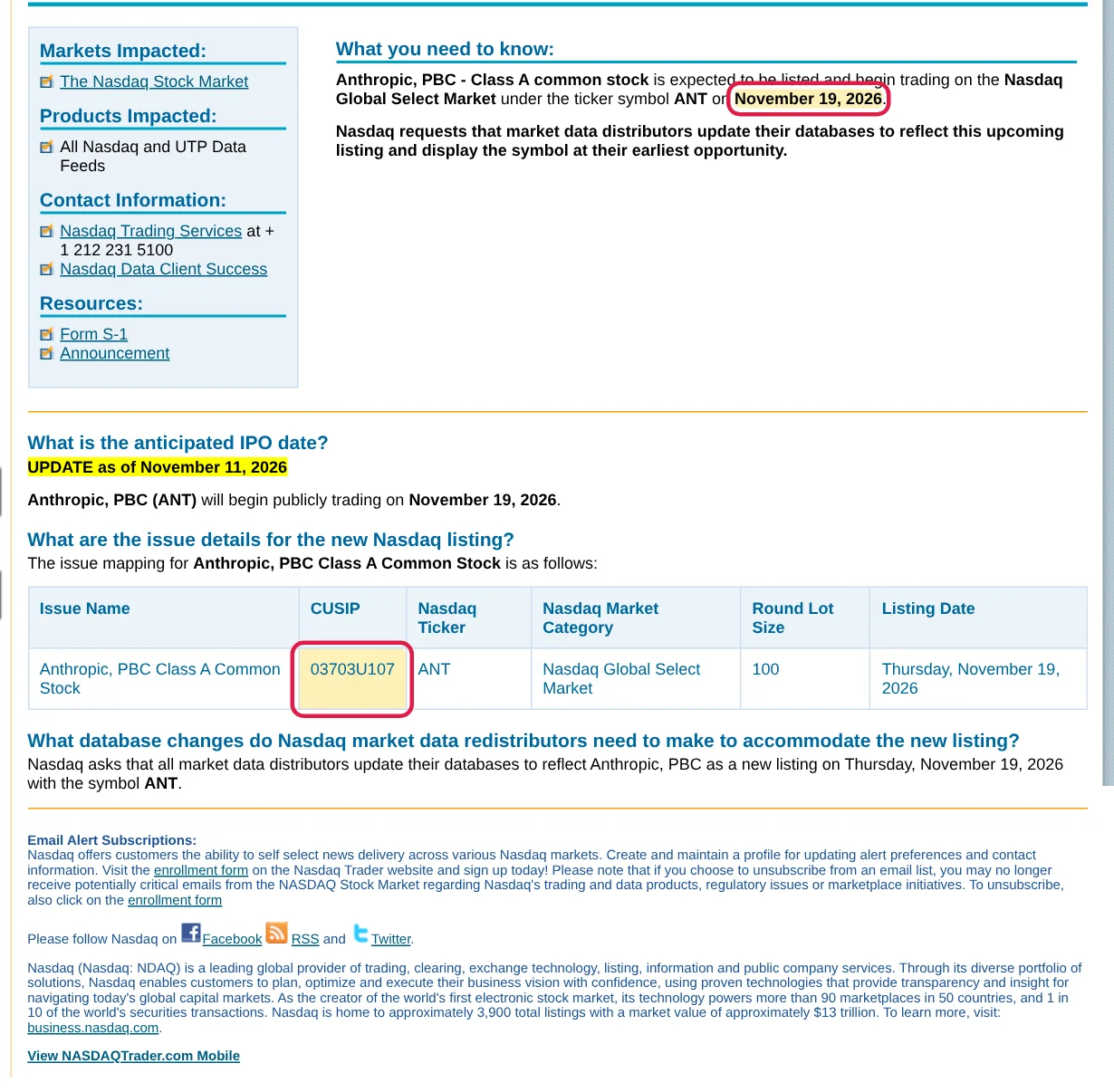
Two-Track Capital Raise Ahead of Nov. 19
At the $78.00 top of the range, the public offering raises up to $64.35B (often rounded to $64.4B), implying roughly $1 trillion in basic market value or about $1.4 trillion on a fully diluted basis, The Next Web reported, citing Reuters. On top of that, Anthropic signed a concurrent $26.0B private placement, pushing total potential proceeds to $90.4B.
The $26.0B Class N non-voting shares are not going to passive index funds. They are split among seven companies that supply Anthropic's silicon and cloud capacity: AMD, Broadcom, Google, Micron, Microsoft, NVIDIA, and TSMC. The filing notes that this private placement carries no underwriting fees and no underwriter lock-up, though the shares remain restricted securities.
Combine that with the $131.7B in cash and short-term investments Anthropic held as of June 30, per Commons Capital's S-1 breakdown, and short-term liquidity is clearly not a bottleneck for inference capacity. The real pressure sits in the long-term infrastructure ledger and competitive pricing disclosures.
$17.0B Quarterly Revenue Meets a $900.9B Compute Tab
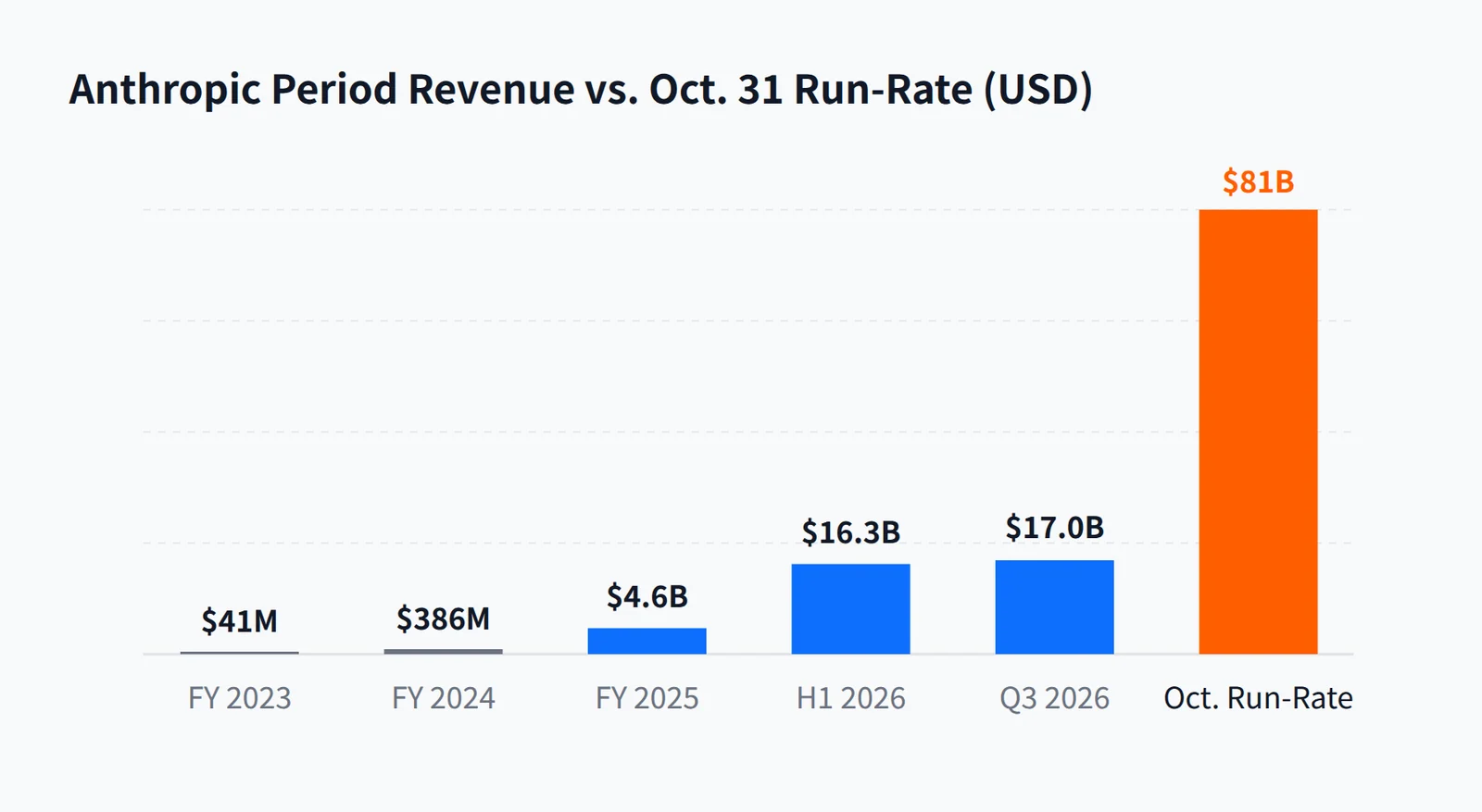
Anthropic's top line has scaled at a remarkable clip: from $41M in full-year 2023 and $386M in 2024 to $4.6B in 2025, then $16.3B in the first half of 2026—roughly 14 times the $1.2B posted in H1 2025. Third-quarter 2026 revenue reached $17.0B ($16.96B in Global Finance's snapshot), more than 12 times the year-earlier quarter, while run-rate revenue hit roughly $81B as of Oct. 31.
Headline GAAP losses look alarming until you separate accounting adjustments from operations. Anthropic posted an $80.7B net loss in H1 2026 and a $23.3B net loss in Q3, largely driven by non-cash revaluations on convertible notes as its valuation climbed—$72.4B of the H1 loss came from that revaluation alone. On an operating basis, Q3 posted an operating loss of $567M—contrasting with a second-quarter operating profit noted by Global Finance—while MLQ.ai reported an adjusted operating margin of 15%.
What should catch every API buyer's eye is the commitment schedule: $900.9B (about $901B) in cloud, chip, and data center obligations extending as far out as 2045. Enterprise demand is doing the heavy lifting right now—as of Sept. 30, Anthropic counted more than 11,900 customers spending $100,000+ over the trailing twelve months, over 1,900 spending $1M+, and about 250 at $10M+.
Yet the S-1 risk section includes two candid warnings for builders. First, revenue relies heavily on a concentrated set of large customers and cloud distribution partners. Second, Anthropic explicitly warns that open-weight models could exert pricing pressure on its offerings, even as it pitches Claude Code as the blueprint for reaching over a billion knowledge workers. In practical terms, Anthropic cannot easily hike token prices to pay down $900.9B in compute contracts; expect it to push higher-tier team plans and agentic workflows instead.
Public Buyers Get No Steering Wheel—And Safety Delays Are Written In
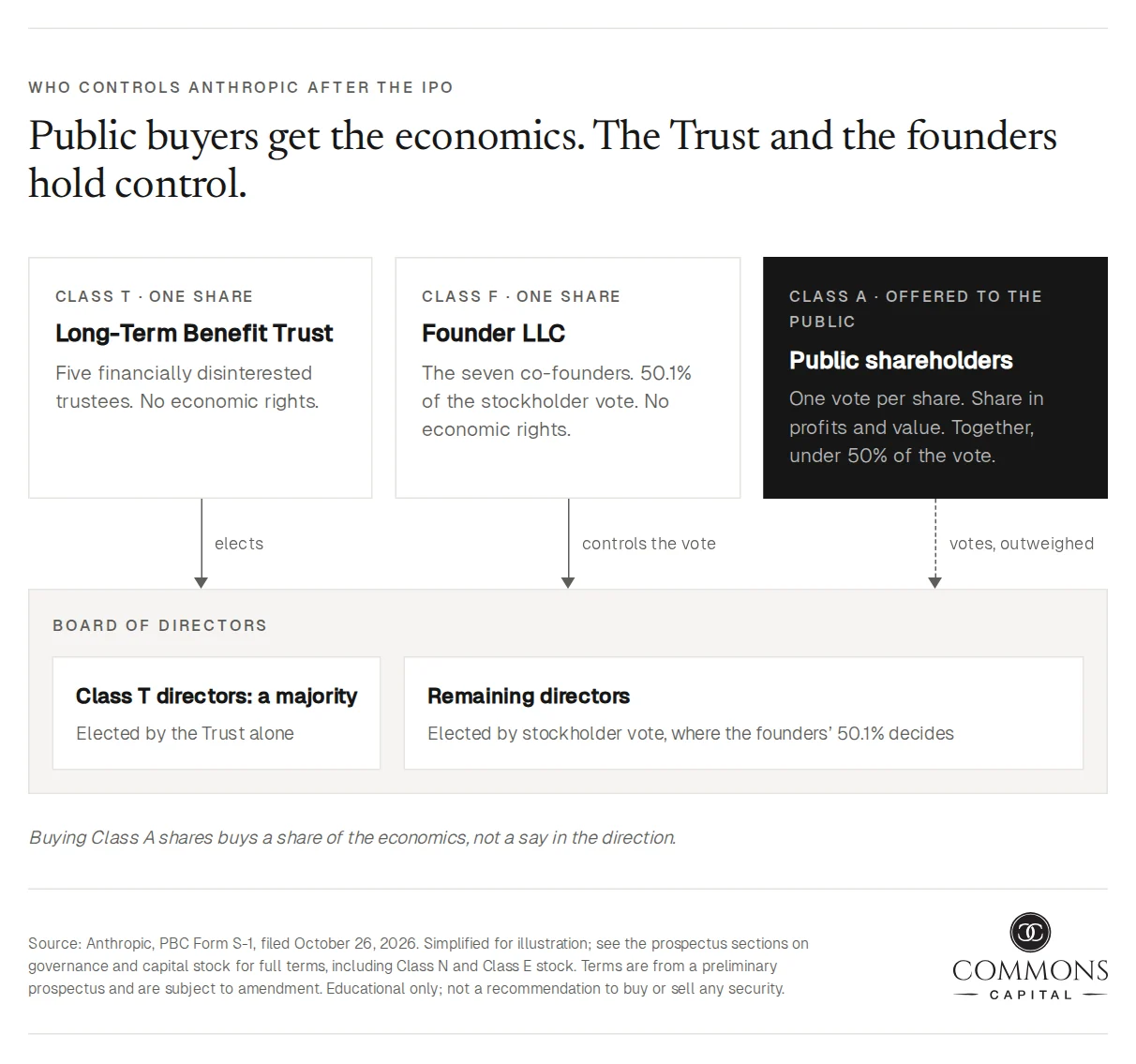
Keeping voting control with the Long-Term Benefit Trust (LTBT) and co-founders means safety reviews can override commercial release schedules even after the IPO. Incorporated as a Delaware Public Benefit Corporation, Anthropic keeps board authority out of public hands. Its five-trustee LTBT holds one Class T share with power to elect and remove a board majority, while the seven co-founders hold a single Class F share carrying 50.1% of general stockholder votes. Class A shares sold in the IPO carry at most 49.9% of voting power.
For engineering teams running production agents on Claude, one S-1 risk disclosure stands out: Anthropic states in writing that it has previously delayed model releases for safety reasons and may do so again, even if rivals move faster. It also warns that contracts and insurance may not cover liabilities from unintended model behavior. Going public will not turn Anthropic into a rigid quarterly-release vendor if safety reviews stall a frontier launch.
Three Practical Checks Before ANT Starts Trading
- Audit team seats and agentic usage: Because open-weight pressure limits straight API price hikes, expect Anthropic to lean harder on Claude Code workflows and higher-tier enterprise plans—review actual token burn against seat costs before renewing.
- Keep fallback routing in production: Because the S-1/A flags potential safety-driven release delays alongside open-weight price competition, maintain tested failover adapters for critical coding and agent pipelines.
- Compare direct API vs. cloud-hosted quotas: With Google and Microsoft participating in the $26.0B private placement while selling cloud capacity—and Amazon serving as a major compute partner—check rate limits, quotas, and enterprise contract terms across direct API billing and major cloud partner channels before locking annual commits.