

If you run CUDA workloads, have GPUs on order or rent Nvidia cloud capacity, here is the short version: Stephen Witt's New York Times opinion essay tearing into Jensen Huang is not, on its own, a reason to alter procurement or deployment plans. Reassess only if actual delivery schedules, contract terms or product roadmaps change. The nearest hard checkpoint is Nov. 17. Nvidia says it will report third-quarter results that day at approximately 1:20 p.m. PT, as previously scheduled, with the earnings call at 2 p.m. PT.
The essay has already appeared in Chinese translation and drawn commentary across tech media and social feeds. It is a signed opinion piece, not an investigation, and it reports no new change in anyone's job. Nvidia had already announced the leadership change itself.
What to check on Nov. 17 and with your suppliers
In Nvidia's investor relations release, new board chair Harvey C. Jones said the board expects operations, customer commitments and the product roadmap "to continue without interruption." He also pointed to an experienced leadership team behind Kress that has been advancing the technology roadmap. That is an expectation, not a contract term. Still, it is on the record, and the earnings call is a scheduled public test of it.
Listen for three things on the call: whether management reaffirms shipment timing for announced products, whether anyone flags delivery delays or supply bottlenecks, and how Kress, speaking as both interim CEO and CFO, fields questions on roadmap execution and customer commitments. If you have specific parts on order, check directly with your supplier, OEM or cloud account manager right after the call to confirm your delivery window and service-level commitments have not shifted.
Two operational threads in Al Jazeera's reporting are also worth tracking if you depend on specific regions or neocloud capacity. Nvidia is not only a chip supplier but also an investor in companies that build and rent out AI computing infrastructure, and it is preparing to invest approximately $10bn in Anthropic. At the same time, US lawmakers are looking into potential national security implications around Huang's reported relationships amid ongoing debate over AI chip exports. For buyers, those two fronts matter far more than personality commentary.
What Nvidia confirmed, and what it did not
The release and the copy filed with the SEC as Exhibit 99.1 are plain. Huang resigned as president, CEO and board member, effective immediately. CFO Colette Kress "has agreed to serve as Interim Chief Executive Officer" and stays CFO until a permanent successor is named. Kress has served as CFO since September 2013, and Jones, now the company's first-ever board chair, previously served as CEO and executive chairman of Synopsys. The board is searching for a permanent CEO and will consider internal and external candidates.
On personality, private conduct and company culture, the filing says nothing. Do not treat adjectives from an opinion column as official Nvidia disclosures.
What the essay argues, and why it does not touch today's shipments
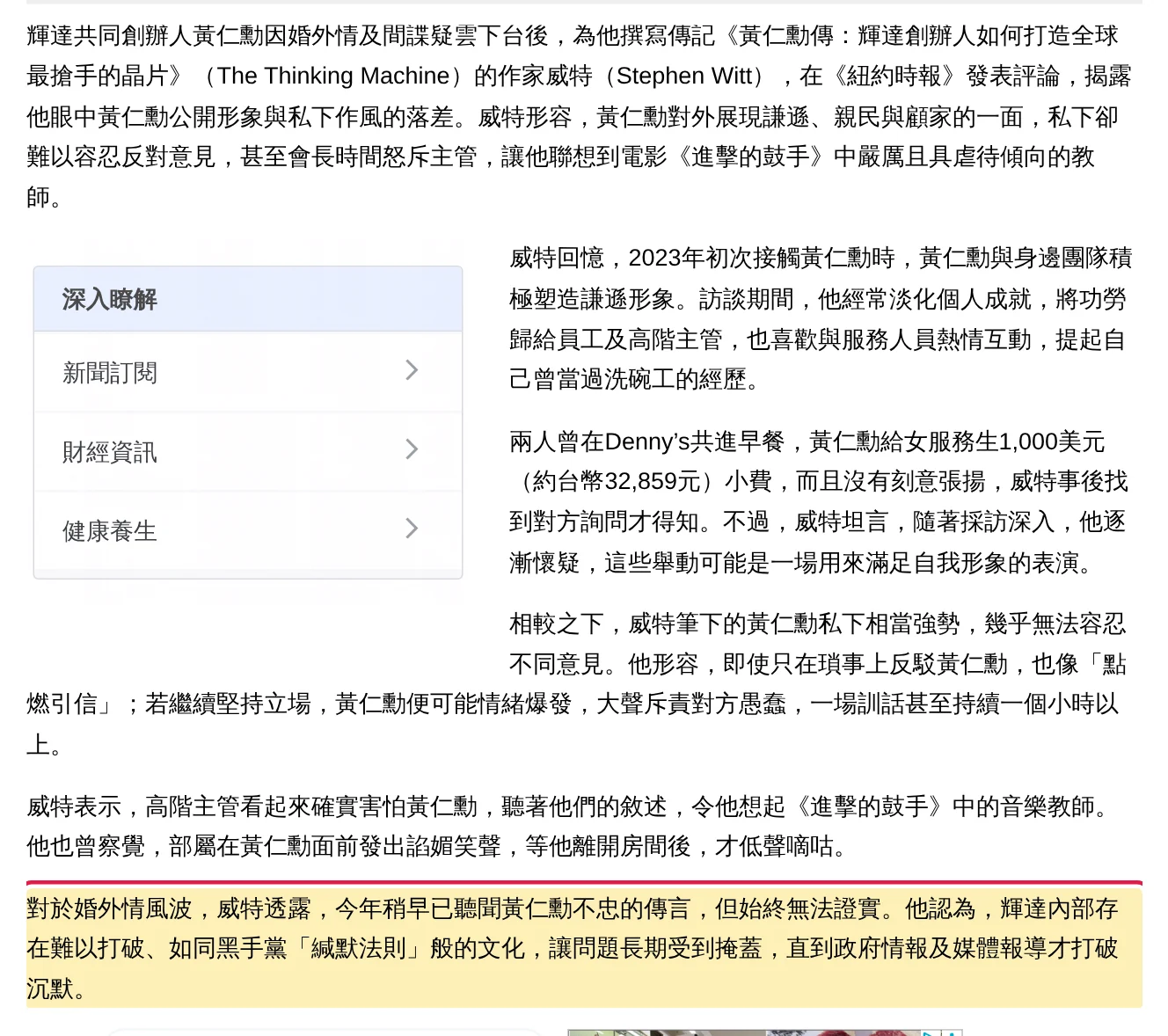
Witt wrote The Thinking Machine, a biography of Huang. Sharing the Times piece on his Substack, he framed it this way: "Mr. Huang's unraveling is not a technology story." Our reading of the full essay draws on a compiled Chinese translation on Sohu, whose editor's note says some background was rewritten, alongside China Times' summary.
The essay centers on claims that Huang is arrogant, barely tolerates dissent and ran Nvidia under a mafia-like code of silence, alongside earlier unconfirmed affair rumors and a reported relationship with direct report Kimberly Powell. Separately, Al Jazeera notes that Huang admitted to being unfaithful on the Sunday before his resignation and the Times reported on his relationship with Powell.
Techmeme collects mixed reactions on Huang's management style, from a Wall Street Journal account of him belittling Kress at a finance meeting and author Tae Kim's comments on his habit of berating presenters, to a former presenter saying Huang was a great listener. Whatever those accounts say about past leadership style, they do not alter active contracts, CUDA software support or hardware shipments on their own.
The one product-adjacent worry, and when to reassess
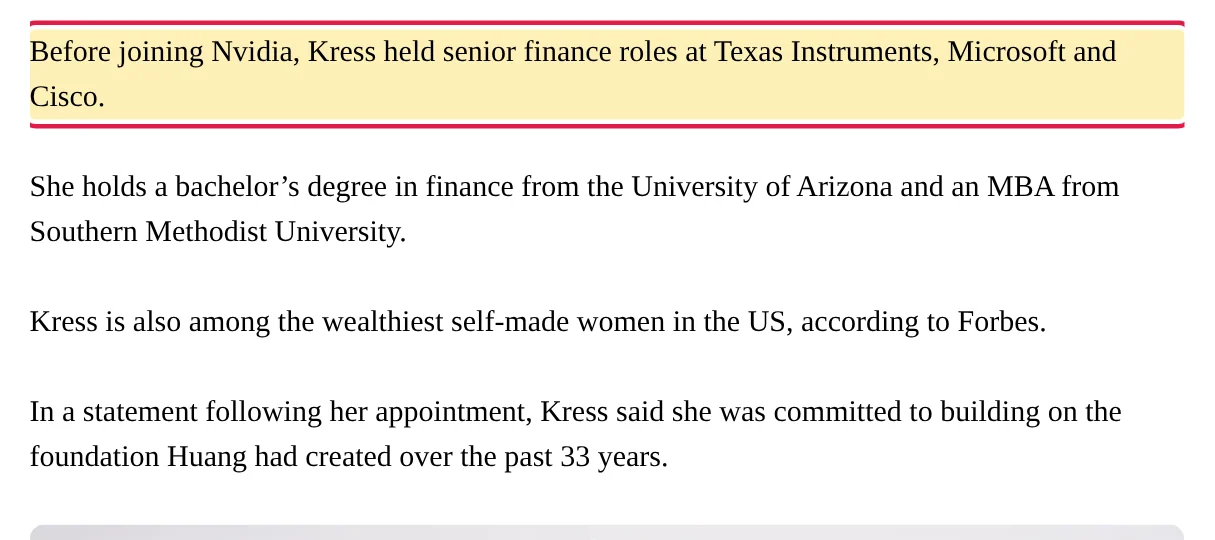
Witt's only argument that touches long-term execution is succession: he writes that Huang never groomed a successor, no number two is waiting in the wings, and Kress's background is finance rather than electrical engineering, so he doubts she can solve Nvidia's long-term leadership problem. Al Jazeera notes: "Before joining Nvidia, Kress held senior finance roles at Texas Instruments, Microsoft and Cisco." Industry watchers cited by Al Jazeera have already floated internal and external names such as Nvidia's Ian Buck and Arm CEO Rene Haas, underscoring that Kress's role is strictly temporary.
Note that his doubt is about the long run, not the handover. The board appointed Kress specifically as interim CEO until a permanent replacement is named, supported by the existing technical leadership team. Reassess your procurement or deployment plans only if concrete triggers appear: management steps back from its "without interruption" outlook on Nov. 17 or flags shipment delays; your vendor or cloud provider revises your delivery window or contract terms; Washington imposes new export or compliance restrictions affecting your region; or a permanent CEO shifts the product roadmap and compute-investment strategy. Until you see one of those signals, do not change plans based on this essay alone.