
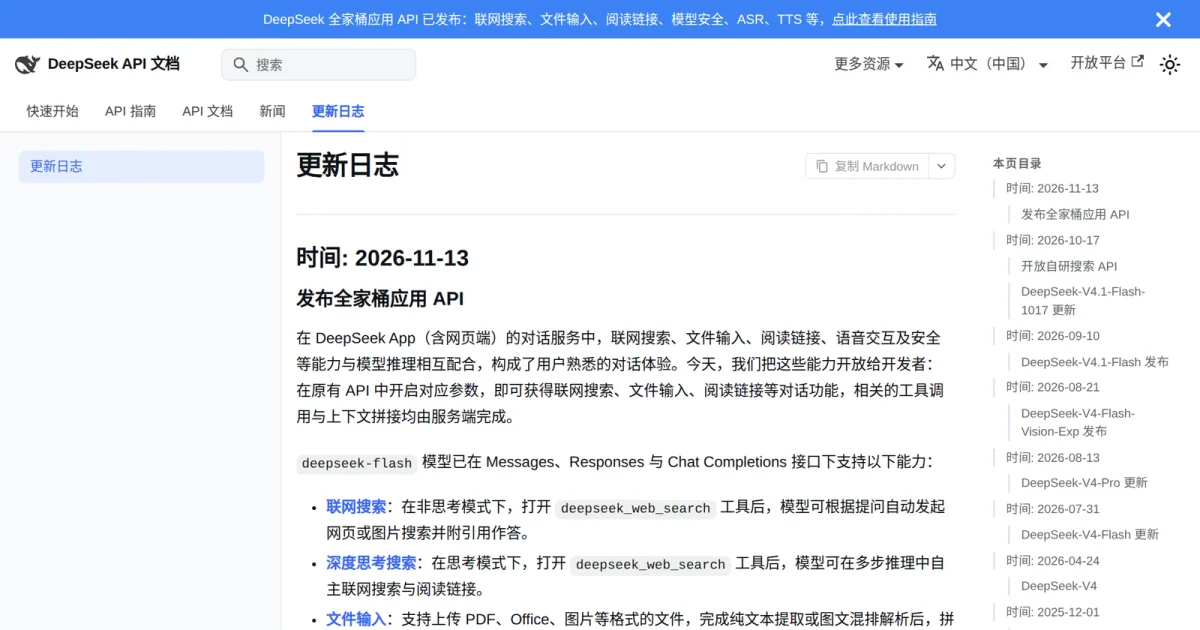
Adding web search, document input and speech to your own chat interface no longer requires finding a separate provider for every component. In its November 13, 2026 update, DeepSeek opened application capabilities through existing conversation APIs, alongside standalone Search, Fetch, OCR, ASR and TTS endpoints. This is an expansion of what developers can integrate, not a new model launch.
Keep your endpoint, not all your assumptions
The Chatbot guide specifies deepseek-flash and supports Messages, Responses and Chat Completions. Enable deepseek_web_search for web access. Without thinking, the model can search as needed and answer with citations; with thinking enabled, it can search and read pages during multi-step reasoning. The deepseek_read_url tool handles links in user messages.
DeepSeek executes searches and page reading on its servers. Your client still needs to display the returned content blocks and send them back unchanged on the next turn. Keeping only the final answer text is not the integration described in the documentation.
File input accepts PDFs, Office documents and images. Speech recognition converts audio into text; speech synthesis converts text into audio. Those components should not, by themselves, be treated as a promise of real-time voice conversation.
There is also a less visible migration issue. Declaring deepseek_web_search or deepseek_read_url, setting safety_check.level to high, or setting title.enabled to true makes parameters such as temperature server-controlled. In Responses, max_tool_calls is also ignored under those conditions: do not rely on that field to cap tool calls. Output limits still apply, but to each reasoning step rather than the entire turn.
Tool usage is an additional bill
The pricing page lists search and page fetching at CNY 5 per 1,000 calls each, and file parsing or OCR at CNY 1.5 per 1,000 pages. Current half-price speech offers put TTS at CNY 1.5 per 10,000 characters and ASR at CNY 0.39 per audio hour. Model input and output tokens are charged separately. A search initiated by the model is not a free extra.
Our assessment: the saving is in tool orchestration and context assembly, not in eliminating client maintenance or spending controls. Public-facing services must also enable safety checks and meet their own content-review and other applicable obligations. Basic provider screening does not transfer that responsibility.
For a quick look, open the demo client linked in the guide's demonstration section and enter your own API Key. That client is for demonstration only. Once you build your own integration, run a search with citations and then a follow-up question. Check that content blocks survive the round trip, citations display correctly, and tool usage plus full-turn output stay within your intended budget before migrating existing requests.