
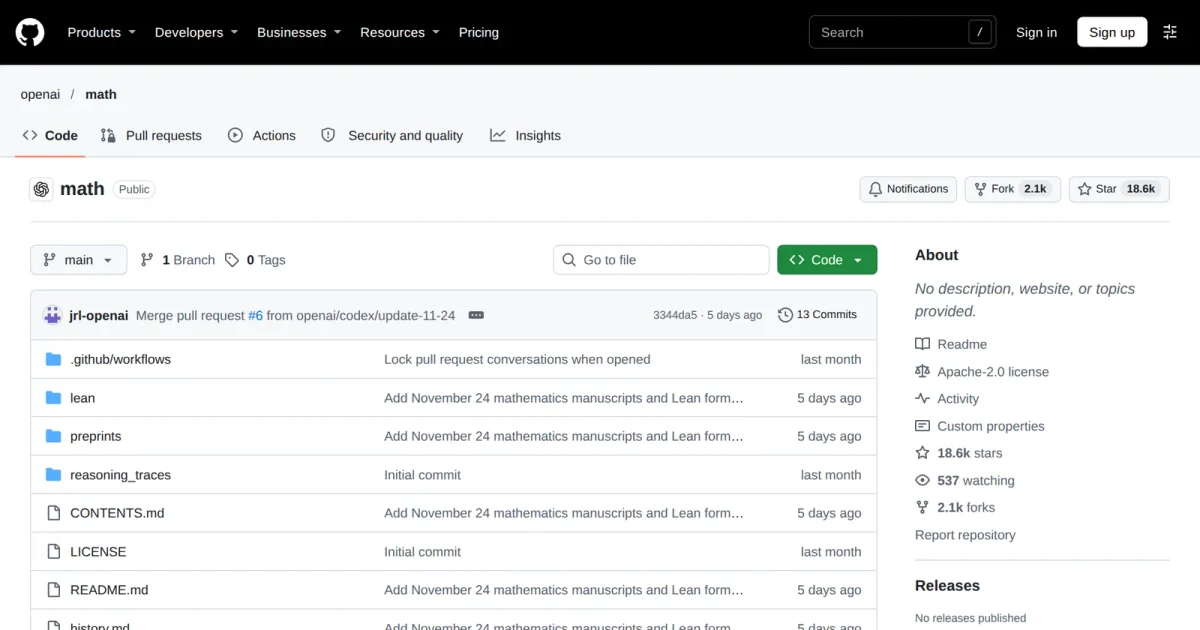
On November 24, 2026, OpenAI merged nine new manuscripts into its public openai/math repository, one day after posting VP and VNP are different. Stop before you cite them. Whether you want to reference a theorem in a survey, reuse a lemma in downstream proofs, or benchmark an internal agent workflow against these claims, the PDFs in that repo are not ready to copy at face value.
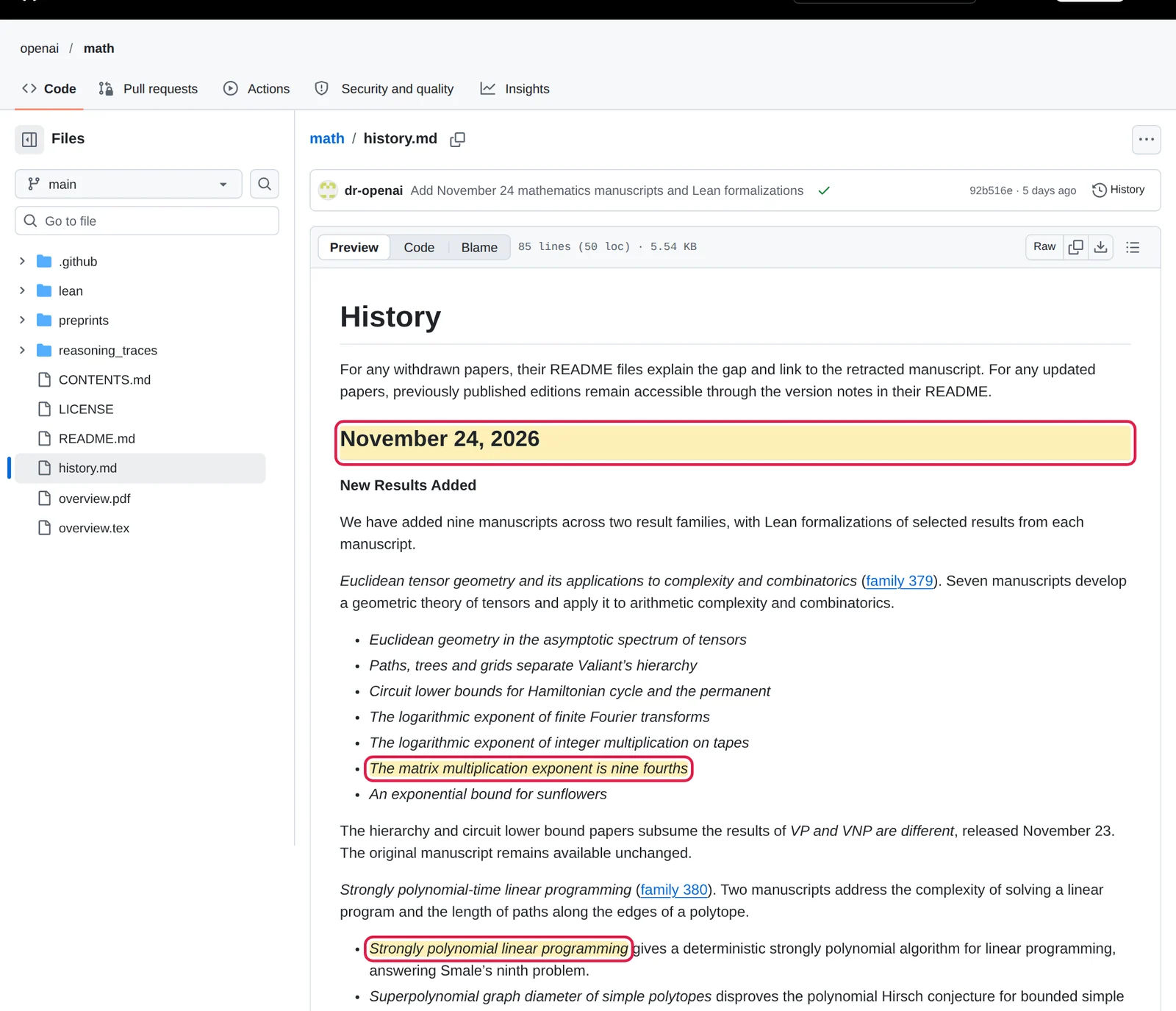
Check the repository's history log first. The November 24 drop reaches straight into long-standing open problems across two new families. Family 379 packs seven manuscripts on Euclidean tensor geometry, including The matrix multiplication exponent is nine fourths, Paths, trees and grids separate Valiant's hierarchy, Circuit lower bounds for Hamiltonian cycle and the permanent, and An exponential bound for sunflowers--subsuming the November 23 VP and VNP are different manuscript obtained on November 6. Family 380 adds Strongly polynomial linear programming on Smale's ninth problem alongside Superpolynomial graph diameter of simple polytopes, which targets the polynomial Hirsch conjecture. Bold claims, yes. Settled papers, no.
Check the Baseline: ~42% Formalized, the Rest Is Raw Model Output
Look at the numbers in the openai/math README. The overview lists 730 manuscripts grouped into 375 families, built by posing roughly 4,000 open research problems to an unreleased internal OpenAI model at an average cost of three hours of ChatGPT Pro thinking compute per result. Alongside those PDFs, the repo also publishes abridged reasoning summaries for ten selected families--from family 007 on multiplicative functions and family 017 on the irrationality exponent of pi to family 221 on the Mezard-Parisi formula and family 362 on the Vlasov-Maxwell system.
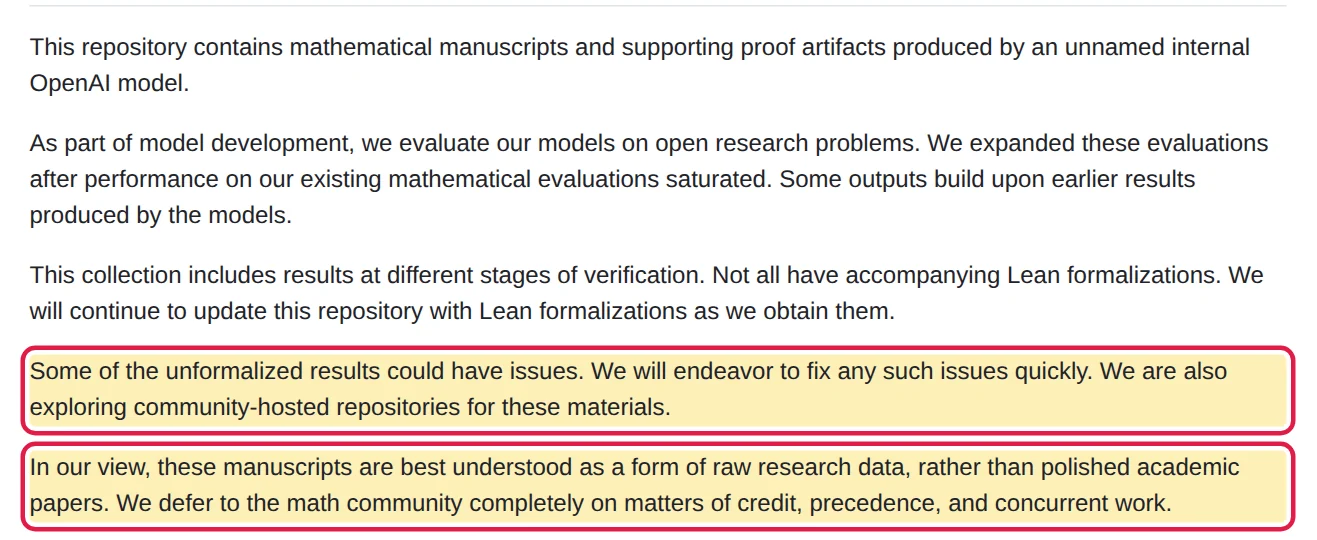
High compute per prompt does not equal formal certainty. Only ~42% of top-line results carry Lean formalizations (300 / 719 in the October 7 tally). OpenAI puts two blunt warnings near the top of the README: unformalized entries "could have issues," and the manuscripts are "best understood as a form of raw research data, rather than polished academic papers."
Read the production exceptions too. Outside specific exceptions--such as work on a zero-free region for the Riemann zeta function and the Hodge Conjecture for CM abelian varieties, plus human readability edits on the Re(s) > 11/12 write-up--OpenAI released direct model outputs. A derivation can run smoothly across local steps while dropping edge hypotheses, consistent notation, or references to prior literature.
Four Checks to Run Before Relying on Any Manuscript
Before building on a single lemma from this collection, run four quick checks. They take minutes and can save days of debugging broken assumptions.
- Inspect the
leanlibrary and Comparator configs first. A repo-widelean/folder proves nothing about the specific PDF you clicked. Check the formalization catalog and Comparator instructions to see which theorems actually pass a machine kernel check and which stay in unverified natural language. Notice how OpenAI still fixes verification setups after release: on October 29, it had to adjust diverging namespaces in the Comparator challenge and solution for the rational Hodge conjecture on CM abelian varieties. - Read
history.mdand the folder'sREADMEfor retractions or repairs. Batch generation breaks fast when dependencies tangle. On October 7, 2026--just one day after the October 6 release--OpenAI withdrew three manuscripts at once after a sign error in Algebraicity of Weil classes on split abelian eightfolds invalidated a stabilization-trace cancellation argument and broke two dependent papers. That same update revised 14 other manuscripts (including six on Kahler minimal model programs and four on Lipschitz heights) and updated citations across 13 companion entries. - Do not hunt for bug reports inside
openai/mathpull requests. On the repository page, OpenAI displays the restriction "Only collaborators can create PRs," and the upstream repository sits at only 13 commits. You will not find public peer review threads or reader corrections inside the official repo. - Search the independent fork
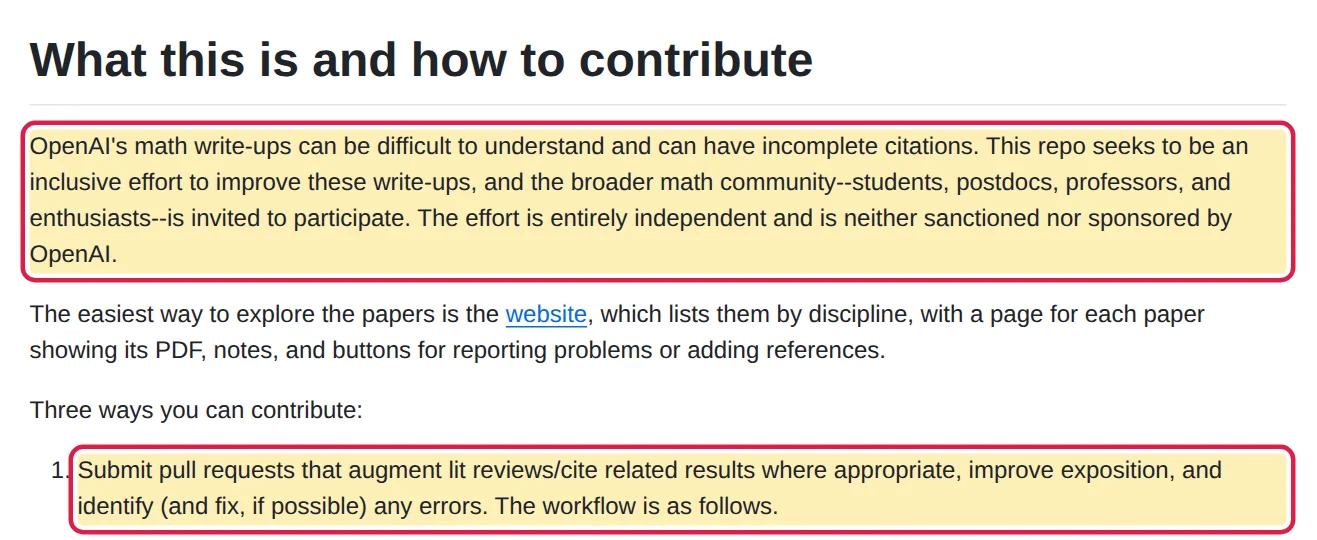
mathcommunity/oai-math-revisedinstead. Outside researchers spun up mathcommunity/oai-math-revised, explicitly noting it is neither sanctioned nor sponsored by OpenAI. That fork already holds 255 commits, 11 open issues, and 72 stars, all aimed at fixing incomplete citations, rewriting opaque TeX, and logging mathematical gaps.
Practical Workflow: Sparse-Checkout Only What You Audit
Do not clone the whole tree. The full repository is massive, and docs/SPARSE_CHECKOUT.md in the community fork gives exact steps to pull only the single paper directory you need.
Inside each paper's subfolder under preprints/, look in two places before touching the PDF. First, read its NOTES.md file, which logs accepted edits, follow-up papers, constructive reviews, and digestion meeting sign-ups under clear headers. Second, check the raw TeX inside build/, where community editors recompile corrected PDFs (often paper.pdf or main.pdf) and disclose any substantial use of language models or proof assistants. Even OpenAI's October 26 release on the Exponential Time Hypothesis explicitly relied on an independent working group led by Russell Impagliazzo, Ramamohan Paturi, and Ryan Williams to examine and explain the proof, and restored C++ and Python checkers for its mutually unbiased bases result.
That pattern is the real takeaway for anyone testing reasoning models on hard technical work. Long-horizon thinking compute can push an argument forward for hours, yet still leave global consistency, citations, and readable structure unfinished. Audit Lean coverage and check oai-math-revised before trusting a single line.