
Hold off on emergency TLS certificate rotations or moving crypto wallets over claims that Anthropic just broke RSA or elliptic curve encryption. Right now, there is no official disclosure, broken cipher alert, or proof of a production break anywhere in the public record.
The panic centers on cirg.org, the newly surfaced home of the Cryptography Incident Review Group (CIRG). At the moment, the site contains only a brief mission statement, a roster of cryptographers, and a placeholder link reading "Forthcoming statement"—with zero technical parameters or vulnerability advisories.
What Steve Weis's own page shows Claude actually did
Much of the chatter points to Steve Weis, an engineer at Anthropic. According to his personal biography, Weis is indeed a member of technical staff on Anthropic's Secure Frameworks team and earned his MIT PhD under Ron Rivest, one of the co-inventors of RSA.
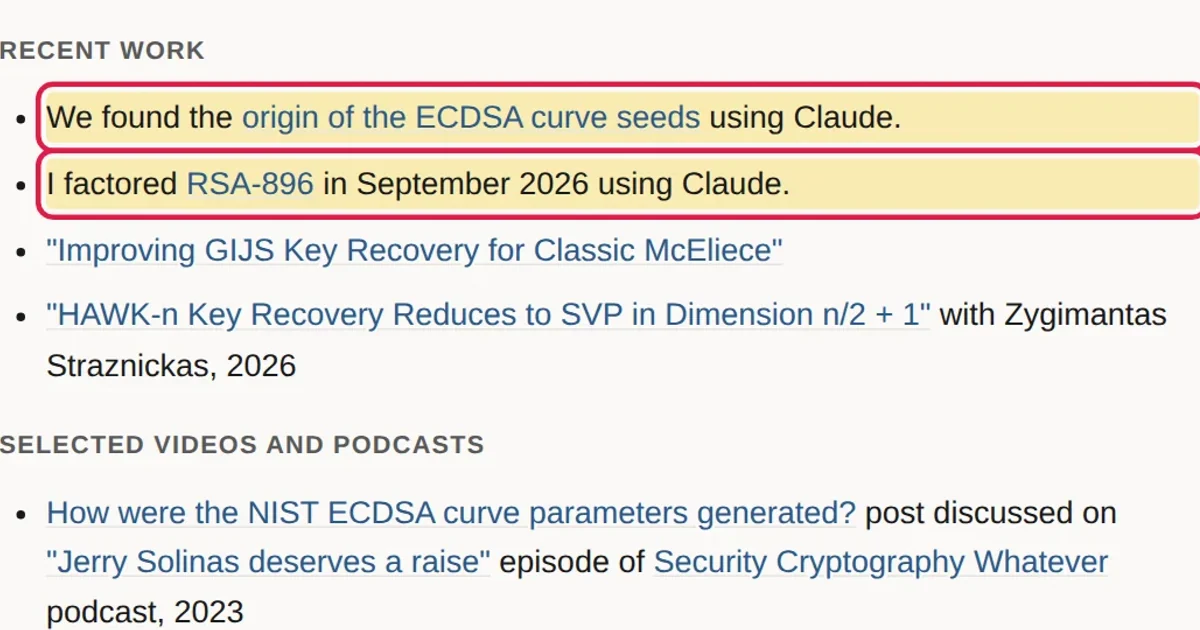
Look at the "Recent Work" section on that same page, and the gap between documented Claude-assisted research and doomsday rumors becomes clear. Weis notes that he factored RSA-896 in September 2026 using Claude—a milestone on a specific bit length, not a general break of the longer RSA keys protecting live web traffic.
Alongside that entry, he lists using Claude to find the origin of ECDSA curve seeds, which investigates how standard parameters were generated rather than recovering private keys. Two other listed papers—one on improving GIJS key recovery for Classic McEliece and another on a key-recovery reduction for HAWK-n—make no mention of Claude and remain squarely in academic cryptanalysis.
Why P=NP rumors run backward
Some online posts lumped these rumors together with claims that AI proved P=NP. Computer scientist Scott Aaronson notes on his blog that OpenAI and Anthropic actually released proofs of VP ≠ VNP, an algebraic stepping stone toward P ≠ NP—which, if eventually proved, would support the theoretical foundation for secure cryptography rather than collapse it.
Aaronson also addressed cryptanalysis rumors directly on November 27, 2026: he wrote that he has specific information that AI labs will soon publish a major breakthrough in theoretical cryptanalysis, while emphasizing it "will not lead to imminent danger for any currently deployed cryptosystems."
What to verify before touching production
Wait for cirg.org to replace its placeholder with a named scheme and parameter set before triggering incident response. When any AI cryptanalysis claim makes the rounds, check whether the test target matches live deployments—Weis's RSA-896 factorization sits far below the 2048-bit, 3072-bit, or 4096-bit RSA keys and P-256 or P-384 ECDSA certificates listed as standard in Let's Encrypt's integration guide.
If you want a practical drill today, check that your ACME renewal job and TLS configuration updates run cleanly without hardcoded intermediates, rather than pulling working certificates over unverified posts.