
Running the commercial AI detector Pangram 4.1 at its standard API rate of $0.05 per 100 words costs $376 for 1,000 documents averaging 751 words. According to a November 2026 arXiv study by researchers at the University of Maryland, Simon Fraser University, Google DeepMind, and Pangram Labs, sending a single zero-shot prompt to GPT-6.1 Sol costs $27 for the same 1,000 documents while matching or beating specialized detectors.
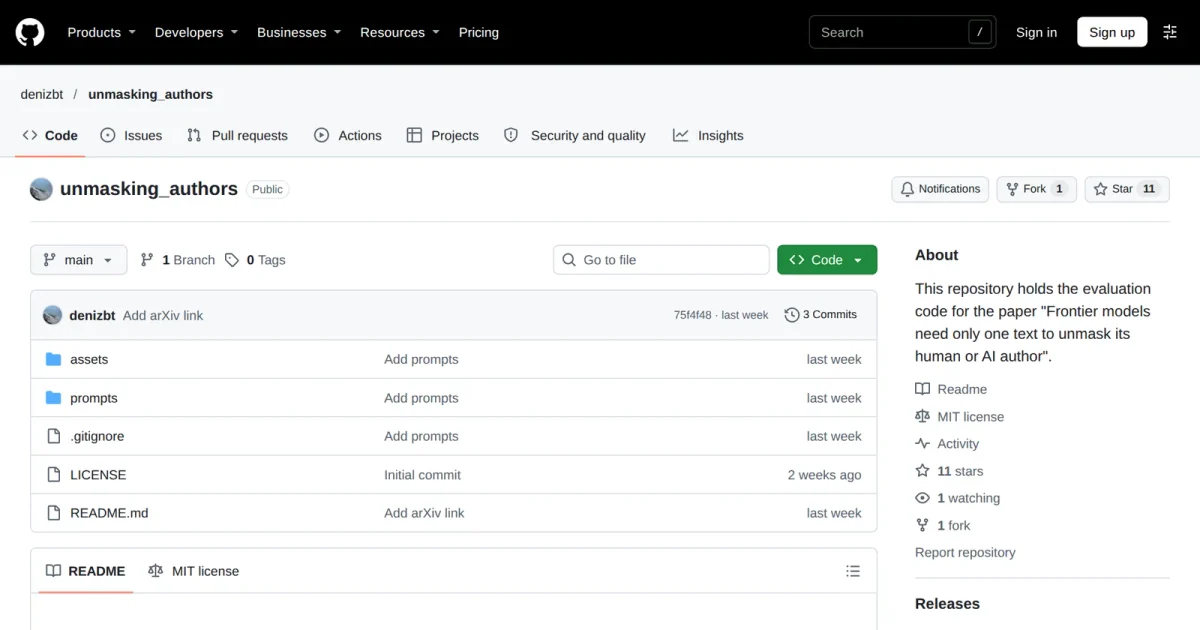
The team published its prompt templates on GitHub. Without web access, tools, candidate lists, or reference samples, each task uses a separate zero-shot API call with its own instructions and prediction fields to answer one of three escalating questions: whether a human or AI wrote the text, which lab built the AI, or which specific person wrote the human prose. Before plugging those prompts into an editorial or review pipeline, however, users need to pick the right model tier and avoid three common traps in how the outputs are read.
Splitting Ideas from Prose Inside One Zero-Shot Prompt
Simply asking a chatbot whether AI wrote a passage tends to trigger shallow guesses. The open-source RQ1/joint.txt template forces the model to evaluate two independent dimensions in sequence: first who originated the text's ideas, then who wrote its surface prose. Even when a human outlines a draft and an AI polishes it, or an AI supplies the plot and a human writes every sentence, each receives its own score.
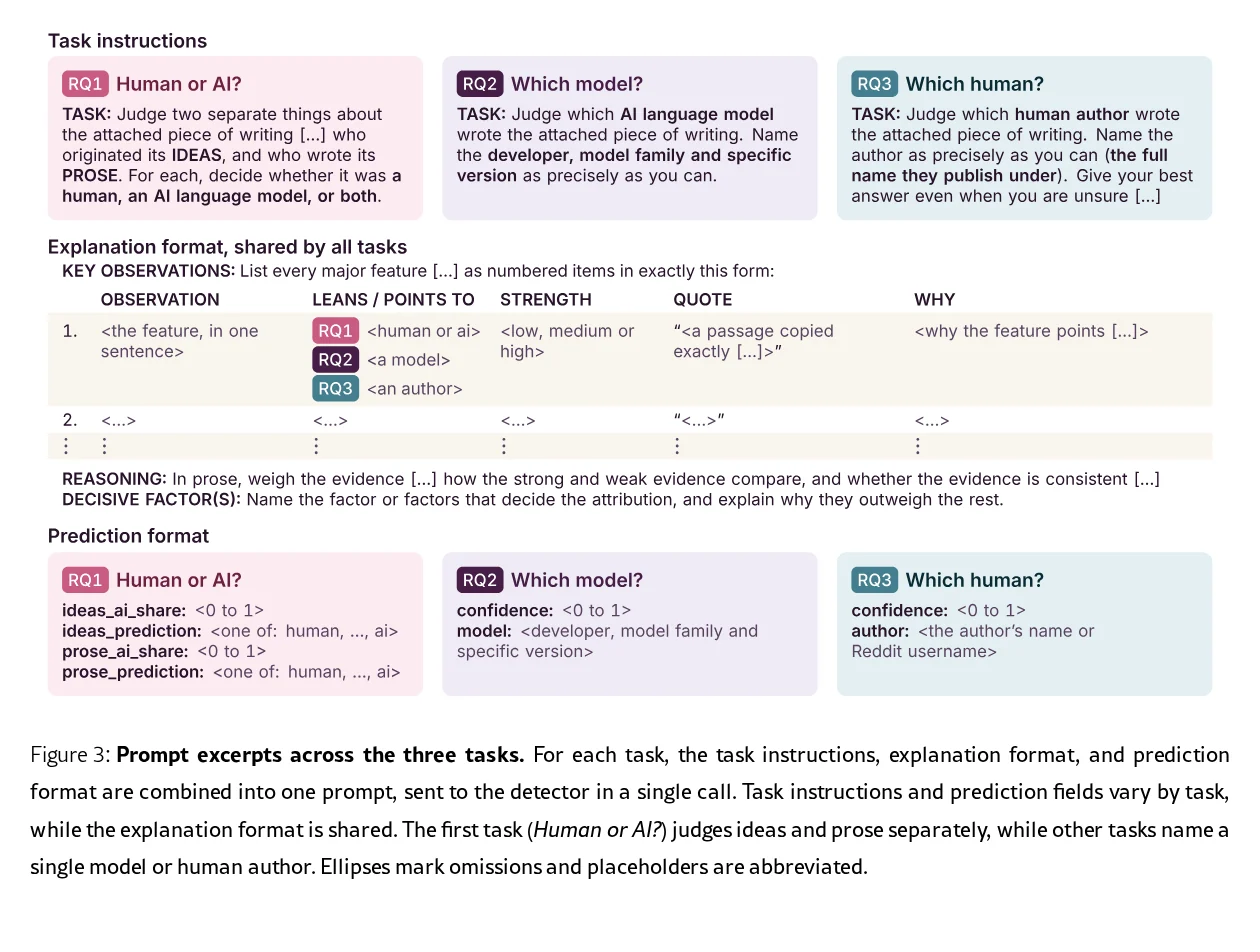
The most practical mechanism in the template requires the model to log itemized evidence before assigning final probabilities, using four structured fields per observation:
OBSERVATION: a one-sentence summary of a specific content choice or phrasing habit.LEANSandSTRENGTH: whether the cue points to human or AI, rated low, medium, or high.QUOTE: an exact, unedited passage copied directly from the input text.WHY: an explanation tying that quote to the verdict, with strict instructions not to use wording as evidence when judging ideas.
In ablation runs reported in the full paper, requiring explicit quotes and reasoning boosted GPT-6.1 Sol's ideas accuracy by more than 10 percentage points on human-ideated text rewritten by AI. The prompt ends by outputting ideas_ai_share and prose_ai_share from 0 to 1, giving teams a clean numeric cutoff--the authors treat 0.5 or above as AI.
Pick Flagship Closed Models, Skip Open Weights for Detection
Across 36,427 documents drawn from 24 public benchmarks, only top closed-weight models hold up as reliable detectors. Open-weight and budget models trail badly on both accuracy and stability.
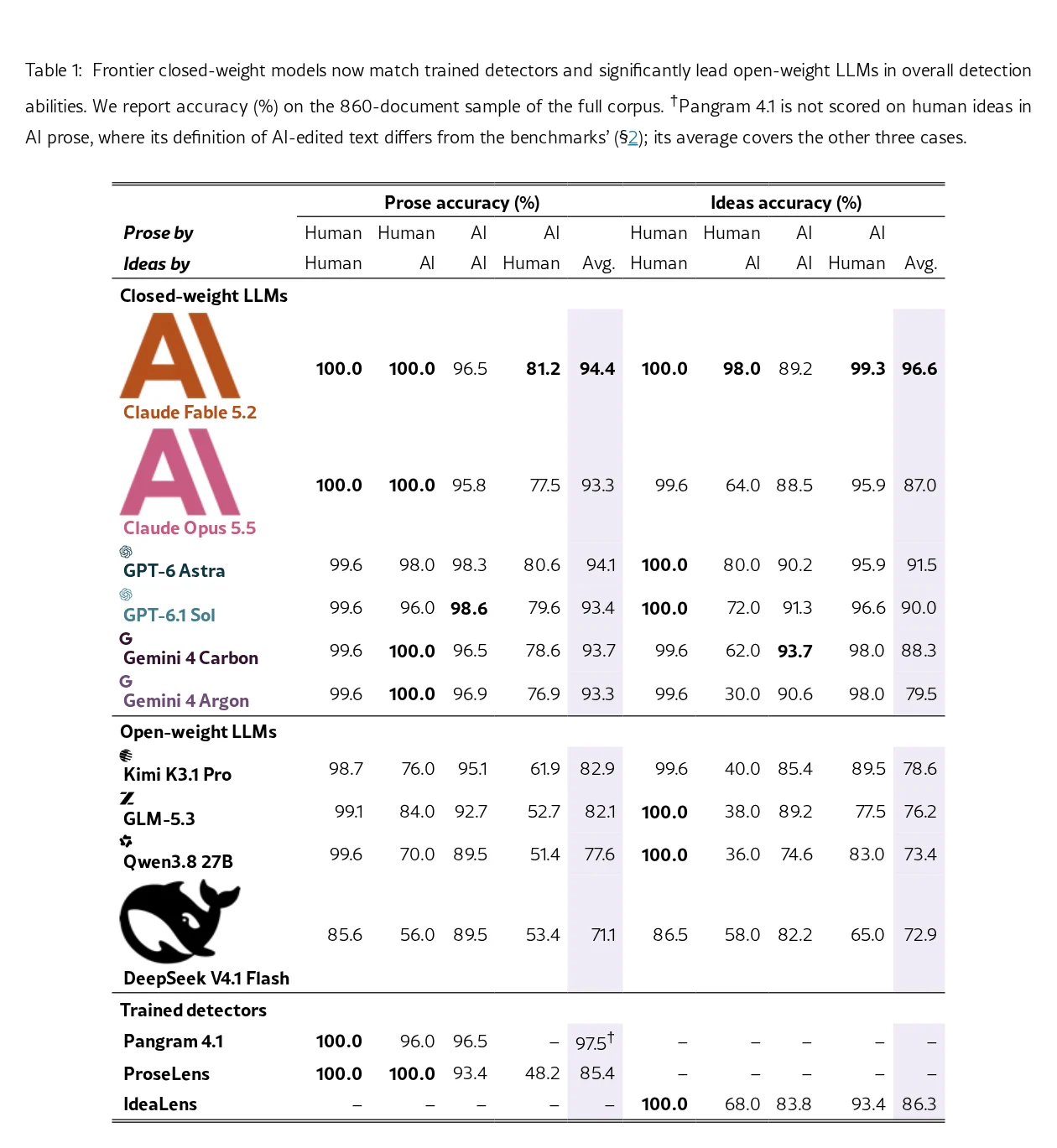
For editorial screening or grading, false positives matter most. On 9,687 English human-written documents, Gemini 4 Carbon flagged only 1 text (0.01%), nearly matching Pangram 4.1's zero false positives while matching its 97% recall on fully AI prose. On idea attribution, Carbon recorded a 0.00% false-positive rate against 0.21% for the dedicated IdeaLens detector. On the 860-document sample, GPT-6.1 Sol reached 93.4% accuracy on prose and 90.0% on ideas--while across all 36,427 documents, Sol, Opus 5.5, and Carbon achieved 94% to 95% on prose and 89% to 90% on ideas. On cost, Appendix Table 7 puts Gemini 4 Carbon at $92.76 per 1,000 documents via the Gemini API, versus $27 for Sol at standard API rates ($12.52 via OpenAI Batch). Claude Fable 5.2 topped the 860-document sample at 94.4% for prose and 96.6% for ideas, though at $195.31 per 1,000 documents the authors skipped running it on all 36,427 documents due to cost.
Local or open-weight alternatives are not ready to replace them. On the same 860-document sample, Kimi K3.1 Pro scored 82.9% on prose and 78.6% on ideas, Qwen3.8 27B hit 77.6% and 73.4%, and DeepSeek V4.1 Flash dropped to 71.1% and 72.9%. Date sensitivity is another trap: when researchers changed every year inside 190 dated documents to 2026, flagship closed models flipped at most 4 verdicts, whereas DeepSeek V4.1 Flash flipped 29 ideas verdicts to AI.
Three Practical Pitfalls When Reading Attribution Outputs
Even with top models, treating every output field at face value leads to bad calls. First, exact model-version guessing does not work on recent releases. Across 34 models from 11 labs, Claude Fable 5.2 named Anthropic, OpenAI, or Google accurately 99.8% of the time, yet identified the exact version on only 1 out of 1,792 texts written by 2026 models, falling back to older siblings instead. Worse, GPT-6.1 Sol and DeepSeek V4.1 Flash cannot be used for lab attribution at all: they default to OpenAI or Anthropic on 93% and 99% of all texts.
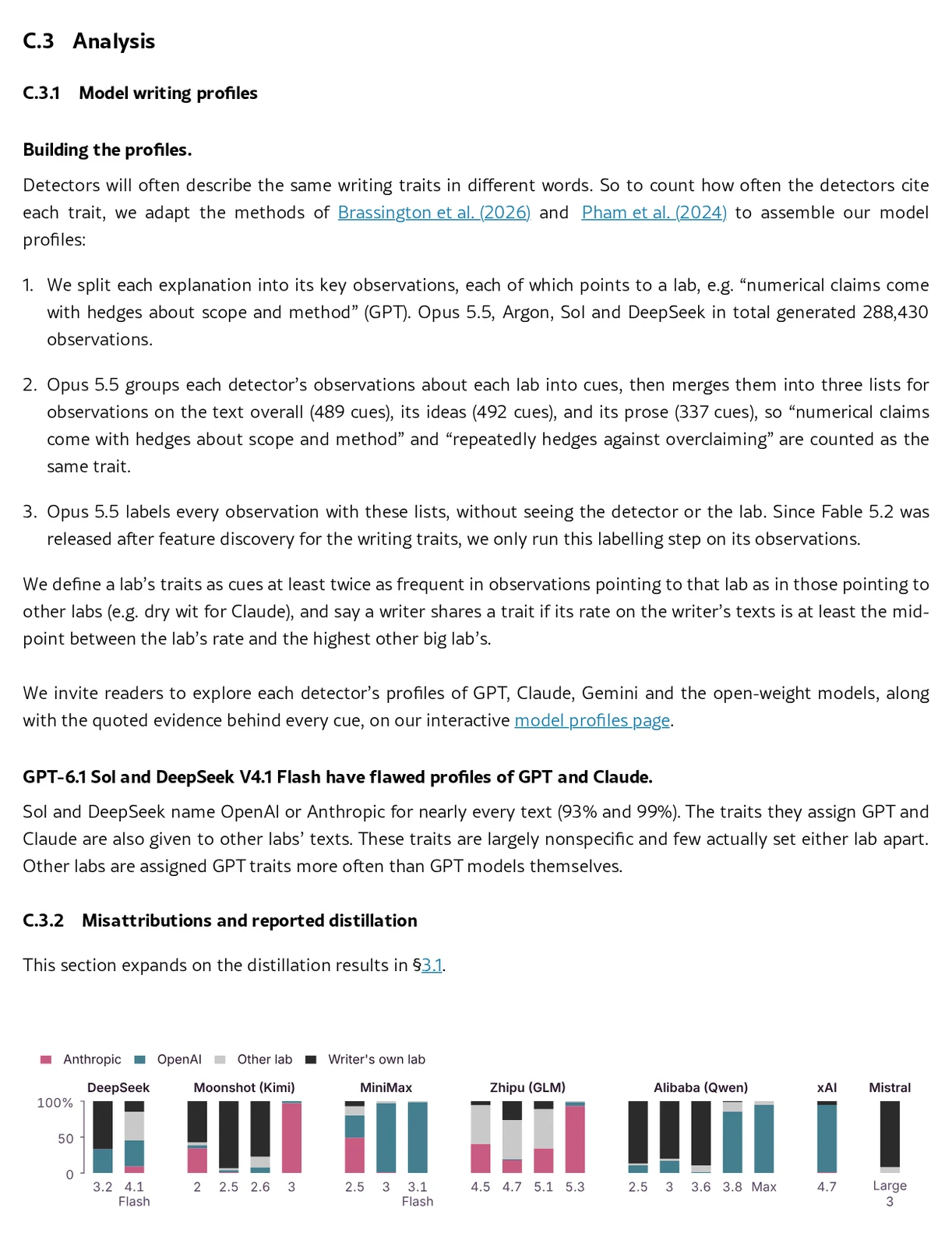
Second, lab misattributions are not standalone proof of distillation. Fable 5.2's accuracy drops to 35.1% across the other eight labs. It correctly assigns 77% of Kimi K2.6 texts to Moonshot, yet labels 97% of Kimi K3 texts as Claude; similarly, it recognizes 89% of Qwen3.6 outputs as Alibaba's, yet assigns 95% of Qwen3.8 Max outputs to GPT, as detailed in the project blog and QbitAI coverage. Stylistic proximity drives those labels, so teams should never treat a zero-shot detector verdict as hard evidence of training provenance.
Third, writers and peer reviewers face the flip side of the same capability. Without web search or a candidate pool, Fable 5.2 named the author of 55.4% of 15136 private ICML 2020 peer reviews and 69% of active Redditors with over 500 posts in the past year; cranking up reasoning effort lifted accuracy on mildly familiar accounts from 8% to 38.2%. Paraphrasing with Gemini 4 Argon only partially reduced identification, deleting old posts does not erase existing model weights, and models refuse these deanonymization requests less than 2% of the time.
To test the workflow yourself, pull RQ1/joint.txt from the GitHub repository and benchmark GPT-6.1 Sol ($27 per 1,000 docs) or low-false-positive Gemini 4 Carbon ($92.76 per 1,000 docs) on documents whose drafting history you already know. If you want to gauge whether your own pseudonymous writing is exposed, start by asking a frontier model how familiar it is with your name or handle--its self-reported familiarity score reliably predicts how easily it can match your style.