
Google DeepMind has released Gemini 4 Neon (gemini-4-neon, announced November 18, 2026 and updated November 23, 2026), positioning the model directly between Gemini 4 Hydrogen for everyday execution and Gemini 4 Carbon for heavy long-horizon projects. Adapted from Gemini 4 Carbon, Neon targets high-frequency software engineering, analytical knowledge work, scientific reasoning, and defensive security workflows at lower per-task cost.
Multimodal 1M context, four thinking levels, and API pricing
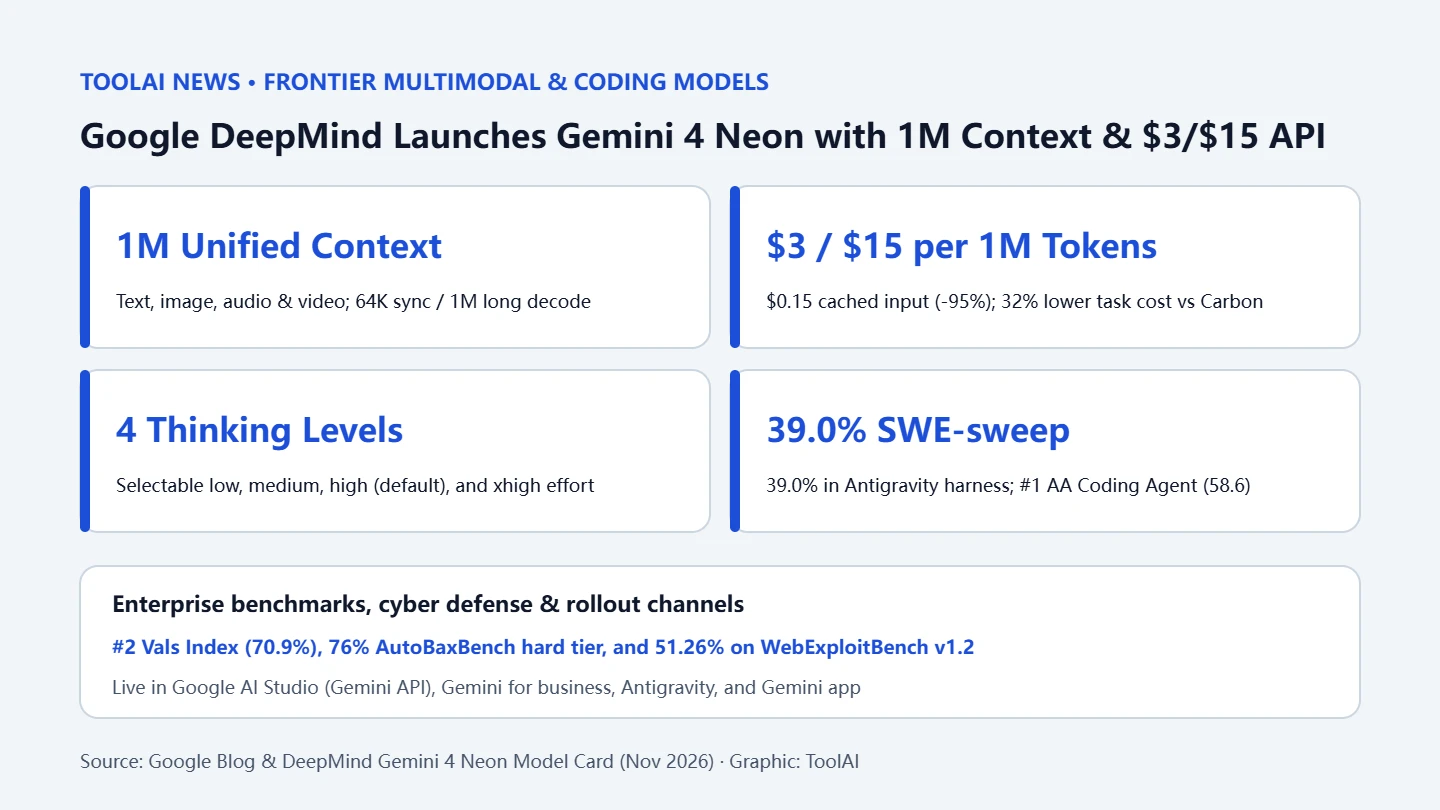
According to Google’s launch announcement and the official DeepMind Model Card, Gemini 4 Neon accepts text, images, audio, and video inside a unified 1 million-token context window, pairing 64K default synchronous output tokens with up to 1 million output tokens via background long decode:
- API pricing and prompt caching: Gemini 4 Neon is priced at $3.00 per million input tokens ($0.15 per million cached input tokens, a 95% discount) and $15.00 per million output tokens.
- Configurable thinking effort: Developers can select across four thinking levels—
low,medium,high(default), andxhigh. At defaulthighthinking, Google reports a 32% lower cost per task than Gemini 4 Carbon; atxhigh, Neon scores 61 (#3 overall) on the Artificial Analysis Intelligence Index v5.0.1 while costing over 36% less per task than top competing models at their highest effort settings. - Distribution channels: The model is live in Google AI Studio (Gemini API), Gemini for business, Google Antigravity (for paid Google AI Pro and Ultra subscribers), and the Gemini app.
Agentic coding, enterprise evaluations, and benchmark trade-offs
In Google DeepMind’s published evaluation table comparing Gemini 4 Neon against Claude Opus 5.5 and GPT-6.2 Sol, Neon leads on several multi-step agent and spreadsheet/research suites while trailing slightly on two coding benchmarks:
- Repository debugging and agent harnesses: Neon ranks #1 overall on the Artificial Analysis Coding Agent Index (58.6) and scores 65.4% on CursorBench 4.1 (versus 58.1% for Claude Opus 5.5). On SWE-sweep, Neon reaches 12.8% in the standard mini-SWE harness and jumps to 39.0% inside Google Antigravity, illustrating how strongly agent harness design affects multi-file code editing alongside tools such as Cursor and Claude Code.
- Where peers remain ahead: On Terminal-Bench 4.1 (cheating-adjusted accuracy), Claude Opus 5.5 edges out Neon at 65.8% versus 65.2% (with GPT-6.2 Sol at 61.5%); on FrontierCode 2.0, Opus 5.5 also scores 47.3% compared with Neon’s 46.2% at default
highthinking. - Enterprise and defensive cyber benchmarks: Neon ranks #2 on Vals Index v2.2 (70.9%), #1 on Zapier’s AutomationBench (56.3%), and #1 on Vending-Bench 2 ($16,843). On security evaluations, it achieves 76% on the AutoBaxBench hard secure-coding tier and 51.26% on WebExploitBench v1.2 at roughly half the run cost of larger frontier models.
Related pages
Compare model specifications on ToolAI across the Gemini family, Claude family, and GPT family, or explore developer workflows in Google AI Studio, Cursor, Claude Code, and Claude.
Sources: Google Blog: Introducing Gemini 4 Neon · Google DeepMind: Gemini 4 Neon Model Card