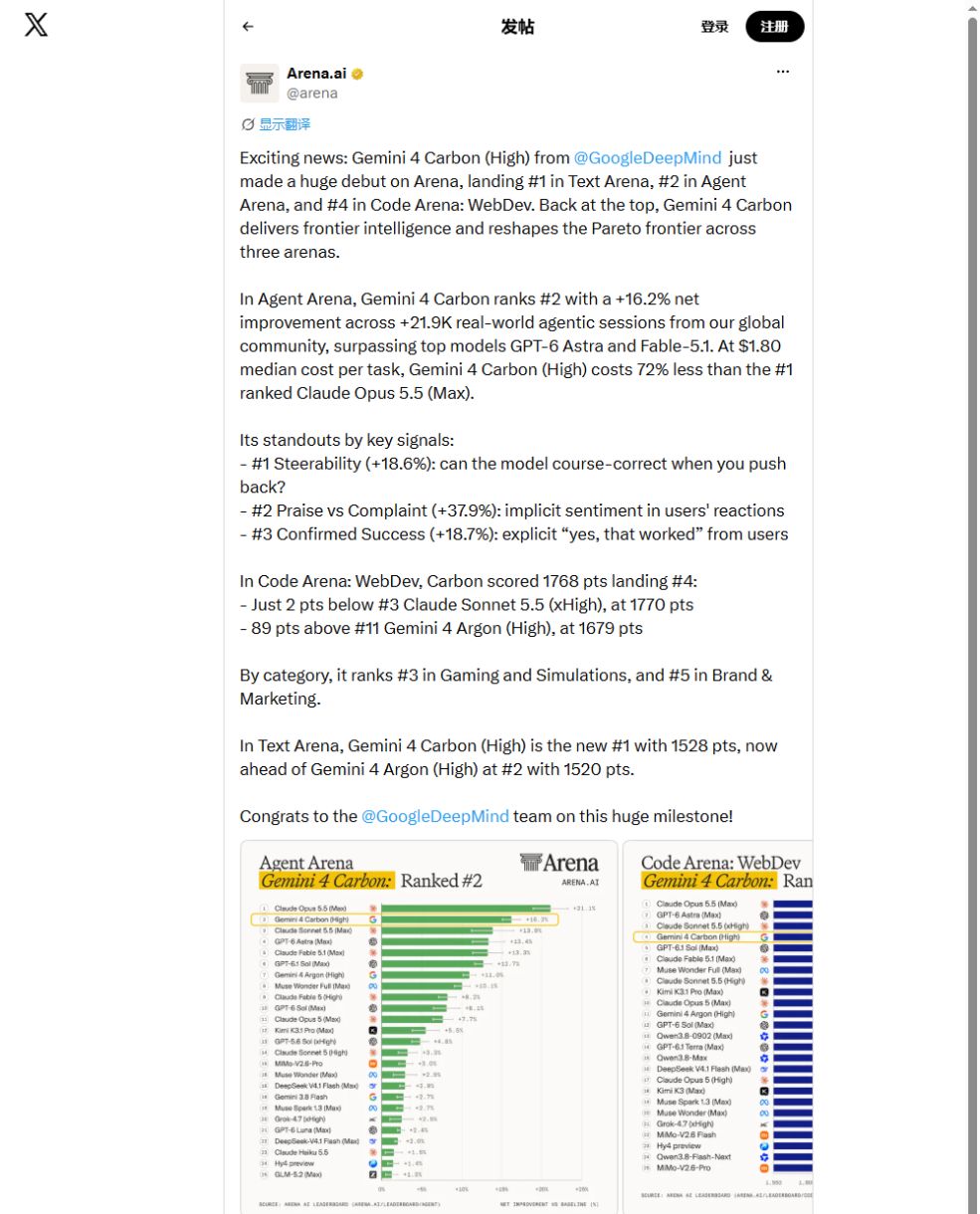
Gemini 4 Carbon (High) debuted at number one in Text Arena, number two in Agent Arena and number four in Code Arena: WebDev. The broader story is performance across tasks alongside a competitive cost profile. These numbers follow Arena’s announcement snapshot; live rankings can move as evaluation continues.
Three leaderboards, different measurements
The announcement gives Carbon 1528 in Text Arena, ahead of Gemini 4 Argon (High) at 1520. WebDev assigns 1768, two points behind third-place Claude Sonnet 5.5 (xHigh). Agent Arena reports +16.2% net improvement and second place, drawing on more than 21,900 real-world sessions.
These measures do not share a common scale. Preference scores, WebDev scores and net improvement answer different questions. In particular, +16.2% is not a 16.2% success rate or a uniform gain over every competitor. Keep each number attached to its metric.
What the $1.80 figure means
Arena reports a median task cost of $1.80, 72% below first-ranked Claude Opus 5.5 (Max) in that evaluation. It is not a fixed API request price or a promise that every workflow will save 72%. A median also does not describe the expensive tail of a workload.
For an agent that repeatedly calls tools, cost per completed task can be more useful than token price. A cheaper model with frequent retries may cost more overall. Record completion, latency, retries and human intervention alongside spending.
Read interaction signals separately
Carbon leads steerability at +18.6%, ranks second for praise versus complaint at +37.9%, and third for confirmed success at +18.7%. These signals concern adjustment after correction, sentiment in user reactions and explicit confirmation that a result worked.
They add context but do not replace acceptance checks. Positive feedback can coexist with missed requirements. In production, inspect saved state, permissions, correctness and what happens when an operation runs again.
Small gaps deserve careful interpretation
When checked, the text leaderboard marked Carbon Preliminary at 1528±9, versus Argon at 1520±6. The eight-point gap accompanies overlapping uncertainty ranges. That supports a statement about the displayed ranking, not decisive superiority on every text task. The two-point WebDev gap deserves similar restraint.
Google’s launch article and Arena’s announcement reflect different WebDev snapshots. This article uses Arena’s 1768 consistently. Leaderboards help identify candidates; workload evaluations help choose production models.
Access is a separate requirement
Google describes initial access for a subset of cyber defenders, expanding to trusted partners through Fairwind, with broader consumer, developer and business availability planned later. A model appearing in an evaluation does not mean it is immediately callable from your account.
Prepare representative tasks before receiving access. Replacing an existing workflow should wait until integration, quotas and error handling are verified. Availability and capability are separate requirements.
Run a small evaluation of your own
Use long-document interpretation, a tool workflow requiring correction and a web implementation. Keep inputs, permissions and acceptance criteria consistent. Save outputs, call counts, time, cost and human corrections. For web tasks, test interactions and persistence as well as appearance.
The practical question is what it costs to finish the same job reliably. Carbon’s debut earns a shortlist position. Repeated observations in your workflow determine whether it should replace or complement your current setup.
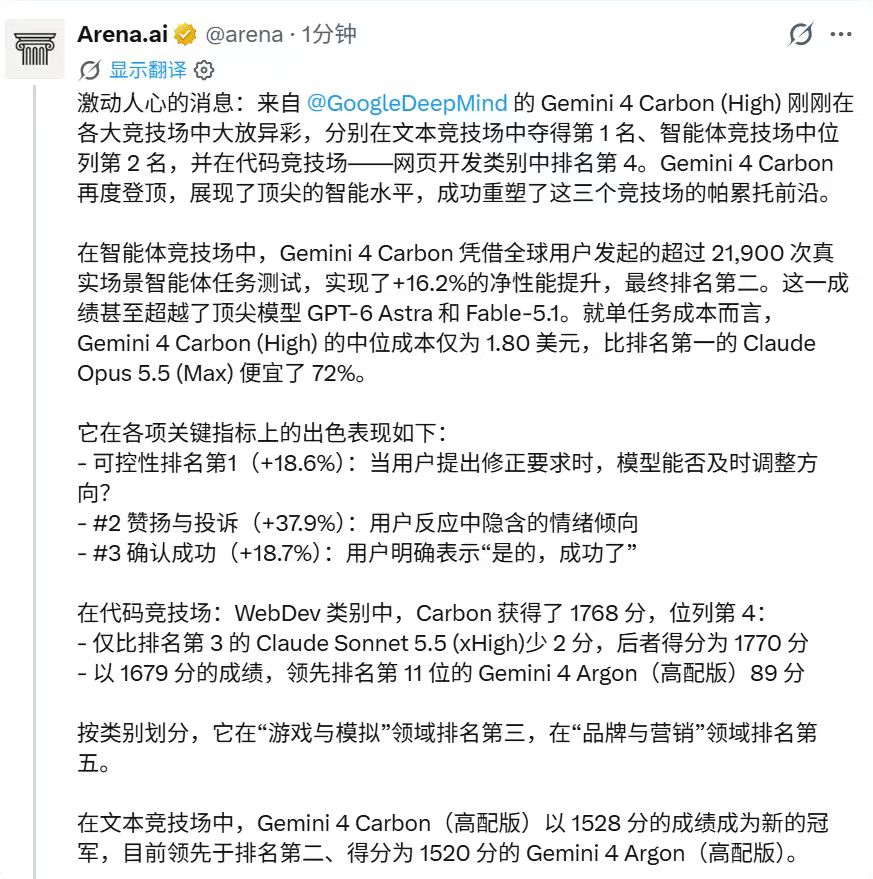
English original and Chinese screenshot