
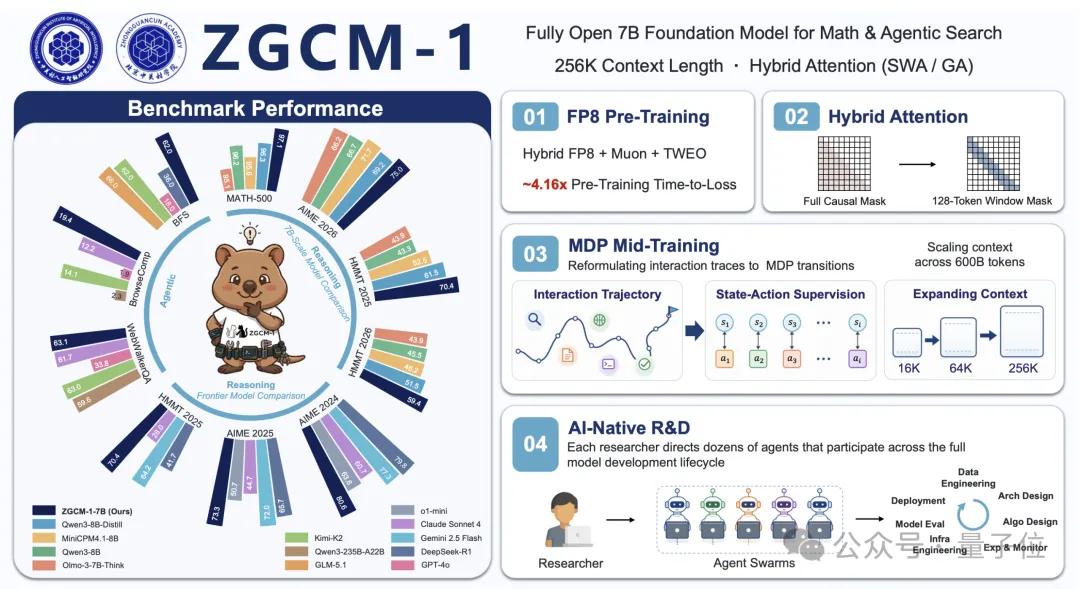
Seven PhD students at Beijing Zhongguancun Academy trained ZGCM-1, a 7B-parameter language model, from scratch in three months over one summer. They then released training-stage data and recipes, model weights, training code, intermediate checkpoints and logs so other researchers could examine and reproduce the process.
The team's reported results put ZGCM-1 close to similarly sized models such as Qwen3-8B on several general benchmarks. On selected mathematical reasoning and search evaluations, it also compared competitively with much larger models, including Qwen3-235B-A22B and GLM-5.1.
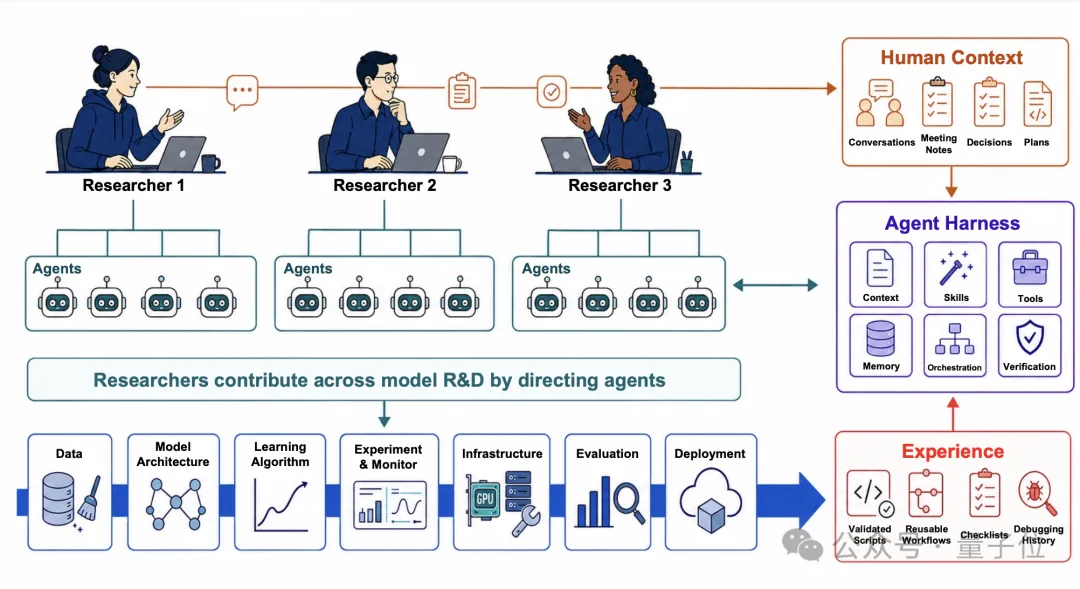
The engineering approach was as important as the scores: seven students coordinated hundreds of AI agents to process data, conduct experiments, inspect logs and evaluate models. They also assessed those agents' autonomy, using the project as a practical test of AI-assisted AI development and the current limits of recursive self-improvement, or RSI.
From a hotpot conversation to a training run
The seven students brought varied backgrounds: two studied artificial intelligence, two networking, and the remaining three chemistry, biology and cybersecurity. Most of their previous model work involved fine-tuning existing systems.
Technical reports left them with questions about how training data was selected, how failures were diagnosed and how many unsuccessful experiments preceded a published method. Over hotpot, they decided that training a model themselves might provide answers that reading alone could not.
Their initial ambition included challenging a model such as Sonnet with just 7B parameters. Instead of relying entirely on knowledge stored in the weights, they wanted their model to spend more time reasoning and learn to search and use tools. They also wanted to document the work for researchers at other schools.
Faculty members were uncertain but provided initial computing resources. After several days and nights reproducing existing projects and rapidly iterating on a small model, the students demonstrated an end-to-end workflow and secured more resources.
Full-scale 7B training exposed gaps in their understanding. Concepts that seemed familiar in papers became difficult when they had to modify implementations or explain experimental behavior. Agents helped investigate underlying principles, which the students then checked against code and experiments.
Organizing hundreds of agents
Data preparation, algorithms, training, cluster operations and evaluation each represented a substantial workload. The data alone involved trillions of tokens from heterogeneous sources, requiring cleaning, deduplication, format checks and repeated distribution audits.
To manage that work, the students organized hundreds of agents into subteams for data, experiments and evaluation. A forum-like system supported task assignment, progress reports, result inspection and assessments of agent performance. Humans set objectives and constraints and retained responsibility for consequential judgments.
Data agents wrote cleaning scripts against human-defined quality requirements, checked resulting distributions and adjusted rules and thresholds. Experiment agents submitted jobs, monitored logs, diagnosed failures and changed configurations. They also identified storage and transfer bottlenecks and optimized training-framework I/O.
The team's ZGent platform turned meeting discussions, development decisions and plans into shared context. Validated scripts, workflows and debugging experience became reusable Skills, allowing newly introduced agents to build on earlier work. For the students, clearly specifying tasks and checking outputs became central responsibilities.
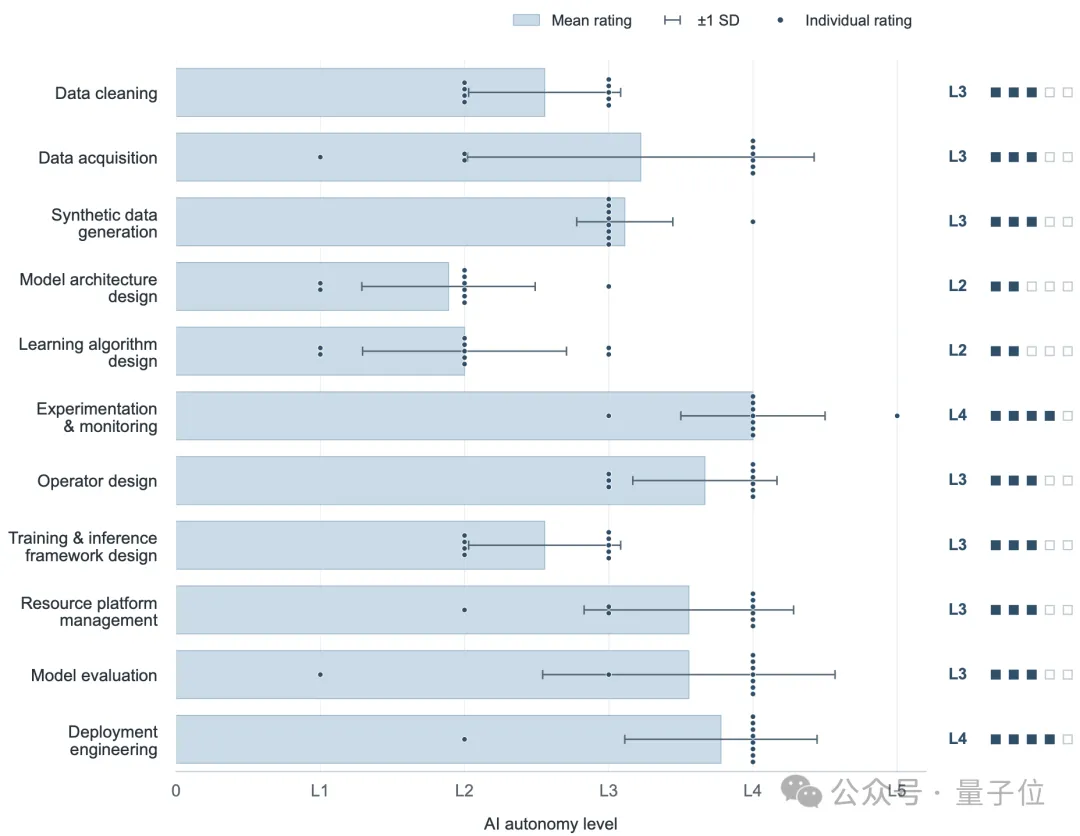
To assess this AI4AI approach beyond anecdotal impressions, the team divided development into 11 task categories and asked core participants to rate agent autonomy on an L1–L5 framework.
Experiment monitoring and deployment reached L4: with goals and constraints supplied by humans, agents could plan, execute and adapt to feedback. Model architecture and learning-algorithm design remained at L2, where agents mainly implemented existing approaches and ran predefined experiments. Research direction and critical design choices still required human leadership.

The task-level ratings averaged assessments from nine core participants. They indicated substantial operational assistance, not autonomous control of the entire research process.
When falling loss concealed declining capability
Agents did not eliminate training failures. During one run, loss continued to fall even as model capabilities deteriorated sharply. The team eventually traced the problem to data sharding and shuffling: the proportions of data actually entering training fluctuated away from the intended mixture.
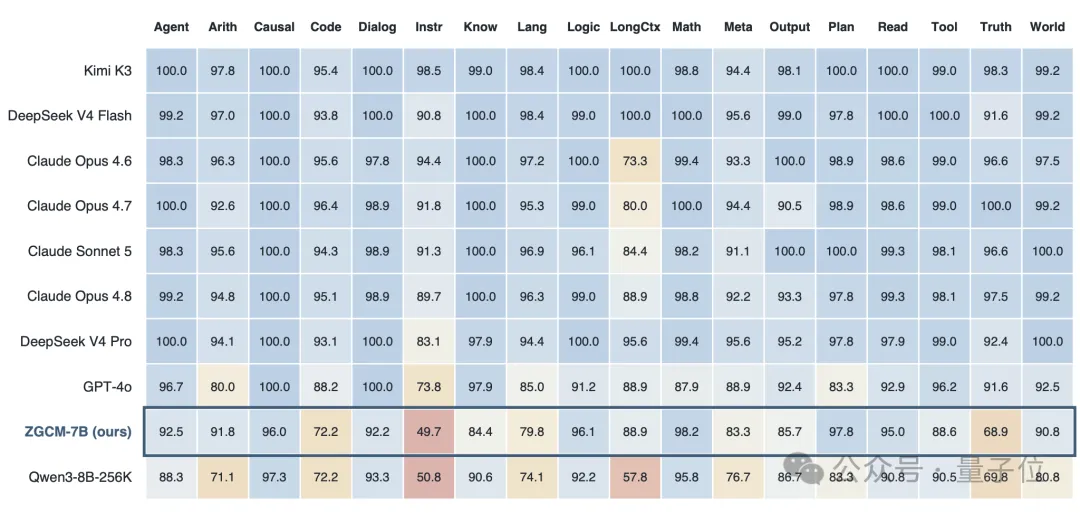
Afterward, the researchers saved intermediate checkpoints more frequently and monitored knowledge, mathematics, coding and reasoning capabilities rather than relying on loss alone. They developed ACE, an atomic-capability evaluation system covering 18 categories and 183 capabilities with 2,503 probes.
Their internal distributed evaluation system completed a diagnostic round in roughly two to three minutes. This helped identify which abilities improved or regressed after a change and whether to investigate the data or training method next.
There were also moments of encouragement. Halfway through training, the team asked the model to write a song, and it succeeded. Seeing a model they had trained from random parameters produce that output felt different from using someone else's system. They celebrated at the hotpot restaurant where the project began.

Using efficiency gains to test more ideas
Managing a training project changed how the students evaluated research efficiency. Each hypothesis consumed accelerator time, making faster training valuable not just for cost reduction but also for the opportunity to test additional ideas.
Their original plan to give a small model more reasoning time created a context-management problem. Extended reasoning, search and repeated tool calls accumulate information that the model must handle affordably.
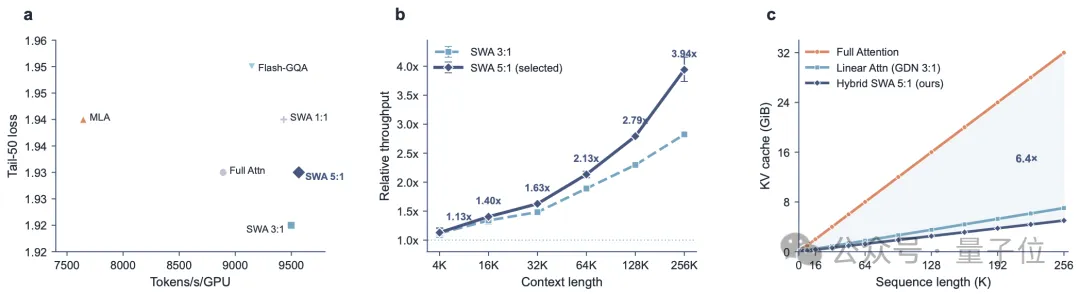
The team combined local and global attention and progressively extended the context window from 16K to 64K and then 256K. At 256K, the design reportedly delivered approximately 3.94 times the throughput of full attention while reducing KV Cache usage to about one-sixth.
They also combined Muon with FP8 and used delayed scaling and TWEO to suppress extreme activations and stabilize low-precision training. In 16K-context pretraining, the complete approach reportedly improved efficiency in reaching the same loss by about 4.2 times relative to a standard BF16/AdamW baseline.
Long-context capacity alone was insufficient for agentic tasks. The model also needed to choose search results, recover from tool failures and revise plans when new evidence arrived. The researchers reorganized interaction trajectories into states and actions, teaching next-step decisions from the current task, interaction history and latest feedback.
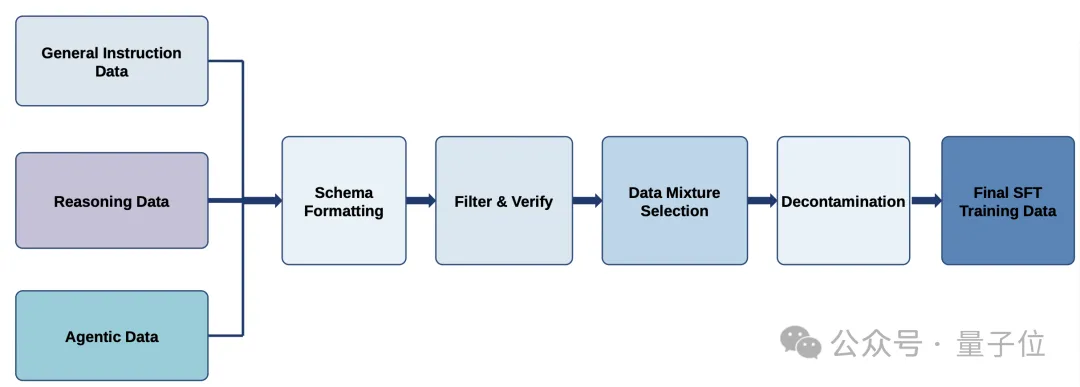
Experiments also exposed data trade-offs. During supervised fine-tuning, stricter quality filtering reduced the sample count by approximately 44.9% while improving overall evaluation performance, although not every capability benefited. Too much long-chain-of-thought data weakened instruction following, and agent-oriented data could not be trained independently of general capabilities.
These findings shifted the team's attention toward the conditions under which a method works and the costs it imposes, rather than treating an improvement as universally beneficial.
Releasing the model and its development record
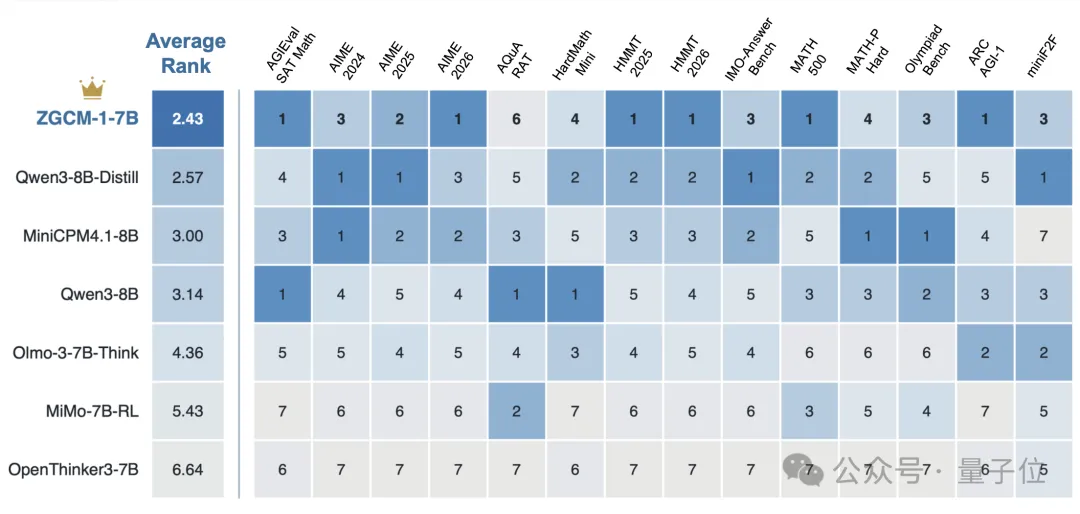
In the final comparisons, the team reported that ZGCM-1 held a leading position among similarly sized models across 14 reasoning evaluations. Selected search and tool-use results also suggested potential for smaller models.
The release extends beyond final weights. Training-stage weights, intermediate checkpoints, code, data recipes and logs are intended to let researchers trace how capabilities emerged and inspect the consequences of individual changes.
The public resources include the ZGCM-1 technical report and training and data-processing code in the zgcagi/ZGCM-1 repository, model weights under zgcagi/ZGCM-1-7B, and training data under zgcagi/ZGCM-1-Data.
The team has already begun experimenting with models at the 400B and 500B scales. Whether its 7B-stage methods transfer, and how much additional work its agent teams can absorb, remain questions for further experiments. The researchers plan to continue recording and sharing that work.
Project participants
He Jiyan of Beijing Zhongguancun Academy and the Zhongguancun Institute of Artificial Intelligence supervised the project. Faculty and students from the AI core division, the Software Intelligence Institute and Future Lab contributed.
The listed core members, in surname-pinyin order, are Feng Wenjun, Guan Haoxiang, Guo Junyi, Liang Guang, Liu Hao, Shen Yifei, Sun Jinbo and Xie Yantai. Additional participants and supporters are Chen Kai, Li Yatao, Liu Tieyan, Ren Yuxuan, Shao Bin, Wei Chuyang, Xu Xueyin, Zhang Xiaoqing, Zhao Wanghongxuan, Zheng Shuxin, Zhou Kexin, Zhu Minghang and Zhu Wenhui.