
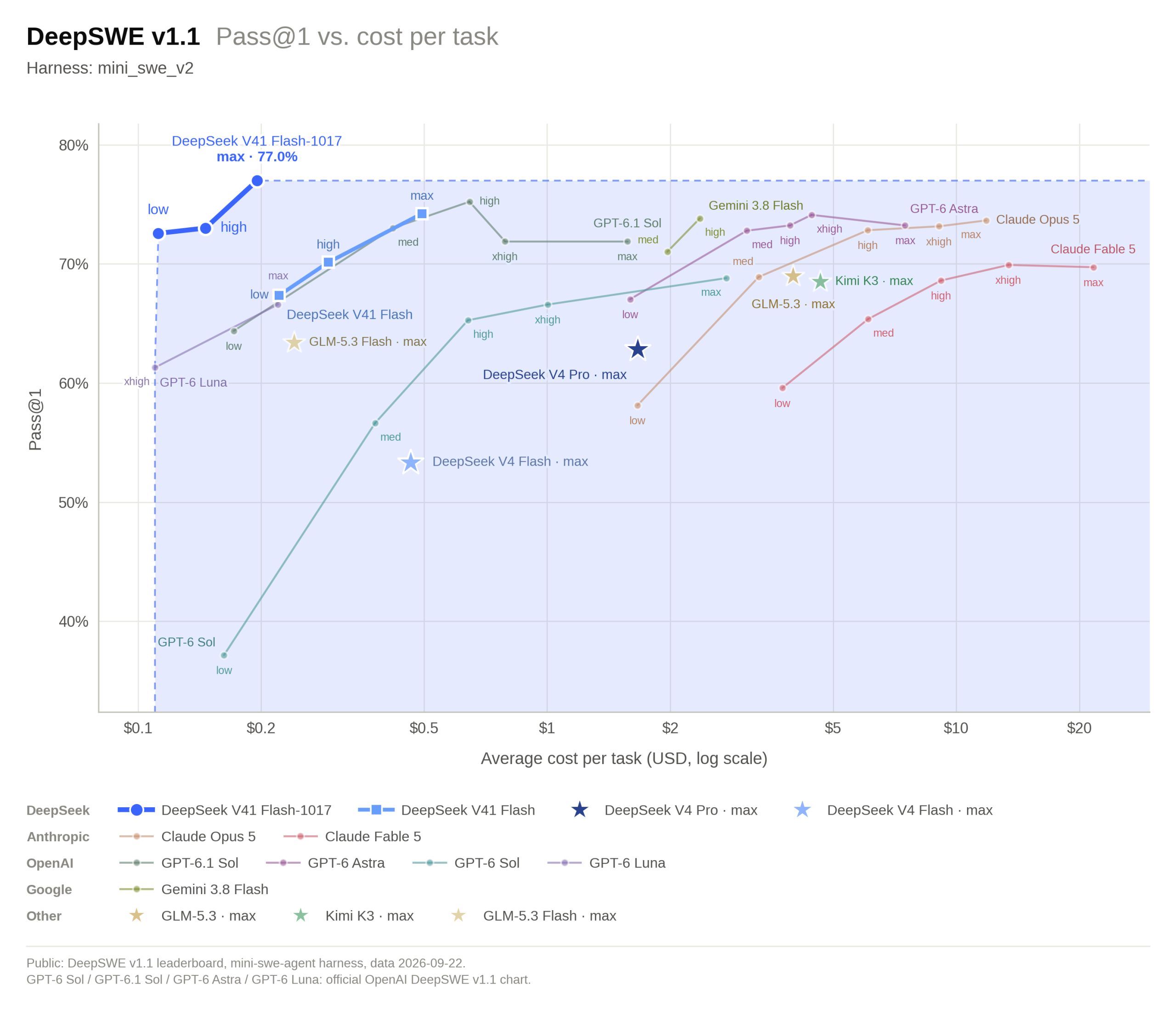
DeepSeek-V4.1-Flash-1017 is now available. Existing DeepSeek API clients continue to use deepseek-flash, with no change to the model calling method or token pricing. This guide focuses on model IDs, integration checks and the separate costs of model tokens and web tools.
Identify the model and the endpoint
The official changelog records the October 17 update. DeepSeek-V4.1-Flash-1017 names the version; deepseek-flash is the official API identifier. A third-party gateway may use a provider prefix, so check that service's documentation instead of assuming its naming matches DeepSeek's.
The integration guide lists https://api.deepseek.com for OpenAI-format clients and https://api.deepseek.com/anthropic for Anthropic-format clients. The protocol, request body and endpoint must agree; adding an arbitrary path to a base URL is not enough.
curl https://api.deepseek.com/chat/completions \
  -H "Content-Type: application/json" \
  -H "Authorization: Bearer $DEEPSEEK_API_KEY" \
  -d '{"model":"deepseek-flash","messages":[{"role":"user","content":"Explain the purpose of a regression test."}],"stream":false}'
This is a Bash-style request example. Set your own Key in the environment variable first. It illustrates the request structure and contains no real credential; it is not a completed inference test. Start with a short request to check authentication and response handling, then add long context and tools.
Validate the project workflow separately
DeepSeek's announcement includes game and 3D-scene demonstrations. This is the original browser-racing example. Such results depend on an execution harness, project files and tool feedback in addition to model inference.
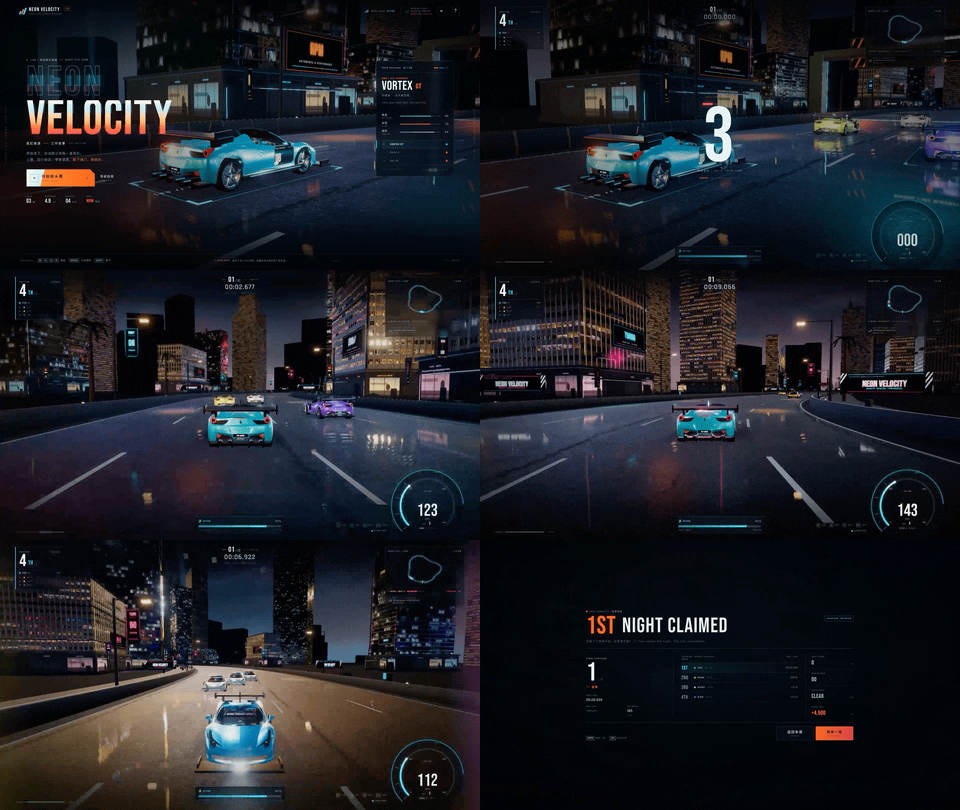
For a trial in your coding client, name the repository, reproduction steps and permitted edit scope. Check whether the agent reads the right files, runs the relevant validation and produces a reviewable patch. A convincing browser preview and maintainable application code need separate inspection.
Read the benchmark conditions
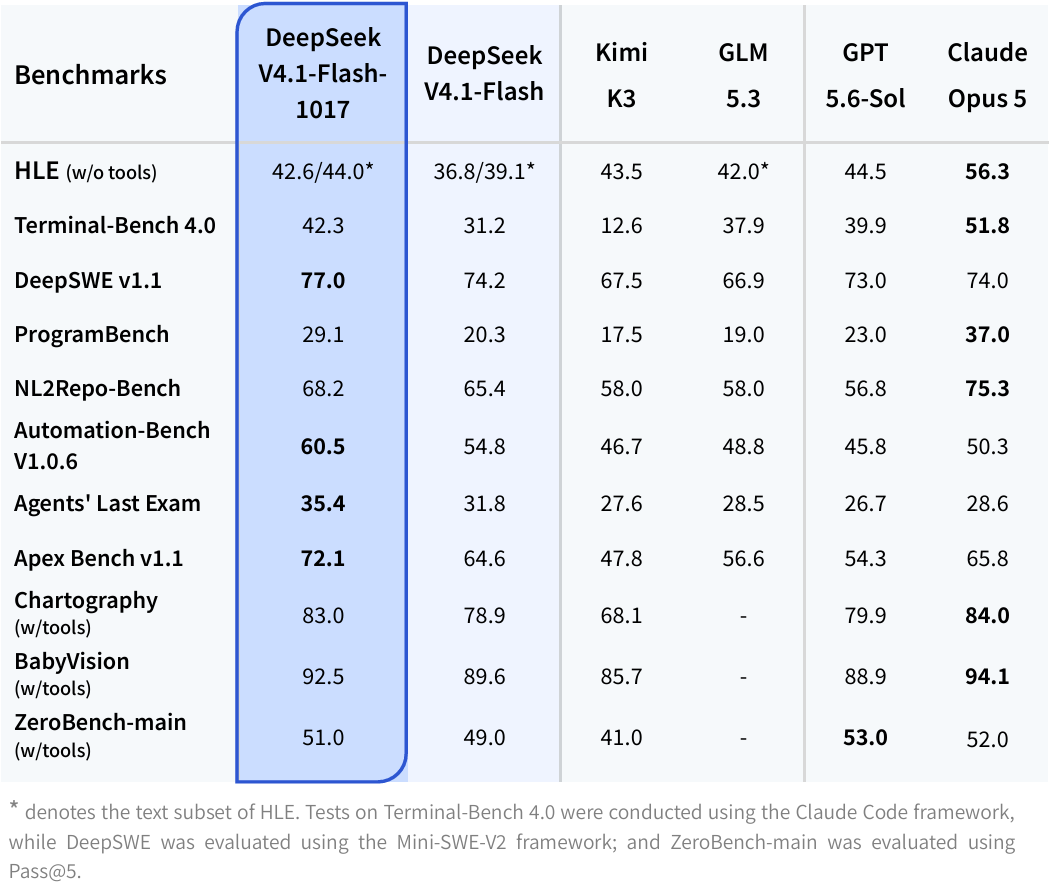
DeepSWE v1.1 in this table is a benchmark, not a second model. The tests also use different harnesses. For a comparison of your own, hold the project snapshot, prompt, tools and attempt budget constant, then record completion, latency and human intervention.
DeepSeek recommends Harness 0.2.1-rc.1 or later. Other clients have their own integration details to verify, including returning tool output to the model, recovering from failed commands and preserving logs.
Calculate token charges by category
The official pricing table separates cached input, uncached input and output. Prices below are per million tokens:
| Category | Off-peak | Peak |
|---|---|---|
| Cached input | $0.003 | $0.006 |
| Uncached input | $0.15 | $0.30 |
| Output | $0.60 | $1.20 |
Peak hours are Monday–Friday, 01:00–04:00 and 06:00–10:00 UTC, excluding Chinese public holidays. Other hours are off-peak. Use the actual cache-hit breakdown, token usage and request time when calculating cost.
Search and Fetch have separate charges
The Search & Fetch guide documents two standalone endpoints: POST /v1/tools/search and POST /v1/tools/fetch. They use the DeepSeek API key to find pages and retrieve page content.
Each is listed at $0.75 per 1,000 successful requests. A transition applies to calls generated by server-side tools in Harness, Claude Code and Codex: those calls become billable at 00:00 Beijing time on November 1, 2026, or October 31 at 16:00 UTC. Account for tokens, Search and Fetch separately.
Before rolling out an automated workflow, set a request budget and retain usage records alongside the completed result. Because a model alias can move to a new version, keep regression examples for outputs your application depends on.