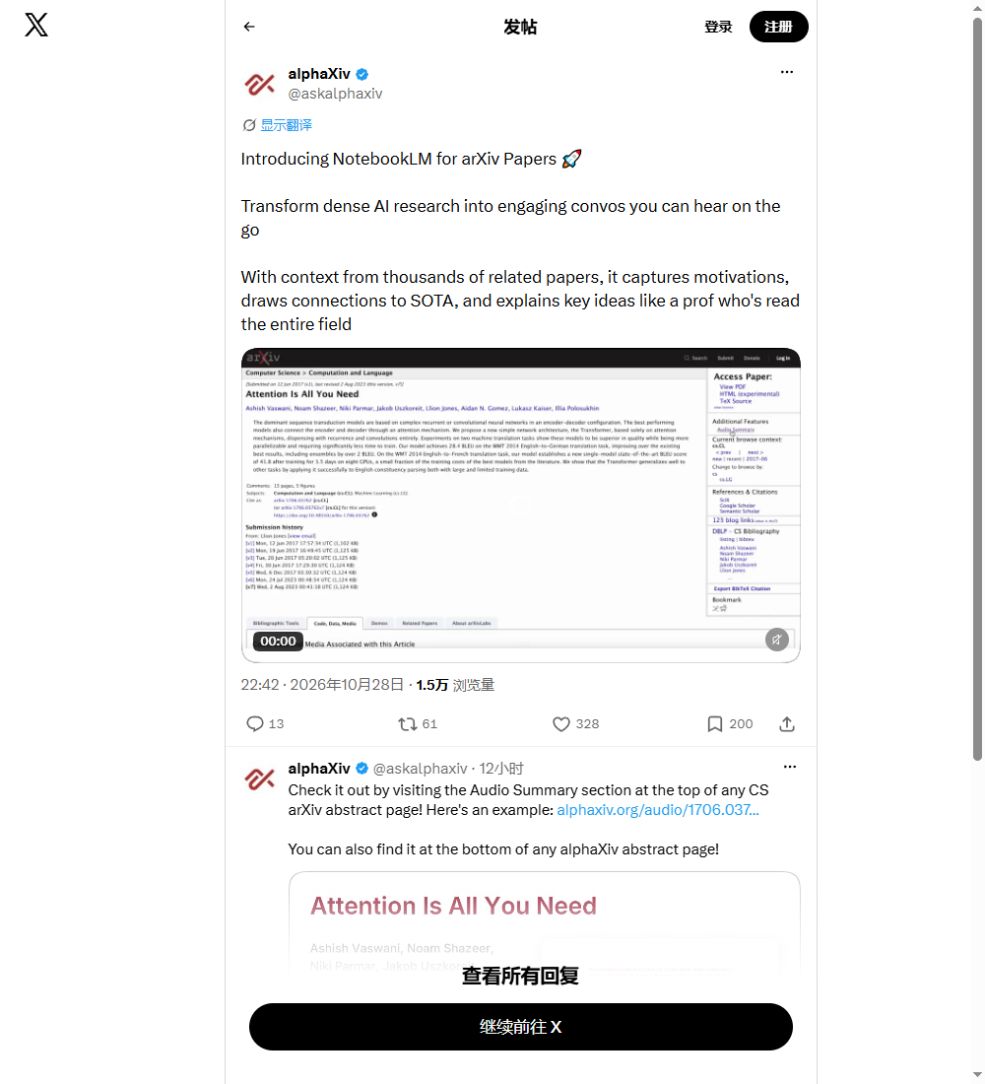
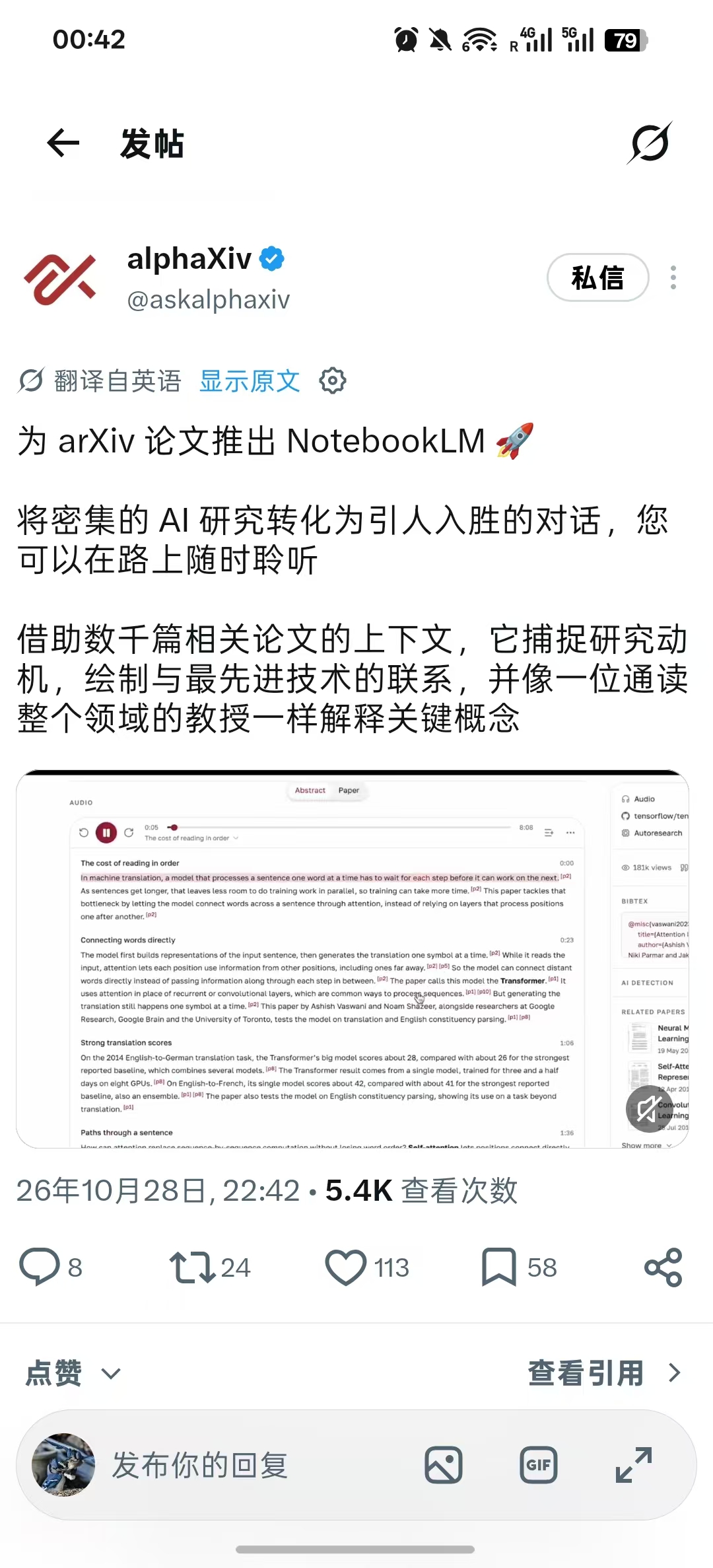
alphaXiv announced audio explanations for arXiv papers on October 28. The feature turns dense research into a discussion readers can follow before returning to the paper. Its comparison with NotebookLM describes the experience; the announcement does not establish a Google NotebookLM integration or partnership.
Why the first pass matters
The hardest part of an unfamiliar paper is often understanding why its problem matters. alphaXiv says its explanations use related research to connect motivation, concepts and the state of the art. Its reference to thousands of related papers is a claim about context, not evidence that every explanation individually verifies thousands of publications.
Listening can help readers form questions before encountering equations and experimental tables. It is particularly useful when deciding which papers deserve closer attention. A smooth explanation cannot establish that a proof is correct or that a comparison used equivalent conditions.
Find the audio and keep the paper nearby
The follow-up announcement points to Audio Summary and offers Attention Is All You Need as an example. Use the audio link below or find the audio section on the corresponding alphaXiv paper page. We checked the player and full-transcript control; this was a feature and source check, not an accuracy benchmark across papers.
Start with a paper you already know. Familiarity makes it easier to notice a missing assumption, an analogy taken too literally or a background connection that needs qualification. This provides a reference point before relying on the feature for a new field.
A listen-then-read routine
Read the title and abstract and write down the research question. Listen once, listing unfamiliar terms and important claims. Locate those claims in the transcript, then return to the method, experiments or limitations in the original paper. Move checked statements into your reusable notes.
For the Transformer paper, useful questions concern the change in sequence processing, how attention connects positions, and the tasks supporting the results. Audio can organize those questions. Complexity, training conditions and comparison fairness still require the paper itself.
Match the tool to the task
Audio is a good candidate for screening a reading list, preparing for discussion or refreshing an idea. Reproducing an algorithm, quoting a numerical result or evaluating a proof needs closer inspection. A single omitted condition can turn a narrow finding into an overly broad conclusion.
Keep the paper identifier and version in your notes. Revisions and new related work can change the context. A note linked to a specific paper is easier to revisit than an isolated paraphrase. The announcement does not establish universal subject coverage, a complete language list or a uniform price.
Measure the benefit on your reading list
Choose three papers of different difficulty. After listening, summarize the problem, methodological change and a major limitation. Compare this with the original and record correction time. The relevant result is whether the tool improves understanding after verification time is included.
Students and developers entering another field may value the lower starting cost. Researchers may prefer screening and revision. Close reading remains necessary, but a well-used audio explanation can make it more focused.
English original and Chinese screenshot