
On November 24, 2026, OpenAI published a research report and preprint titled GPT-6 as a Universal Foundation Model for Protein Biology: Beyond Specialized Models, demonstrating that models in the GPT-6 family can generate 3D protein backbones and amino acid sequences directly through natural-language reasoning and general-purpose Python code execution—without invoking specialized biology generative models during design generation.
Wet-lab validation with Onava across minibinders and antibodies
Working with laboratory partner Onava, OpenAI validated structure and sequence designs generated by a pre-release version of GPT-6.2 across three wet-lab experiments:
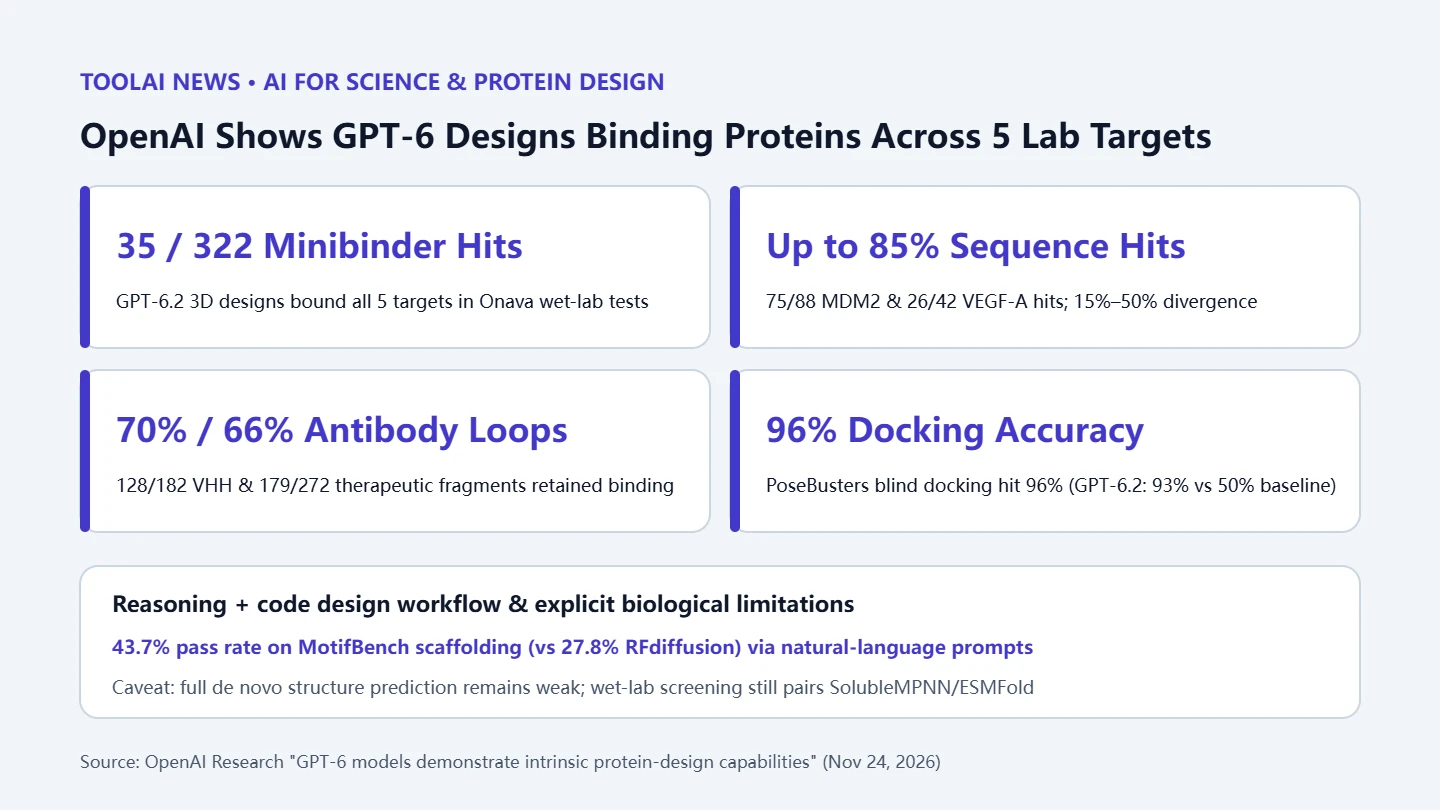
- De novo minibinder 3D backbones (Experiment 1): Given 3D structures of five target proteins and prompted attachment sites, GPT-6.2 wrote code to generate minibinder shapes from scratch (with SolubleMPNN supplying sequences and specialized predictors filtering candidates). Out of 322 tested minibinders, 35 (10.9%) bound their intended targets, producing at least one hit on all five targets: 18 hits for IL-17A, 8 for VEGF-A, 5 for PD-L1, 3 for IL-7Rα, and 1 for TrkA.
- Sequence design for fixed 3D structures (Experiment 2): When given predicted 3D structures with original sequences withheld, GPT-6.2’s proposed sequences bound in 75 of 88 designs for MDM2 (85%), 26 of 42 for VEGF-A (62%), and 8 of 59 for PD-1 (14%), with median sequence divergence of 15% to 50% from reference proteins. Tested on three unpublished GPT-6.2-generated backbones (PD-L1 and IL-7Rα), 14 of 107 sequences (13.1%) bound—including two PD-L1 binders differing at 52 and 58 of 90 amino acids from the original sequence, ruling out simple training-set memorization.
- Antibody binding-loop redesign: Asked to redesign three CDR binding loops across six IL-4Rα VHH nanobodies, 128 of 182 designs (70%) retained binding. Modifying roughly half the amino acids across three loops in five therapeutic antibodies yielded binding in 179 of 272 tested fragments (66%) against PD-1 or PD-L1.
Computational scaffolding, small-molecule docking, and clear limitations
Across 14 computational biology tasks, OpenAI’s latest internal GPT-6 research model passed 43.7% of 30 MotifBench enzyme/interface scaffolding tasks (versus 27.8% for RFdiffusion), passed 18.9% of 200 CATH specified-fold challenges (versus 17.1% for Proteina), and matched observed small-molecule binding poses on PoseBusters blind docking in 96% of scored predictions (93% for GPT-6.2 versus 50% for DiffDock-L).
At the same time, OpenAI highlighted concrete limitations: predicting complete protein 3D structures from sequence alone remains a clear weakness for GPT-6 models; wet-lab minibinder hit rates were lower than those reported in the original RFdiffusion study (though sensitive to pre-lab filtering thresholds); and practical lab pipelines still paired GPT-6 with specialized sequence/folding tools such as SolubleMPNN, ProteinMPNN, and ESMFold commonly hosted on platforms like Hugging Face and Replicate.
Related pages
Review specifications for the GPT model family on ToolAI, or explore general reasoning and open bio-ML ecosystems via ChatGPT, Hugging Face, Replicate, and LangChain.
Source: OpenAI Science Publication: GPT-6 models demonstrate intrinsic protein-design capabilities