Anthropic's AI Cryptanalysis Results
Cryptographer Matthew Green has published a blog post analyzing Anthropic's latest cryptanalysis results, which were produced by an unreleased model called Claude Mythos. The AI achieved two notable outcomes: an attack on the post-quantum signature scheme HAWK and an improved attack on reduced-round AES.
According to Green, the HAWK attack could potentially kill a cryptographic scheme that was seriously being considered for standardization. However, Green emphasizes that the AI did not invent new mathematics; it simply combined known tools more thoroughly than humans have done. He quotes Claude's own assessment of its contribution, calling it 'embarrassing to read'—not for the AI, but for the field, as human cryptanalysts had missed such an obvious combination.
HAWK Attack Details
HAWK is a post-quantum signature scheme based on the module-LIP problem, related to Falcon but relying on a different hard problem. Its main selling point is efficiency. Anthropic's attack roughly halved the security bits, which could theoretically be compensated by doubling key sizes, but that would negate HAWK's raison d'être. The attack code successfully ran against weakened challenge instances within hours, though it did not directly break real deployment parameters.
AES Attack Details
The AES attack is less dramatic. It targets 7-round AES, which already had known attacks, and improves on a 2013 result by a constant factor. It requires 2^89 cryptographic operations and 2^105 chosen plaintext encryptions, which is far from a practical threat. Green describes it as 'a small increment to our knowledge.'
Methodology and Verification Bottleneck
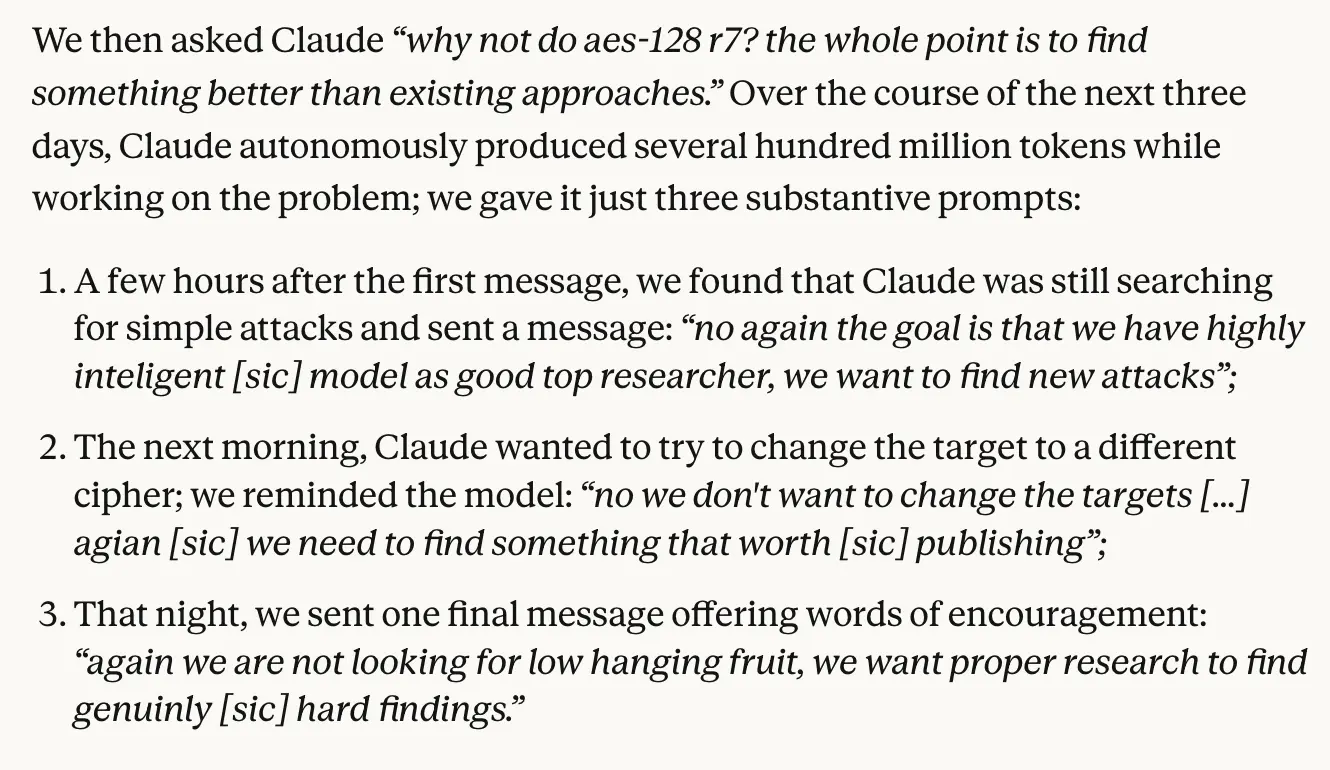
Anthropic's methodology involved instructing the AI to find results and letting it run until it succeeded. Green reviewed the prompts and found them revealing: the model can understand existing cryptanalysis literature, synthesize genuinely new attack paths, and execute extended tasks without detailed human intervention.
However, Green also cautions that models are better at producing outputs that look plausible but are misleading than at making real discoveries. Verification is becoming the new bottleneck, replacing generation. For the HAWK attack, verification was straightforward—run the code for a few hours. For subtler attacks like the AES one, verification is harder. Formal proof systems like Lean help, but writing the proposition itself is error-prone.
Green notes that recent high-profile mathematical results, including the Jacobian conjecture counterexample discussed on Tao's blog, share a pattern: they either come with machine-verifiable proofs, are computable counterexamples, or require extensive expert review. This is no coincidence.
Implications for Different Audiences
Green offers advice to three groups:
- Cryptography users: Symmetric ciphers are deliberately designed to be robust and hard to break; he doesn't think adding more AI intelligence will easily break them. AI will also help design stronger ciphers. Public-key cryptography is more fragile, but the field is migrating to post-quantum algorithms, so enhanced cryptanalysis comes at the right time.
- Scientists: This is the best time to have an AI collaborator that is powerful but not yet smart enough to fully replace you.
- Everyone: Don't dismiss these models as 'advanced autocomplete,' but don't think AGI has arrived either. Green uses a metaphor: working with these tools is like wading in a pond where the ground can suddenly drop off. You're in waist-deep water one moment, swimming the next. For experienced researchers, the line between capability and incompetence is easy to find, but it is slowly moving outward.
Claude Mythos has not been publicly released. These results serve as a capability demonstration, showing where that line currently lies.