
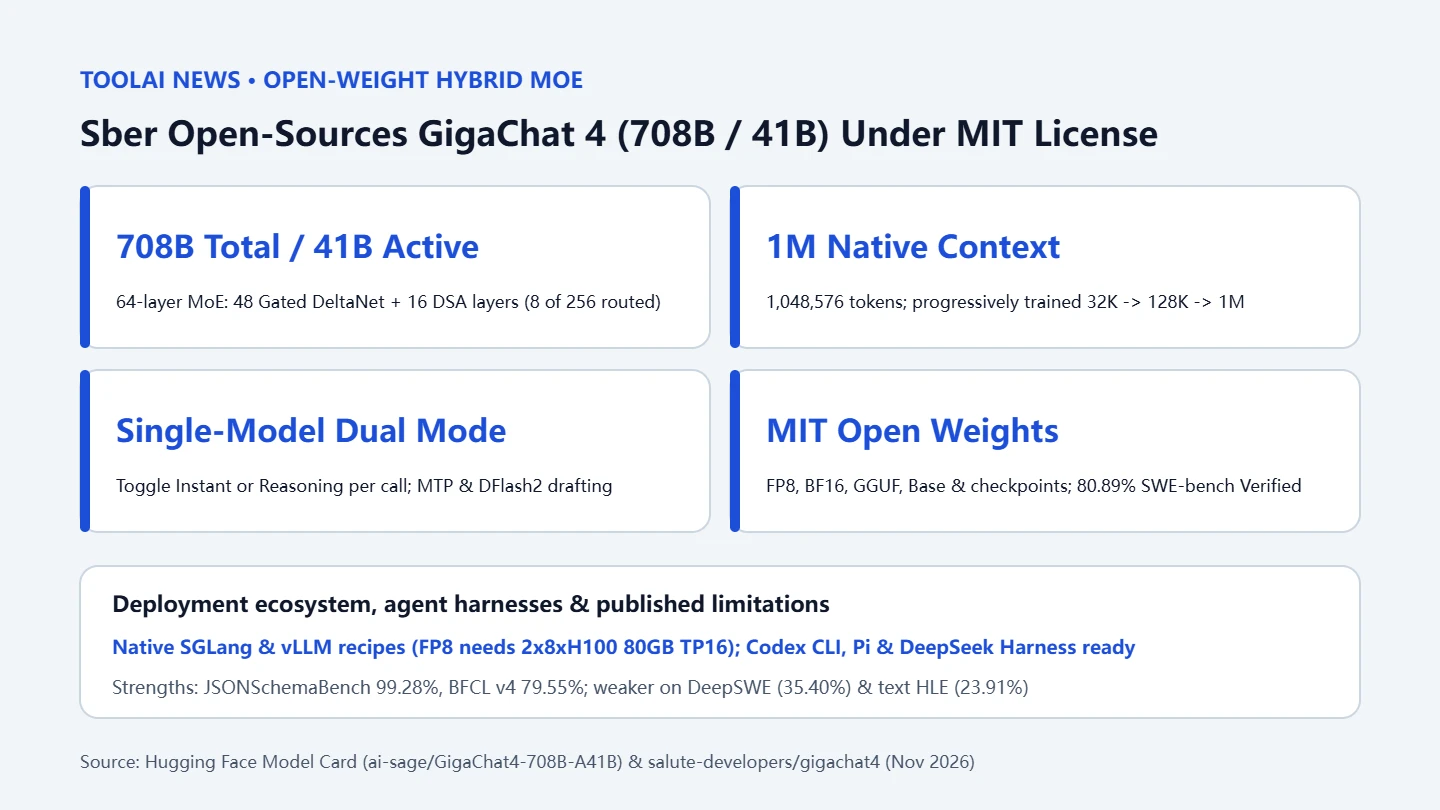
On November 26, 2026, Sber unveiled and open-sourced GigaChat 4 (ai-sage/GigaChat4-708B-A41B) under the permissive MIT License on Hugging Face and GitHub, with FP8, BF16, GGUF, base, and intermediate checkpoints ready for self-hosted inference via SGLang and vLLM. The flagship Mixture-of-Experts model pairs 708B total parameters (41B active per token) with a native 1,048,576-token context window and unifies fast responses and deep reasoning inside a single checkpoint.
Hybrid Architecture, Dual Modes, and Speculative Decoding
- 708B/41B MoE with 3:1 Hybrid Attention: Across 64 decoder layers (hidden size 7,168; initial 3 layers dense), GigaChat 4 interleaves 48 linear-attention Gated DeltaNet (GDN) layers and 16 DeepSeek Sparse Attention (DSA) layers. Each MoE block routes 8 of 256 experts plus 1 shared expert, while DSA attends to 2,048 selected historical tokens per query.
- Progressive 1M Context Scaling: Context length scaled sequentially from 32K to 128K and finally 1,048,576 tokens, training the DSA indexer before jointly optimizing indexer and backbone weights at full 1M length.
- Single-Checkpoint Instant and Reasoning Modes: Unlike GigaChat 3.5, which shipped separate checkpoints, developers toggle
chat_template_kwargs.reasoning(falseortrue, enabled by default) per OpenAI-compatible API call. - Recurrent MTP and DFlash2 Drafting: The model supports both a built-in recurrent Multi-Token Prediction (MTP) head—shrinking drafter parameters roughly 3× versus GigaChat 3.5—and a separate five-layer BF16 DFlash2 drafter predicting eight-token blocks.
Published Benchmarks and Objective Limitations
On Sber's Harbor-based evaluation suite in Reasoning mode, GigaChat 4 708B posts strong tool-use, structured output, and general software-engineering numbers: 99.28% on JSONSchemaBench, 80.89% on SWE-bench Verified (7-hour timeout), 88.82% on LiveCodeBench v6, 79.55% on BFCL v4, 83.31% on τ²-Bench, 96.67% pass@8 on AIME 2026, and 100.00% on NIH Complex retrieval.
However, the official model card shows clear gaps against competing frontier checkpoints tracked on our DeepSeek V, Qwen, and Mistral pages: DeepSWE reaches only 35.40% (compared with 53.10% for DeepSeek V4 Flash 0731 and 74.34% for DeepSeek 4.1 1017), τ³-Bench Banking stands at 18.03%, and Humanity's Last Exam (text-only, without tools) scores 23.91%. Long-context AA-LCR accuracy also drops from 70.33% in Reasoning mode to 48.00% in Instant mode, and the official language metadata covers Russian and English primarily.
Developer Impact and Deployment Requirements
Full-precision FP8 serving targets multi-node clusters—the documented SGLang (commit ff14289793) and vLLM (PR #69762) recipes run across two 8×H100 80GB nodes (TP16)—while GGUF quantizations target local experimentation alongside ecosystems such as Ollama, LM Studio, and hosted endpoints like Together AI. The repository also ships drop-in profiles for Pi, Codex CLI, and DeepSeek Harness.
Related Links
Explore Hugging Face, Ollama, LM Studio, Together AI, and our DeepSeek V model tracker on ToolAI.
Sources: Hugging Face Model Card (ai-sage/GigaChat4-708B-A41B) · GitHub salute-developers/gigachat4 · SGLang GigaChat 4 Cookbook