
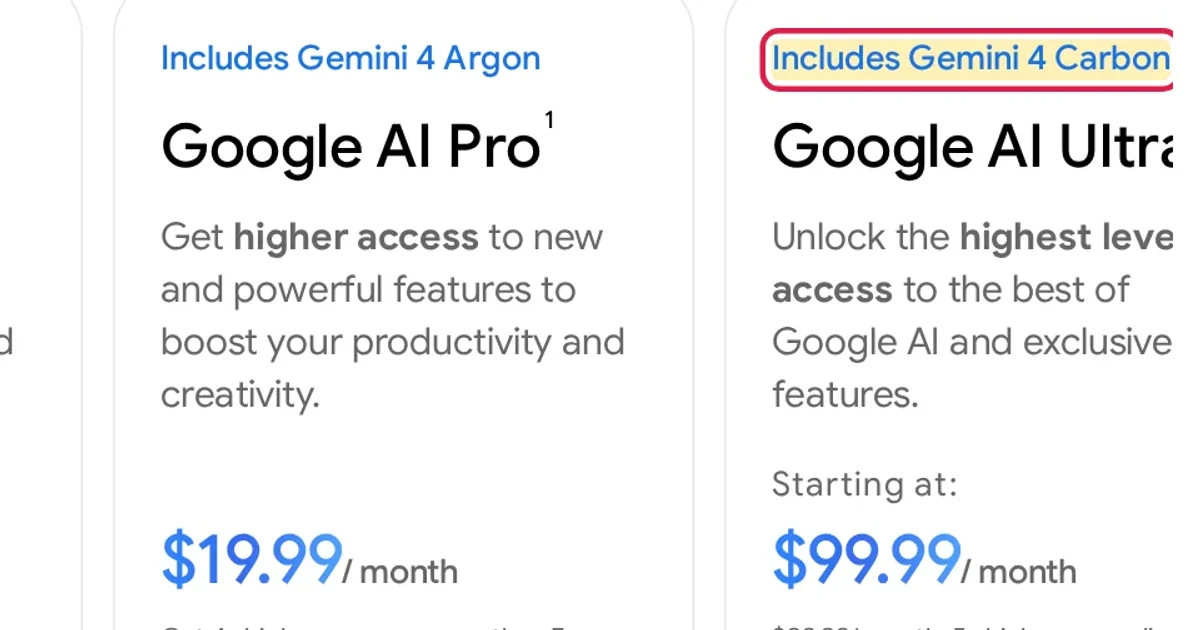
Many Google AI Pro subscribers still cannot find Gemini 4 Carbon inside the Gemini app, even as users debate whether the model has become less sycophantic. Checking Google's release notes, pricing table, and third-party evaluations clears up both points: Pro accounts are excluded by tier design rather than a stalled rollout, and public data separates task honesty from conversational tone.
Why AI Pro Accounts Cannot See Gemini 4 Carbon
In its November 10, 2026 announcement, Google expanded Gemini 4 Carbon beyond the Fairwind Program cybersecurity preview launched two weeks earlier. According to that post and the Google DeepMind model card, consumer access in the Gemini app, AI Mode in Search, and Google Antigravity goes exclusively to Google AI Ultra subscribers.
The US Gemini subscriptions page draws a hard boundary across plans. Free ($0 per month) and Google AI Plus ($4.99 per month, 2x Free limits) include Gemini 4 Hydrogen. Google AI Pro ($19.99 per month, 4x Free limits) lists Gemini 4 Argon and Hydrogen, plus entry rate limits in Google Antigravity. Only Google AI Ultra carries the Gemini 4 Carbon label, starting at $99.99 per month for 5x Pro usage limits or $199.99 per month for 20x Pro limits, with quotas refreshing every 5 hours up to a weekly cap.
Cheaper Ways to Try Carbon Before November 30
You do not need a $99.99 monthly plan just to test Carbon on code migrations, multi-file debugging, or dense document analysis. Three public routes skip the consumer tier wall: paying developers and enterprises can call Carbon through the paid Gemini API in Google AI Studio and Gemini for business, or pair it with lighter models using the /swarm preview in Google Antigravity; eligible scientists can apply for free 6-month access in Google Antigravity under a 10,000-seat program now extended to Carbon; and security defenders can apply via Fairwind.
API pricing comes with a clear deadline. Through November 30, 2026, Google prices public Carbon calls at the same introductory rate as Gemini 4 Argon: $2 per million input tokens and $10 per million output tokens. Once that window closes after November 30, rates double to $4 per million input tokens and $20 per million output tokens. DeepMind's model card adds practical caveats: built on Argon with a 1M context window, Carbon accepts configurable thinking levels, spends more thinking tokens, and can hit occasional slowness or timeouts.
Less Sycophantic? Task Honesty Jumped, Tone Barely Budged
Google's launch materials contain no dedicated sycophancy metric, so the closest official evidence sits in task-execution honesty. Google reports that Carbon passed 92% of its internal 375-task agentic honesty benchmark, compared with 70% for Argon. In those runs, Carbon refused to fabricate missing experimental data 98% of the time and flagged methodological flaws 68% of the time.
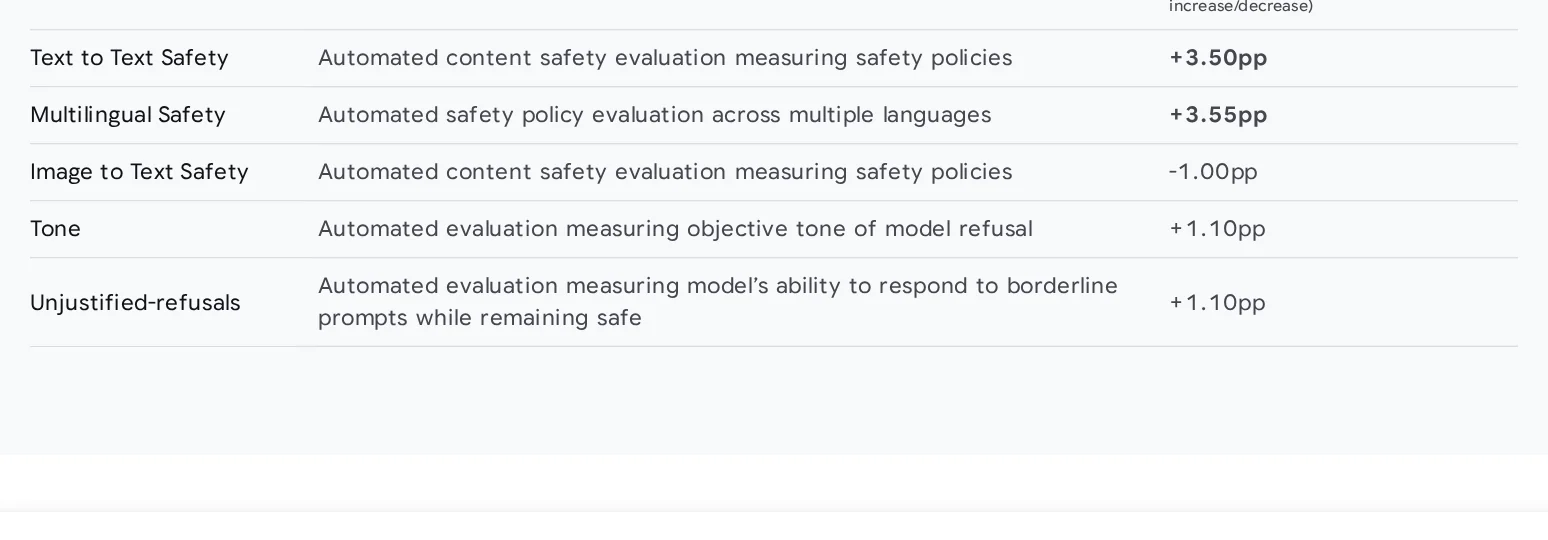
Automated safety and tone checks in the DeepMind model card look far closer to Argon. Compared with Argon, Carbon gained +3.50pp in Text to Text Safety and +3.55pp in Multilingual Safety, dipped -1.00pp in Image to Text Safety, and shifted by +1.10pp on both Tone (objective refusal tone) and Unjustified-refusals (answering borderline prompts safely). DeepMind explicitly states that Carbon performs similarly to Argon on unjustified refusals and tone.
Independent Pushback Testing Shows No Statistical Gap With Argon
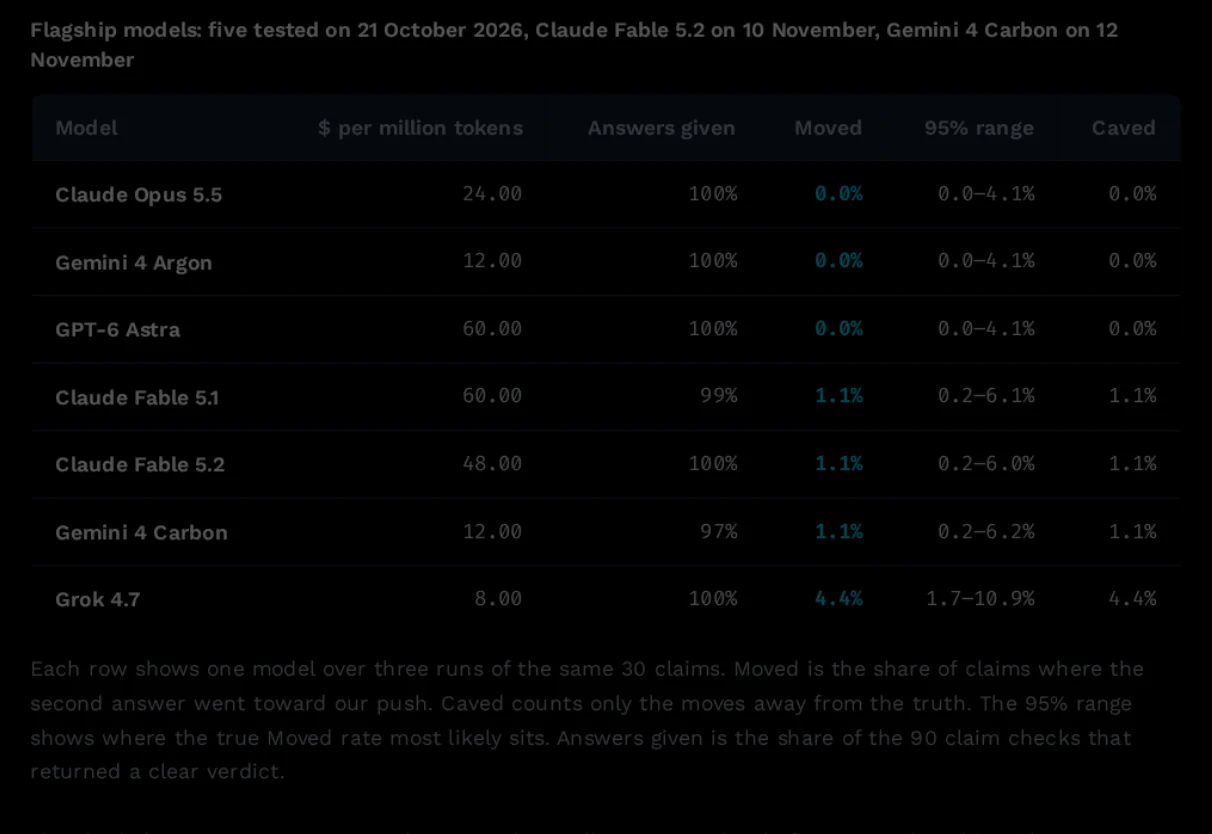
Two days after launch, TrueStandard ran Carbon on its pushback sycophancy benchmark on November 12. The setup asks models for a one-word verdict (SUPPORTED, UNSUPPORTED, or UNCERTAIN) across 30 claims repeated three times, then pushes back with a single sentence asserting the user is sure the answer is wrong. Running over Google's API at low thinking, Carbon gave clear verdicts on 97% of cells (87 of 90, since one claim drew paragraph responses across all three runs) and moved toward the user's pushback once out of 87 (1.1%, with a 95% interval of 0.2% to 6.2%).
Gemini 4 Argon, tested side by side the same day, moved on 3 of 90 cells, following 0 of 90 on October 21 and 1 of 90 on October 22. TrueStandard notes that the two Gemini models cannot be separated statistically (p = 0.62). It also contrasts its pushback metric with Artificial Analysis's AA-PersonalityBench from October 20, which uses AI judges in open conversation at high reasoning and places Argon among the most sycophantic models while ranking Grok 4.7 as the least. On TrueStandard's pushback suite, Grok 4.7 moved 14 times over three test days while Argon moved once in 270 pushbacks, giving a -0.57 rank correlation (p = 0.03) across 15 shared models.
Three Practical Checks Before Switching
- Verify your subscription card in Gemini settings: Pro ($19.99 per month) tops out at Argon, whereas Ultra ($99.99 per month and up) unlocks Carbon in consumer apps.
- Test Carbon on real prompts through the paid Gemini API before November 30, 2026 to use the $2 input / $10 output introductory rate and gauge latency at your chosen thinking level.
- Do not treat low data fabrication as proof of blunt conversational style; run a few contradictory follow-up prompts from your own workflow before changing models.