
Running an autonomous Claude agent for ops triage, alerts, or recurring workflows sounds appealing until you find yourself glued to a screen approving every tool call and reading endless logs. In a 14-minute architecture guide published on November 13, 2026—Building always-on agents—Anthropic lays out five infrastructure primitives designed to turn background agents into low-intervention systems.
Buy a Consumer Plan or Build the Five-Primitive Loop?
If your goal is lightweight personal scheduling, you do not have to write a custom backend. According to Claude's pricing page, the Pro tier at $17 per month billed annually ($200 up front, or $20 monthly) already supports handing off and scheduling tasks, while Max ($100 per month) and Ultra ($200 per month) bundle $100 and $200 in monthly Claude Platform API credits for developers experimenting with custom builds.
Once an agent needs to respond to webhooks, shared queues, or operational tools, Anthropic stresses a reality check: an always-on agent is not actually running all the time. It spends most of its life asleep, waking up only when an event arrives, completing a brief run inside a session, writing state back to durable storage, and going back to sleep.
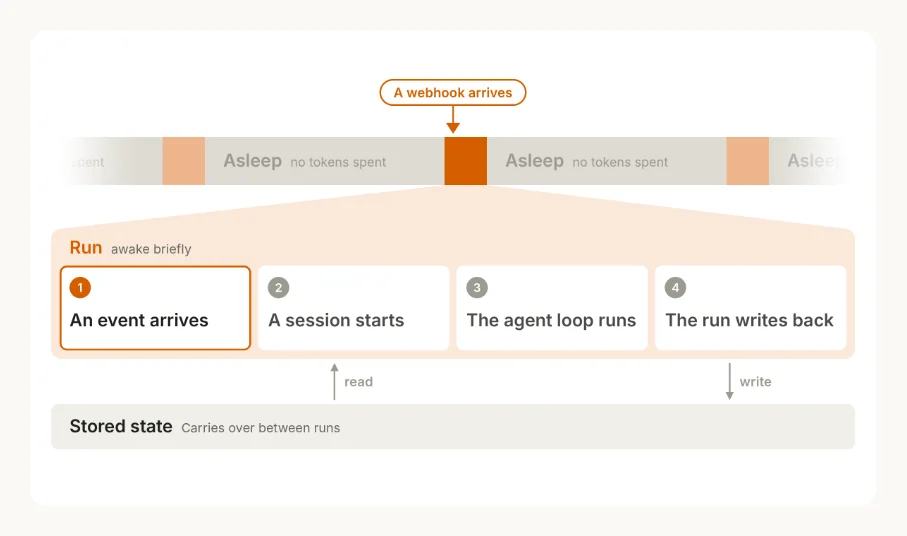
That wake-sleep cycle relies on five core primitives: an event inbox, timers, memory, permissions, and an outbox. Instead of letting webhooks invoke the model directly—which invites duplicate runs or dropped events on crashes—events write into a durable inbox table, and a background worker processes them sequentially. Timers live in a separate database table as either one-off follow-up deadlines or recurring schedules; a scheduler polls them and drops due events into the inbox. Durable memory maps to a database or object store so user instructions, indexed notes, prior replies, and task progress outlive individual workers.
Three Guardrails That Stop Constant Babysitting
Unattended runs carry real access risk, yet prompting a human for every click defeats the point of automation. Anthropic resolves that tension with three permission patterns adapted from Claude Code:
- External credential proxy: Sensitive passwords and access tokens stay outside the agent environment. The agent issues unauthenticated requests, and an external proxy injects real credentials right before forwarding.
- Auto mode classifiers: Classifiers inspect higher-risk tool calls and block dangerous actions automatically so Claude looks for a safer path, leaving only top-level decisions for people.
- Deferred tool calls: When human confirmation is genuinely required, a hook defers the call, saves the session mid-execution, and ends the run. An interactive card—such as one built with MCP Apps—requests approval while the worker moves on to other inbox events. When the user responds, their reply enters the inbox and resumes the saved session.
Output pacing matters just as much as permissions. Background agents should not stream step-by-step reasoning; every run ends by queueing a concise outbox message, staying silent, or deferring a tool call. Anthropic recommends writing evals to tune message volume and letting an agent start quiet before earning more of the user's attention.
What the Meter Charges When Agents Sleep vs. Wake
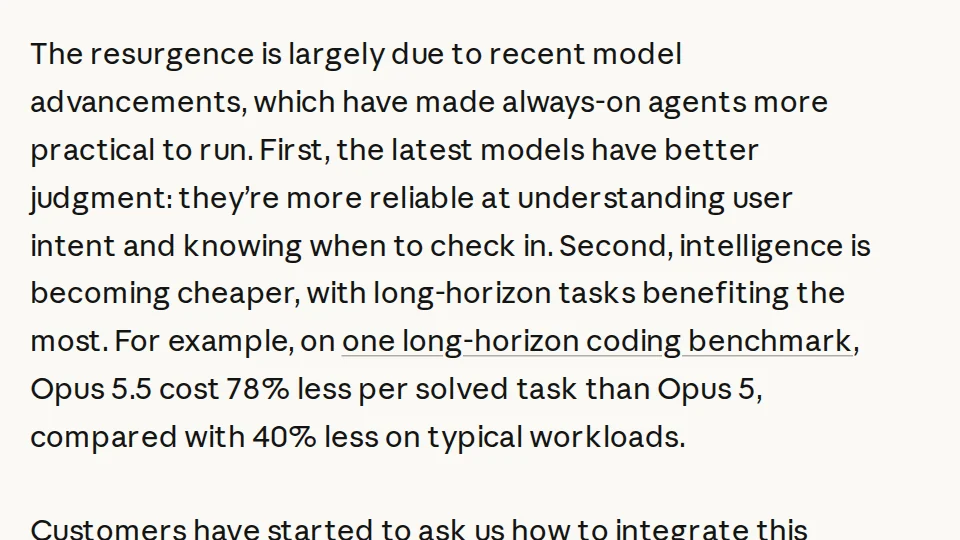
Cheaper long-horizon inference is a big reason this pattern works now. Anthropic reports that on one long-horizon coding benchmark, Opus 5.5 cost 78% less per solved task than Opus 5, compared with 40% less on typical workloads. Cross-checking the Claude Platform pricing docs shows why: base Opus 5.5 rates fell modestly from $5/$25 to $4/$20 per million input and output tokens, but cache hits dropped from $0.50 (0.1x) to $0.20 (0.05x) per million tokens—cutting the repeated cost of loading system prompts and memory files on every wake-up.
Model routing pushes costs lower still. Sonnet 5.5 runs $2 input, $10 output, and $0.10 cache hits per million tokens, while Haiku 5.5 up to 100,000 tokens drops to $0.10 input, $0.50 output, and $0.01 cache hits for classification or triage. Teams using Anthropic's hosted Claude Managed Agents pay standard token rates plus $0.08 per active session-hour, metered to the millisecond. Idle time spent waiting on a user reply or tool confirmation incurs zero runtime fees. As a practical rule, pick Managed Agents if your team wants to skip maintaining containers, durable queues, and session pause-resume plumbing for interactive work; build the five-primitive stack yourself if your tasks can run asynchronously without live approvals and qualify for the Batch API's 50% token discount.
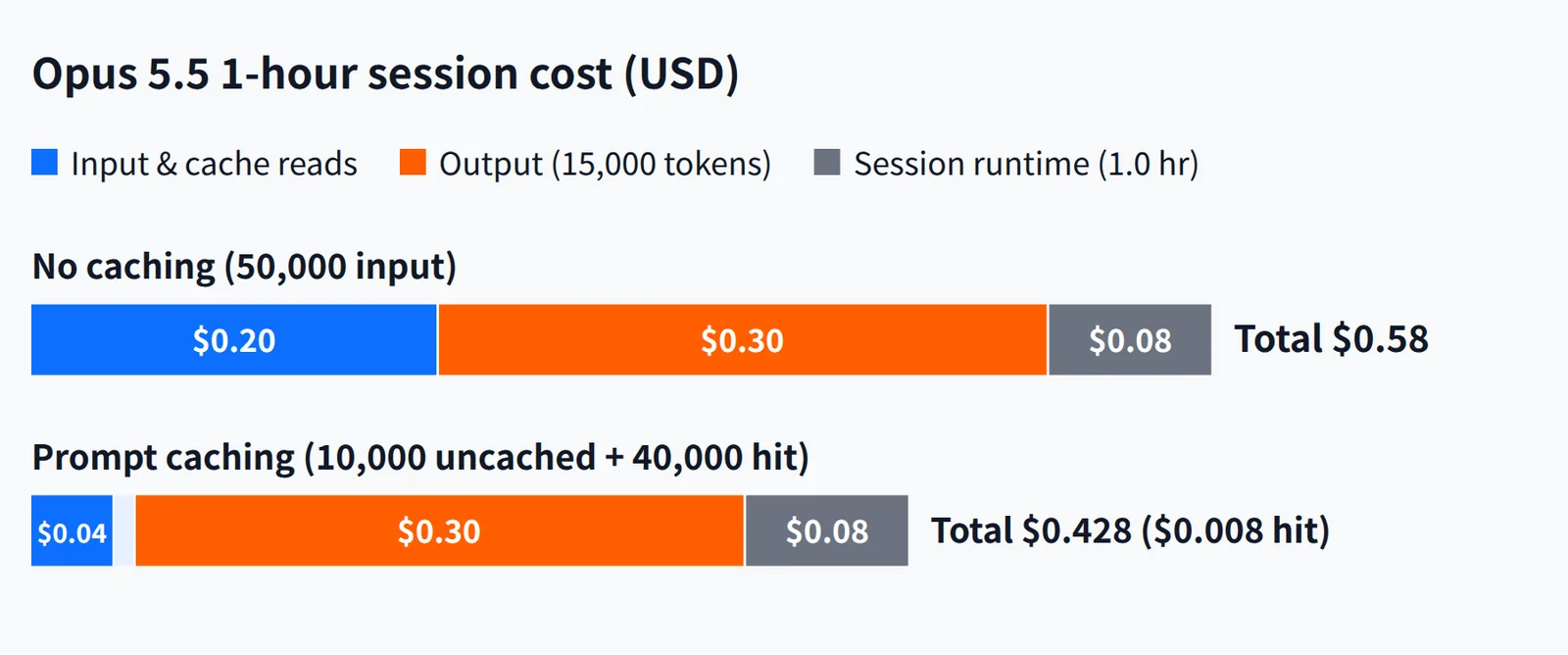
Anthropic's worked example illustrates the gap: a 1-hour Opus 5.5 coding session consuming 50,000 input tokens and 15,000 output tokens costs $0.58 uncached ($0.20 input, $0.30 output, $0.08 runtime), or $0.428 when 40,000 input tokens hit cache ($0.04 uncached input, $0.008 cache read, $0.30 output, $0.08 runtime). Watch one operational catch, though: 5-minute cache writes carry a 1.25x multiplier and 1-hour writes cost 2x. If a timer wakes your agent only every few hours, the cache expires between runs and reloads your full prompt overhead at base input prices—making lean startup context essential.
Four Pre-Launch Checks Before Deploying
- Single-worker inbox locking: Deduplicate incoming events by source ID, batch rapid-fire messages into one run, and allow only one active worker per inbox at a time.
- Fast webhook acks: Keep HTTP handlers lightweight so providers do not time out; defer heavy checks like prompt-injection scanning until the run begins.
- Pointers over duplication: Store pointers for external issue trackers in memory, load only an index of user notes and task progress at startup, and compact or rotate overly long sessions.
- Check billing edge cases: Managed Agents sessions are stateful and do not get the Batch API's 50 percent discount, and Haiku 5.5 prompts exceeding 100,000 tokens jump to $0.50 input and $2.50 output per million tokens.