

Gemini 4 Carbon makes a strong case for complex coding and supervised tool work. Its launch evidence also exposes tradeoffs: improving over Argon does not put it first on every engineering benchmark, and stronger knowledge scores can coexist with less cautious answers. For people building websites, maintaining software or publishing research, the useful comparison is the quality and cost of the finished work.
Google announced Carbon on October 28, 2026. The judgments below use published evaluations and methods checked on October 29, Beijing time, with no hands-on testing by ToolAI yet. Initial access is limited to selected cyber defenders and trusted partners through Fairwind, with broader product availability planned. A leaderboard entry therefore does not establish access for an ordinary developer account. Google launch announcement.
Four measurements that help explain the practical difference
The Arena and Artificial Analysis results cited here use Gemini 4 Carbon with High reasoning.
| Work being measured | Published result | Practical reading |
|---|---|---|
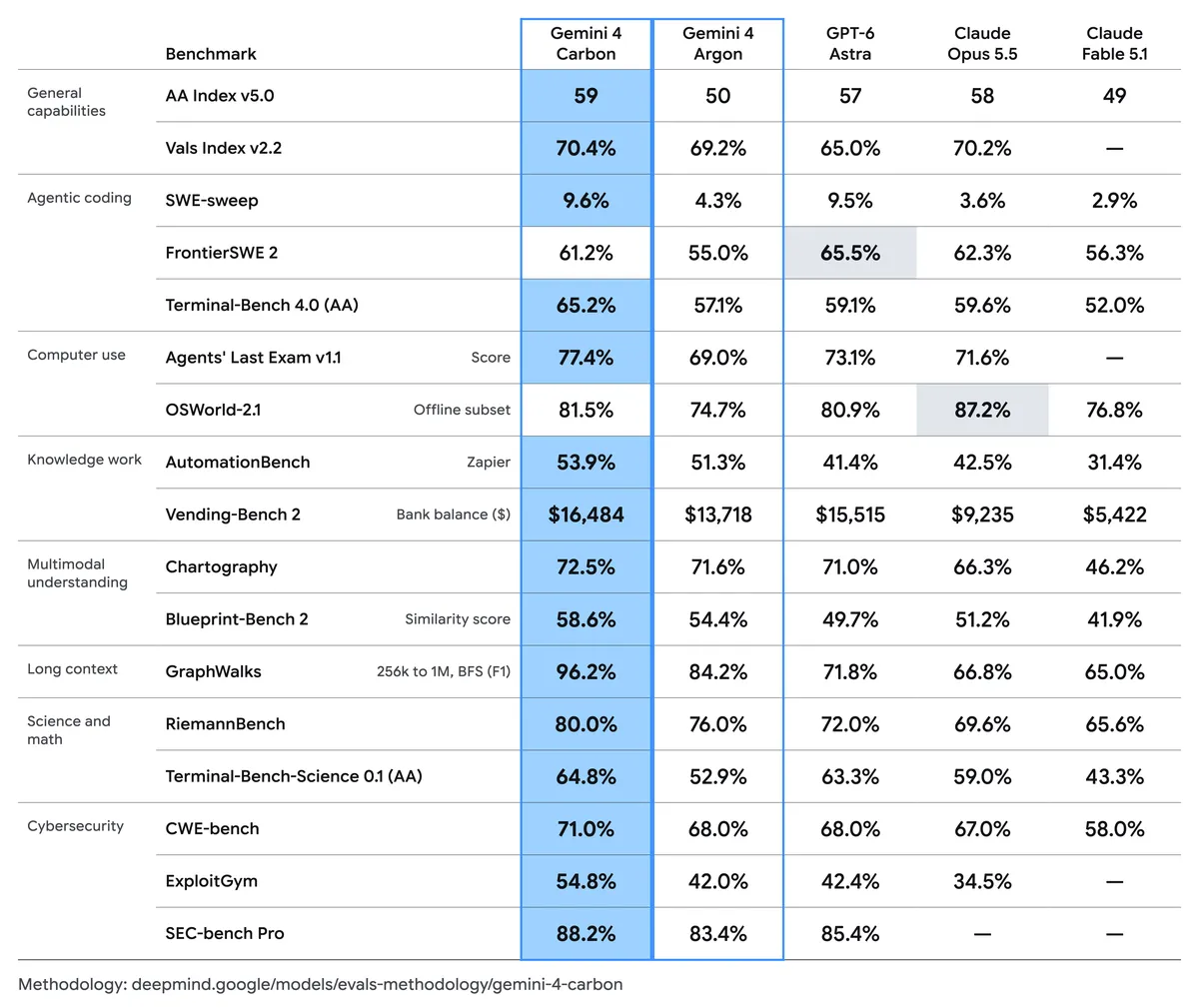
| Software engineering: FrontierSWE 2 | Carbon 61.2%; Argon 55.0%; GPT-6 Astra 65.5%; Opus 5.5 62.3%. | A clear improvement within Gemini, with competing models still ahead on this benchmark. |
| Desktop operation: OSWorld-2.1 offline subset, partial score | Carbon 81.5%; Opus 5.5 87.2%. | Evidence of capable computer use, with remaining failure cases and a higher-scoring alternative. |
| Knowledge: AA-Omniscience v1.1 | Carbon answers 58% correctly; its hallucination metric is 11%, versus Argon's 4%. | Knowledge coverage and willingness to avoid unsupported answers need separate attention. |
| Agent Arena sessions | Carbon ranks second, Preliminary: +16.04 ± 1.00 percentage points net improvement; $1.74 median task cost. | Promising observed performance at a lower task cost than the leader in this snapshot. |
Sources: Google benchmark table, Artificial Analysis evaluation and Agent Arena. The agent page is dated October 28 and was read on October 29. These are different evaluation systems, not one combined scorecard.
Coding: the upgrade is meaningful, and the task still matters
Carbon's FrontierSWE result improves on Argon by 6.2 percentage points. For an existing Gemini workflow, that makes repository maintenance and difficult debugging credible reasons to evaluate the upgrade. It does not show that Carbon will fix 61.2% of the bugs in an arbitrary application. Nor does it establish an overall coding lead over Astra or Opus.
Google's table combines several evaluation sources. Its methodology says FrontierSWE results come from Proximal's public leaderboard; other rows include Google evaluations and provider reports. Most Gemini results use the highest thinking setting and a single attempt, with stated exceptions. For OSWorld, the 82-task offline subset reports Gemini's best of three runs. This is not a uniform independent test of every model under identical conditions. Evaluation methodology.
For a website team, the valuable artifact is a patch that preserves existing behavior, handles an error path and survives a repeat run. Carbon's engineering results justify considering it for that work. A polished preview alone says little about permissions, stored data or regression risk. Inspecting the resulting diff remains more useful than judging the confidence of its completion message.
Research and content: stronger knowledge still needs traceable sources
Artificial Analysis reports 58% correct answers on AA-Omniscience v1.1, up from Argon's 48%. Carbon's 11% hallucination metric has a specific denominator: incorrect answers divided by incorrect, partially correct and unattempted answers combined. It is not the error rate across all questions, and it does not imply 89% accuracy. Metric definition.
For a tool-comparison article, an invented pricing condition can outweigh several paragraphs of fluent explanation. Carbon looks useful for organizing supplied product material and drafting comparisons, while the published knowledge result gives no reason to remove source checks. Keep the original pricing page, distinguish retrieved facts from interpretation, and let the draft say when a detail is missing. The useful gain is less research and editing effort without introducing unsupported claims.
Agents: a compelling cost profile with a measurable outcome tradeoff
The current Agent Arena snapshot covers 26,511 Carbon sessions. Opus 5.5 Max leads at +20.94 ± 2.15 percentage points net improvement and $6.66 median task cost. Carbon's lower observed cost accompanies a lower aggregate outcome score. Net improvement combines signals relative to a randomized average-model baseline; it is not a task success percentage. Live results and ranking method.
Arena measures at most the first three tasks in each session to reduce accumulated-context effects. Its median is neither a fixed API request fee nor a quote for your workload. Cost methodology.
That combination is attractive for reviewable research, document preparation and coding iterations. For an unattended desktop workflow, the OSWorld gap matters more: a cheaper session can still leave a wrong field, incomplete save or failed export. Human review time and recovery effort belong in the cost comparison alongside model charges.
Budget for both launch pricing and the completed workflow
Google lists introductory pricing of $2 per million input tokens and $10 per million output tokens. The announced post-introductory rates are $4 and $20; no end date is specified. Pricing and footnote.
As an illustration, 100,000 uncached input tokens plus 20,000 billed output tokens cost $0.40 at launch rates or $0.80 at the later rates. This calculation excludes additional calls and tool charges. A real agent may revisit documents and repeat steps, so a one-pass token estimate should not become a project budget. Arena's task costs also use a different workload from Artificial Analysis; their dollar figures cannot be combined into a universal savings claim.
Where Carbon belongs on a practical shortlist
- Repository maintenance and supervised coding: a strong candidate, particularly when replacing Argon; compare accepted patches and reviewer time with your existing model.
- Source-based research and multilingual drafts: useful for synthesis, with factual checks retained for prices, capabilities and quotations.
- Desktop tasks with consequential final actions: keep review before publishing, sending or changing important records. The available offline benchmark does not establish reliable autonomous operation in a live business system.
The evidence supports giving Carbon difficult, reviewable work. A production switch should be earned by fewer rejected deliverables or less total effort on the same recurring tasks. Preserve the inputs, outputs and acceptance checks so the decision reflects finished work rather than a memorable single demonstration.