Researchers at MIT CSAIL and Tsinghua University have developed GeoPT, a pre-training method designed to help AI models simulate how objects respond to physical forces such as wind, water, light, and collisions.
Many AI systems are capable with text, images, and 3D generation, but they are less reliable when modeling physical behavior. Producing the extensive physics data required for dependable simulations is expensive and slow because numerical solvers must calculate properties throughout 3D shapes.
GeoPT addresses this limitation by exposing models to synthetic dynamics: 1.3 million simulations in which small particles move at different speeds and angles before stopping when they contact complex 3D objects. This gives the system a general understanding of physical interactions before it is trained on labeled data.
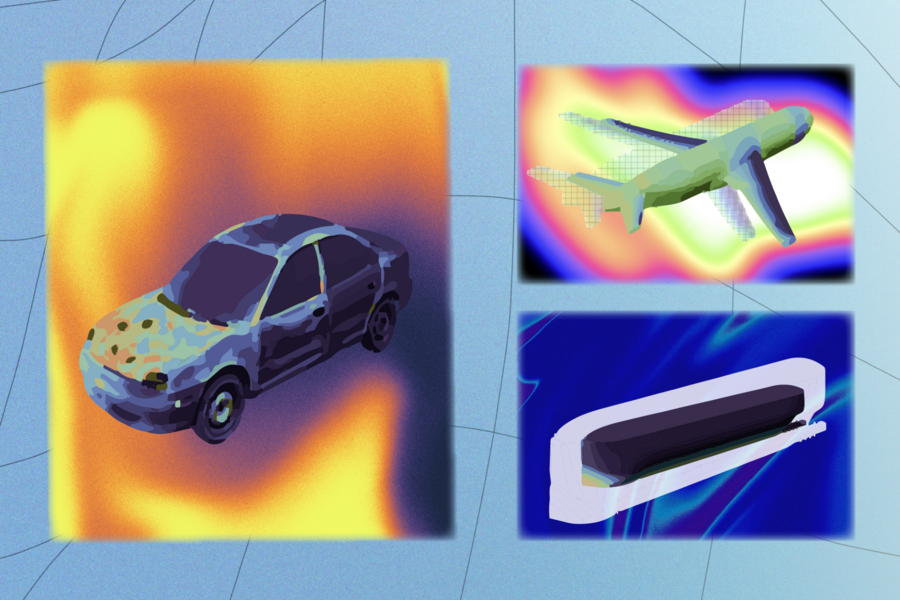
Users can upload a 3D object and specify the direction and speed of a force. GeoPT then produces a heat-map-like prediction showing how different parts of the object respond. Potential applications include analyzing vehicle crashes, light behavior, and whether boats remain stable in turbulent water.
Performance across industrial simulations
Across benchmarks, GeoPT outperformed leading simulation models in speed, accuracy, or data efficiency. It modeled responses to wind currents and surface pressure, captured how fighter jets react to airflow, and simulated the effects of air and waves on a boat hull.
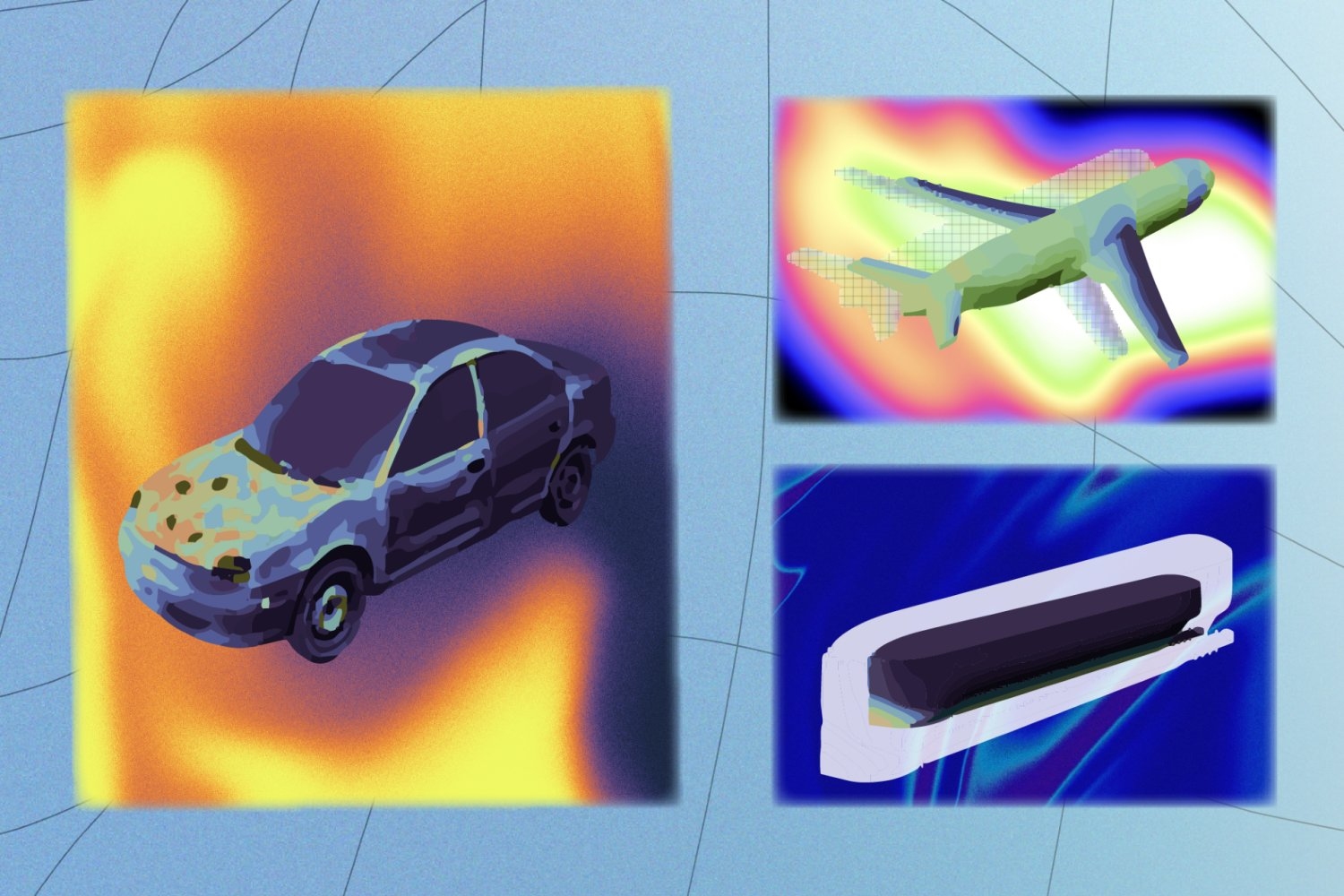
For the boat-hull task, GeoPT used 60 percent fewer labeled examples and reached peak accuracy four times faster than leading baselines. It also predicted vehicle deformation after collisions with less data and accurately simulated light passing through a toy rabbit model, despite not being trained on that shape or on light physics.
The researchers report that GeoPT generated high-fidelity simulations involving more than 100 million mesh points in seconds. They say this could allow engineers to evaluate vehicle designs with fewer physical experiments.
Toward physics foundation models
The team describes GeoPT as an early step toward a physics foundation model: a broadly trained system that can generalize across physical tasks. Future work may scale the approach to more shapes and phenomena, including weather patterns, material behavior, and realistic video generation.
Minghao Guo and Haixu Wu co-led the paper with researchers including Zongyi Li, Zhiyang (Frank) Dou, Kaiming He, Wojciech Matusik, and Tsinghua University Associate Professor Mingsheng Long. The paper, “GeoPT: Scaling Physics Simulation via Lifted Geometric Pre-Training,” was presented at the International Conference on Machine Learning in July. The work was partly supported by Neural Modular Physics Twin for Robotics.