
Captures d'écran du projet
Vue d’ensemble
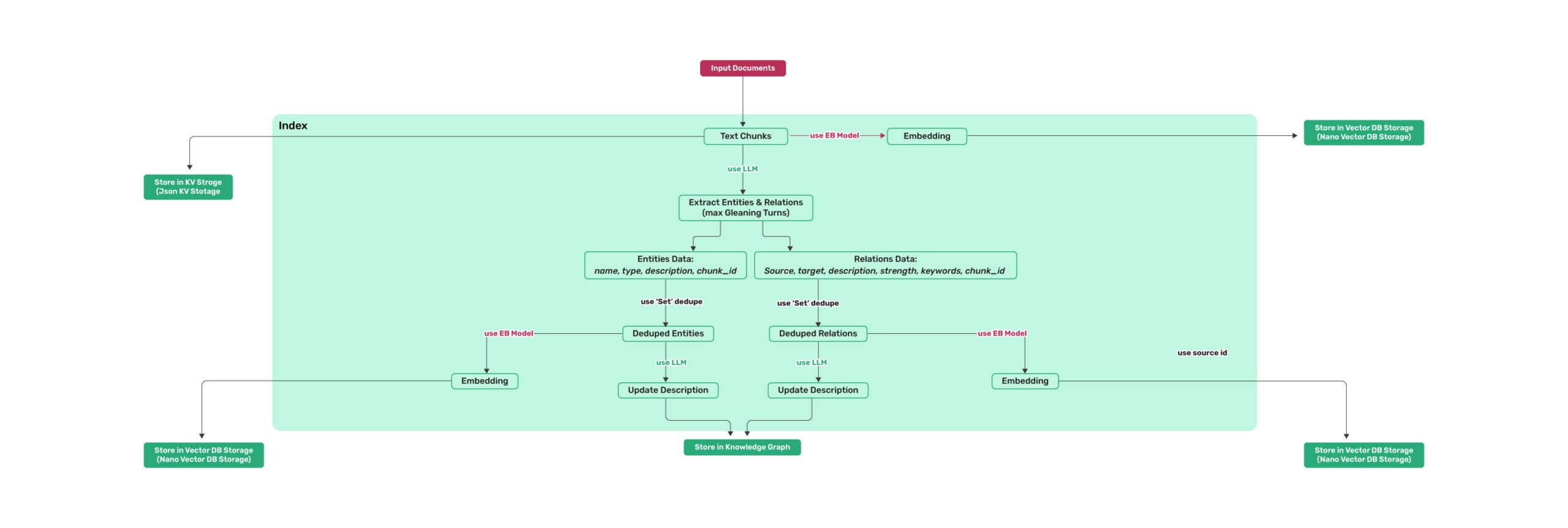
LightRAG is an open-source Python framework designed as an efficient alternative to traditional graph-based RAG systems. It bridges vector-based and graph-based RAG by managing both knowledge graphs and vector embeddings concurrently. The framework addresses common challenges in large-scale RAG deployments, such as high computational overhead, slow response times, and the cost of incremental data updates. It supports multiple document parsing engines, text chunking strategies, storage backends, and role-specific LLM configurations. Recent updates have introduced multimodal content processing, allowing it to handle images, tables, and formulas within documents.
Fonctionnalités clés
- Dual-layer architecture combining knowledge graphs and vector embeddings
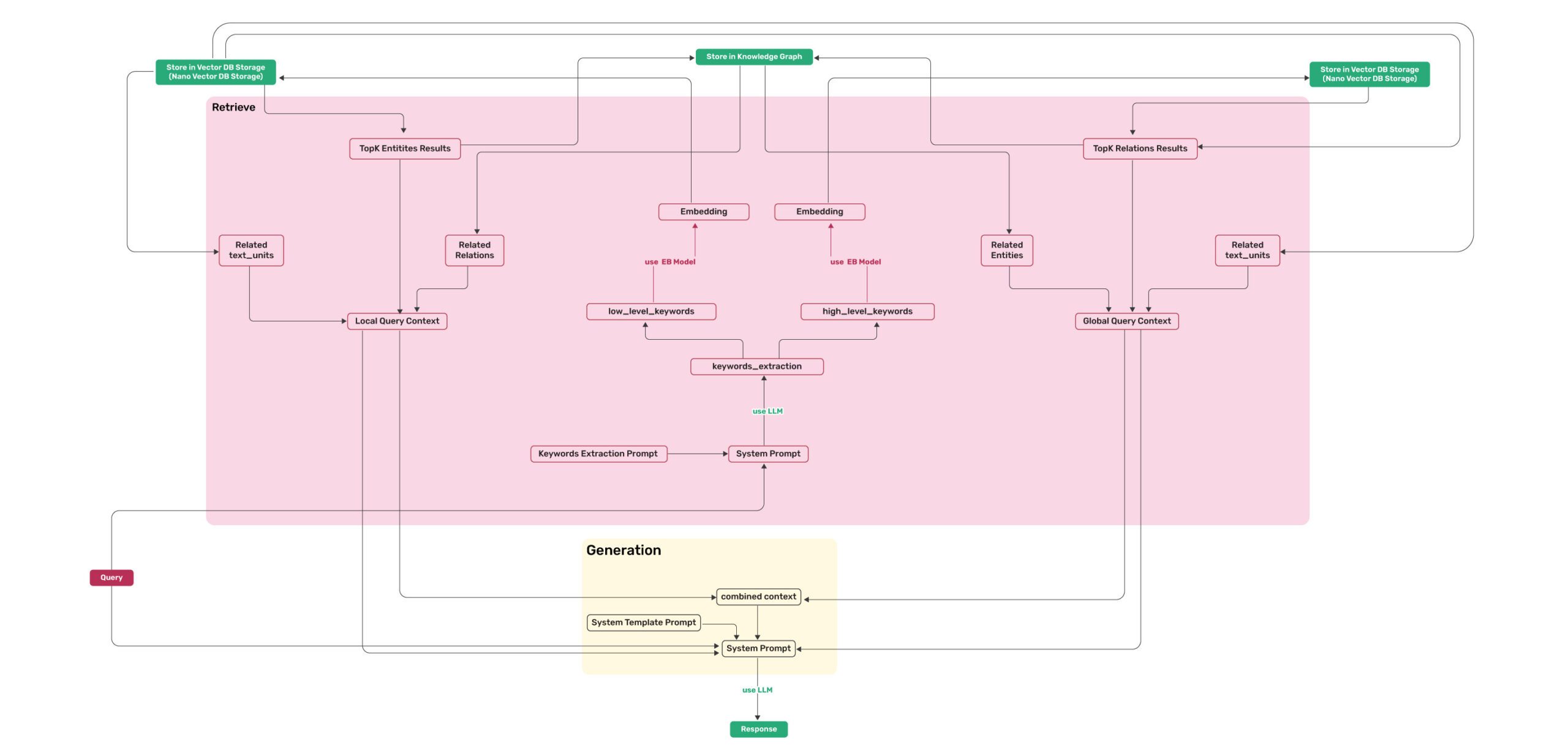
- Dual-level retrieval mechanism for comprehensive context integration
- Incremental updates and selective document deletion with KG regeneration
- Role-specific LLM configuration (EXTRACT, QUERY, KEYWORD, VLM)
- Five query modes: local, global, hybrid, naive, and mix
- Multiple document parsing engines: MinerU, Docling, and Native
- Four text chunking strategies: Fixed, Recursive, Vector, and Paragraph
- Multimodal content processing for images, tables, and formulas
- Support for multiple storage backends including PostgreSQL, Neo4j, and MongoDB
- WebUI and REST API for document insertion, querying, and visualization
Prérequis, installation et démarrage rapide
Utilisation
Compatibilité des modèles et cas d’usage
LightRAG supports configurable models for four roles. For extraction, non-thinking models like GPT-5.6-luna, Claude Haiku, Gemini-mini, DeepSeek-V4-lite, or Kimi are recommended; locally, Qwen3-30B-A3B-Instruct is a minimum. The query role requires a stronger, potentially thinking-capable model. The keyword role requires a fast, non-thinking model. The VLM role supports mainstream multimodal models, with Qwen3.6-35B-A3B suggested for local deployment. For embeddings, low-dimensional, fast models like BAAI/bge-m3 are recommended.
Licence et notes sur les risques
The repository is licensed under the MIT License.
Editorial verification 2026-08-09: repository URL, owner, description, license and repository statistics were reviewed. License metadata: MIT. README was fetched for the channel draft; re-check repository dependencies, releases and model terms before production use.
Publication et maintenance
The repository indicates acceptance to EMNLP2025. Recent updates include merging RagAnything for multimodal processing, adding Smart Heading recognition for Word documents, introducing four text chunking strategies, integrating OpenSearch, adding a setup wizard, and supporting role-specific LLM configurations. The repository was created on 2024-10-02 and has accumulated 38,423 stars and 5,403 forks.