
Intel’s Arc Pro B70 32GB is becoming a more interesting option for local AI. Recent XeStrata results show Qwen3.8-Flash-Next handling coding, extraction and document tasks at usable speeds on a single B70. The development worth watching is how much better software can make use of the hardware already available.
Two sets of numbers sit behind the discussion
A post by seekinganythingbutalpha estimated roughly 1,500–2,000 tokens/s for prefill and 60–90 tokens/s for decode with IQ3S, based on the XeStrata author’s results. That is a projected range, rather than a result every configuration can be expected to reproduce.
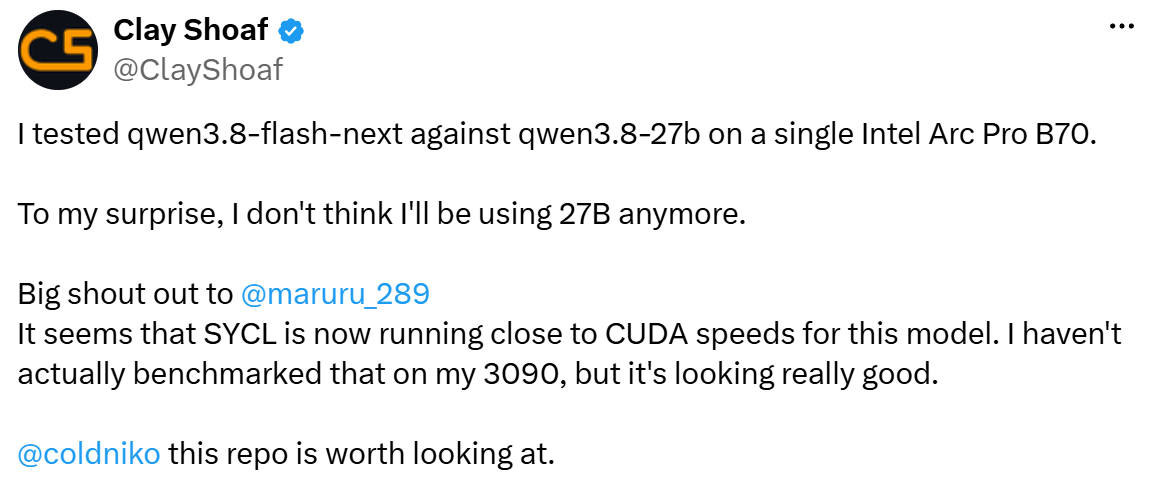
The post quoted Clay Shoaf’s hands-on comparison. His chart reports 64.5–69.8 tokens/s across four tasks with Qwen3.8-Flash-Next IQ3_S under XeStrata. The machine used a B70, Core i3-12100, 64GB RAM, a PCIe 3.0 ×16 host link and Xubuntu 26.04.
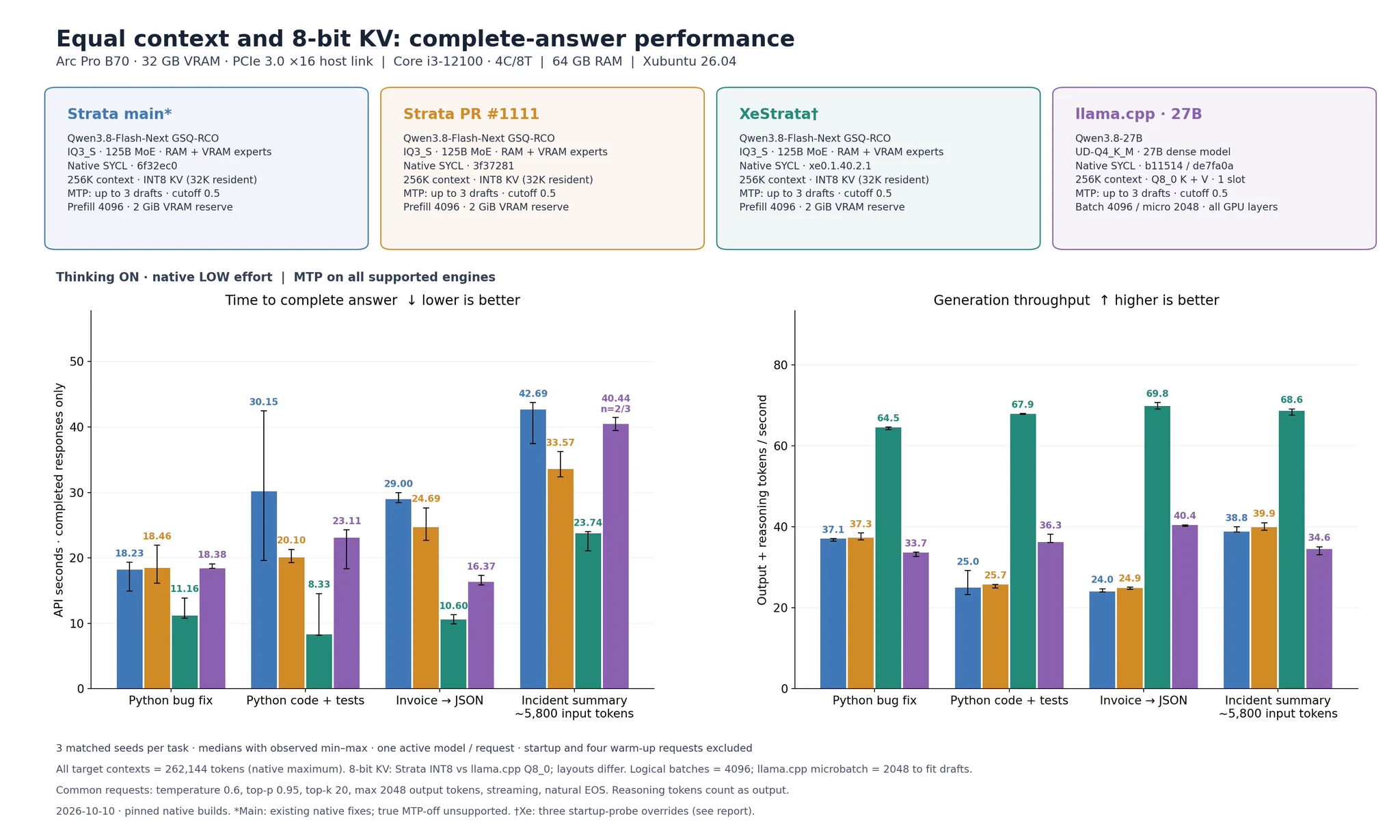
Those measurements include reasoning tokens. They use three matched seeds per task, medians, and exclude startup and warm-up. A 256K context setting is a capacity setting; it does not mean every task contains a 256K-token prompt. Nor does a throughput comparison establish equal answer quality across different models.
Input speed and output speed answer different questions
Prefill processes the prompt; decode produces the answer token by token. Faster prefill can shorten the wait after submitting a large document. Faster decode makes the response arrive more quickly once generation starts. A 2,000-token/s prefill figure is therefore not a claim of 2,000 output tokens per second.
The xe0.1.40.2.1 release measurements use Qwen3.8-Flash-Next IQ3_XXS. On B70, they report prefill/decode rates of 1,501/82.4 tokens/s at 4K, 2,310/79.5 at 32K, and 1,967/74.3 at 64K. These results overlap the social post’s range, but use a different quantization and procedure from the IQ3_S chart.
The release compares XeStrata with upstream Strata v0.1.41’s SYCL implementation on the same PC, using coding-agent prompts, 256 output tokens and the median of two alternating runs. It demonstrates the importance of the inference implementation when evaluating a GPU.
One GPU still relies on the rest of the PC
XeStrata ports Strata’s GPU work to SYCL and Level Zero. Its approach combines GPU memory, system memory and expert scheduling. Running a 125B model with one 32GB card does not mean all its weights fit inside that card’s VRAM.
RAM, the PCIe connection, quantization and drivers belong in the same purchasing and configuration decision as the GPU. The project currently targets Linux; installation should follow the requirements for the selected distribution and release.
The next test is everyday reliability
There is useful context in Shoaf’s follow-up: two model startups failed before benchmark requests ran. Runtime overrides subsequently allowed testing and additional successful starts. The developer replied that the next version should address the issue and asked for verification with defaults. Version and configuration still matter.
The B70 now has concrete task results behind its local-AI appeal. For coding assistants, document workflows and private knowledge tools, sustained operation, multi-turn behavior, time to first token and answer quality are the next measures that count. Strong throughput makes a system promising; dependable daily use makes it useful.