
Joypanner
Core Features:
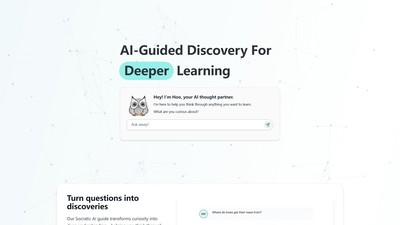
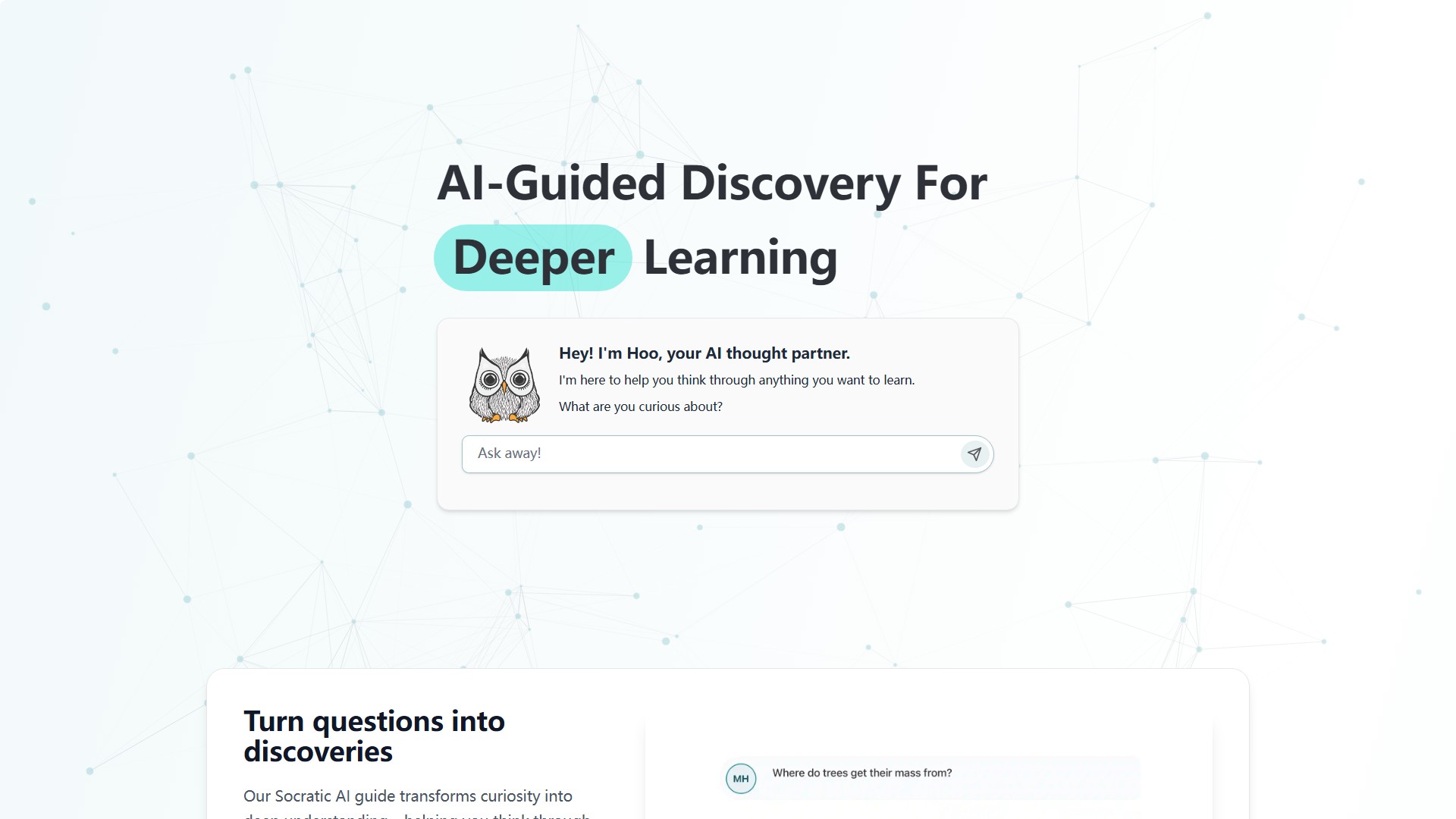
- Socratic AI-Guided Discovery: The AI assistant named Hoo acts as a thought partner, guiding students to think through interactive questions rather than providing direct answers.
- Turn Questions into Discoveries: Transforms curiosity into deep understanding across subjects like Math, Science, Language Arts, History, Geography, and Civics.
- Sharpen Writing Skills: Asks the right questions to help refine thinking, strengthen arguments, and develop a unique style without cookie-cutter fixes. Supports Argumentative Writing, Research Writing, Creative Writing, Narrative Writing, Expository Writing, Persuasive Writing, and Compare and Contrast Writing.
- Reflect on Learning Experiences: Assigns reflection exercises after projects, experiments, problem-solving, reading, or field trips. Includes Research Project Topic Selection and Motivation, Personal Reflection and Growth, and Goal Setting and Progress Monitoring.
- Voice-to-Text: Accurate voice-to-text capabilities to distinguish it from other AI tools, making it accessible for younger kids.
- Teacher Tracking: Teachers can track student interactions and step in when students push their limits, just like a teacher would.
Target Users: Kids and students aged 5+ (covering Grade 3 to Grade 9+), homeschoolers, lifelong learners, and school teachers looking for a safe AI space for students (e.g., grades 2-4).
Core Advantages:
- Deeper Understanding: Guided discovery learning, when done right, can lead to deeper understanding.
- Improved Problem-Solving Skills: Guiding students rather than giving them direct answers helps develop critical thinking and independent problem-solving skills.
- More Motivation and Curiosity: Exploring and finding things out independently increases student's motivation and curiosity.
- Better Retention: Students remember better when information is generated in their own mind rather than simply read (Generation effect).
- Higher Self-confidence: Letting students discover things on their own boosts their self-efficacy.
Typical Use Cases:
- Math problem-solving guidance (e.g., Number Theory, Set Theory/Venn Diagrams, Polygons and Interior Angles)
- Writing exercises and brainstorming (e.g., Creative writing from perspectives of a raindrop, traffic light, or cloud)
- Science experiment reflections (e.g., discussing observations in Buoyancy and Density experiments)
- Literary analysis (e.g., analyzing themes in 'To Kill a Mockingbird' or 'The Giver')
Pricing Information: Operates on a freemium/paid model with a Pricing page available. Some exercises require users to Login to Respond.
Pays:
Austria
Débat